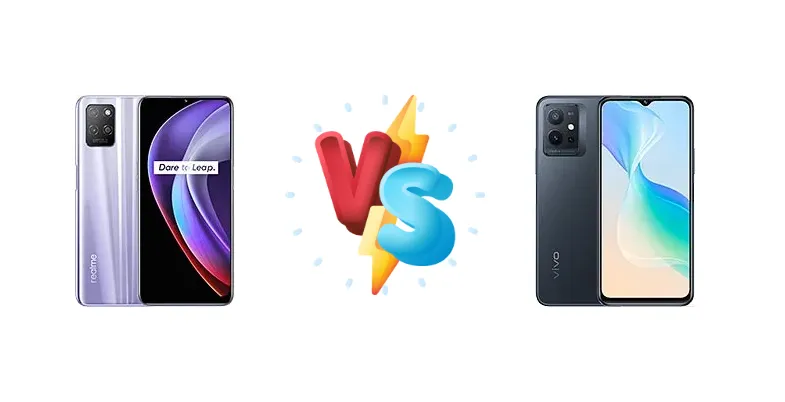
The Realme V11s 5G and vivo T1 5G represent compelling options in the increasingly competitive budget 5G smartphone market. Both aim to deliver 5G connectivity and a smooth user experience without breaking the bank, but they achieve this with different chipsets – the MediaTek Dimensity 810 and the Qualcomm Snapdragon 695 respectively. This comparison dissects their key differences to help you choose the right device.
🏆 Quick Verdict
For the average user prioritizing consistent performance and potentially better long-term software support, the Realme V11s 5G emerges as the slightly stronger choice. Its Dimensity 810 chipset generally offers a performance edge over the Snapdragon 695, making it better suited for demanding tasks and gaming, despite both phones sharing the same 18W charging.
| Network |
|---|
| 2G bands | GSM 850 / 900 / 1800 / 1900 | GSM 850 / 900 / 1800 / 1900 |
| 3G bands | HSDPA 850 / 900 / 1700(AWS) / 1900 / 2100 | HSDPA 850 / 900 / 2100 |
| 4G bands | LTE | 1, 3, 5, 8, 38, 40, 41 - India |
| 5G bands | SA/NSA | 77, 78 SA/NSA - India |
| Speed | HSPA, LTE, 5G | HSPA, LTE, 5G |
| Technology | GSM / CDMA / HSPA / EVDO / LTE / 5G | GSM / HSPA / LTE / 5G |
| | CDMA2000 1xEV-DO | 1, 3, 40 SA/NSA - Indonesia |
| Launch |
|---|
| Announced | 2021, September 24 | 2022, February 09 |
| Status | Cancelled | Available. Released 2022, February 14 |
| Body |
|---|
| Build | - | Glass front, plastic frame, plastic back |
| Dimensions | 8.4 mm thickness | 164 x 75.8 x 8.3 mm (6.46 x 2.98 x 0.33 in) |
| SIM | Nano-SIM + Nano-SIM | Nano-SIM + Nano-SIM |
| Weight | 189 g (6.67 oz) | 187 g (6.60 oz) |
| Display |
|---|
| Resolution | 720 x 1600 pixels, 20:9 ratio (~270 ppi density) | 1080 x 2408 pixels, 20:9 ratio (~401 ppi density) |
| Size | 6.5 inches, 102.0 cm2 | 6.58 inches, 104.3 cm2 (~83.9% screen-to-body ratio) |
| Type | IPS LCD | IPS LCD, 120Hz |
| Platform |
|---|
| CPU | Octa-core (2x2.4 GHz Cortex-A76 & 6x2.0 GHz Cortex-A55) | Octa-core (2x2.2 GHz Kryo 660 Gold & 6x1.7 GHz Kryo 660 Silver)Octa-core (2x2.4 GHz Cortex-A76 & 6x2.0 GHz Cortex-A55) - Indonesia |
| Chipset | Mediatek Dimensity 810 (6 nm) | Qualcomm SM6375 Snapdragon 695 5G (6 nm)Mediatek Dimensity 810 (6 nm) - Indonesia |
| GPU | Mali-G57 MC2 | Adreno 619Mali-G57 MC2 - Indonesia |
| OS | Android 11, Realme UI 2.0 | Android 11, Funtouch 12 |
| Memory |
|---|
| Card slot | microSDXC (dedicated slot) | microSDXC (uses shared SIM slot) |
| Internal | 128GB 4GB RAM, 128GB 6GB RAM | 128GB 4GB RAM, 128GB 6GB RAM, 128GB 8GB RAM, 256GB 8GB RAM |
| | - | UFS 2.2 - India |
| Main Camera |
|---|
| Dual | 13 MP, f/2.2, 26mm (wide), PDAF
Auxiliary lens | - |
| Features | LED flash, HDR, panorama | Dual-LED flash, HDR, panorama |
| Single | 8 MP, f/2.0, 26mm (wide) | 16 MP, f/2.0, (wide) |
| Triple | - | 50 MP, f/1.8, 26mm (wide), PDAF
2 MP (macro)
Auxiliary lens |
| Video | 1080p@30/60fps | 1080p@30fps |
| Selfie camera |
|---|
| Features | HDR | - |
| Single | 8 MP, f/2.0, 26mm (wide) | 16 MP, f/2.0, (wide) |
| Video | 1080p@30fps | 1080p@30fps |
| Sound |
|---|
| 3.5mm jack | Yes | Yes |
| 35mm jack | Yes | Yes |
| Loudspeaker | Yes | Yes |
| Comms |
|---|
| Bluetooth | 5.1, A2DP, LE | 5.1, A2DP, LE |
| NFC | No | Yes (market/region dependent) |
| Positioning | GPS, GLONASS, GALILEO, BDS | GPS, GLONASS, GALILEO, BDS, QZSS |
| Radio | No | FM radio |
| USB | USB Type-C 2.0 | USB Type-C 2.0, OTG |
| WLAN | Wi-Fi 802.11 a/b/g/n/ac, dual-band, Wi-Fi Direct | Wi-Fi 802.11 a/b/g/n/ac, dual-band, Wi-Fi Direct |
| Features |
|---|
| Sensors | Fingerprint (side-mounted), accelerometer proximity, compass | Fingerprint (side-mounted), accelerometer, proximity, compass |
| Battery |
|---|
| Charging | 18W wired | 18W wired |
| Type | 5000 mAh | 5000 mAh |
| Misc |
|---|
| Colors | Black, Violet | Starlight Black, Rainbow Fantasy |
| Models | RMX3125 | V2141, V2157 |
| Price | About 190 EUR | About 180 EUR |
Realme V11s 5G
- Potentially better CPU performance with Dimensity 810
- Slightly better GPU performance for gaming
- MediaTek chipset often offers good power efficiency
- 18W charging is relatively slow
- Camera performance likely average for the price range
vivo T1 5G
- Qualcomm Snapdragon 695 offers a stable experience
- Potential for optimized software experience (Qualcomm ecosystem)
- Competitive pricing may make it a value option
- Slightly lower CPU and GPU performance compared to Dimensity 810
- 18W charging is relatively slow
Display Comparison
Both devices are expected to feature similar LCD panels, typical for this price segment. Without specific display specs like resolution or refresh rate, the comparison hinges on panel quality and color calibration, which are difficult to assess without direct testing. However, the focus should be on practical usability rather than high-end features like LTPO or OLED.
Camera Comparison
Without detailed camera specifications beyond the presence of cameras, a meaningful comparison is limited. Both phones likely feature a primary camera alongside depth or macro sensors. The image processing algorithms will significantly impact the final image quality, and this is where brand-specific tuning comes into play. It's reasonable to expect similar camera performance given the price point, with neither phone excelling in low-light conditions.
Performance
The core difference lies in the chipsets. The Realme V11s 5G utilizes the MediaTek Dimensity 810 (6nm), featuring a 2x2.4 GHz Cortex-A76 and 6x2.0 GHz Cortex-A55 configuration. The vivo T1 5G, on the other hand, employs the Qualcomm Snapdragon 695 5G (6nm) with a 2x2.2 GHz Kryo 660 Gold and 6x1.7 GHz Kryo 660 Silver setup. While both are 6nm chips, the Dimensity 810’s Cortex-A76 cores generally provide a slight advantage in CPU-intensive tasks. This translates to snappier app launches and smoother multitasking for the Realme V11s 5G. The GPU performance is also likely to be marginally better on the Realme, benefiting light to medium gaming. The Indonesia variant of the vivo T1 5G uses the Dimensity 810, making the performance nearly identical.
Battery Life
Both the Realme V11s 5G and vivo T1 5G are equipped with 18W wired charging. This is a relatively slow charging speed by today's standards, meaning a full charge will take well over an hour. Battery capacity is not specified, but given the target market, both are likely to house around a 5000mAh battery. The efficiency of the respective chipsets will play a role in overall battery life; the Dimensity 810’s efficiency could give the Realme V11s 5G a slight edge in endurance.
Buying Guide
Buy the Realme V11s 5G if you need a phone that can handle moderate gaming and multitasking with relative ease, and you value a chipset known for its efficiency. Buy the vivo T1 5G if you prefer Qualcomm's ecosystem and potentially benefit from optimized software experiences, or if you find a significantly better deal on the T1 5G, making it a more attractive value proposition.
Frequently Asked Questions
❓ Will the Dimensity 810 in the Realme V11s 5G handle demanding games like PUBG Mobile smoothly?
The Dimensity 810 is capable of running PUBG Mobile at medium settings with a stable frame rate. While it won't deliver a flagship gaming experience, it provides a playable experience for casual gamers. Expect some frame drops during intense firefights.
❓ Does the Snapdragon 695 in the vivo T1 5G support carrier aggregation for faster 5G speeds?
The Snapdragon 695 does support carrier aggregation, which can significantly improve 5G speeds in areas with good network coverage. However, the actual speeds will depend on your carrier and location. Check with your carrier for specific 5G band support.
❓ How long will it take to fully charge both phones with the 18W charger?
Expect a full charge to take approximately 2 to 2.5 hours with the included 18W charger. This is a relatively slow charging speed compared to modern smartphones with 33W or 65W charging capabilities.