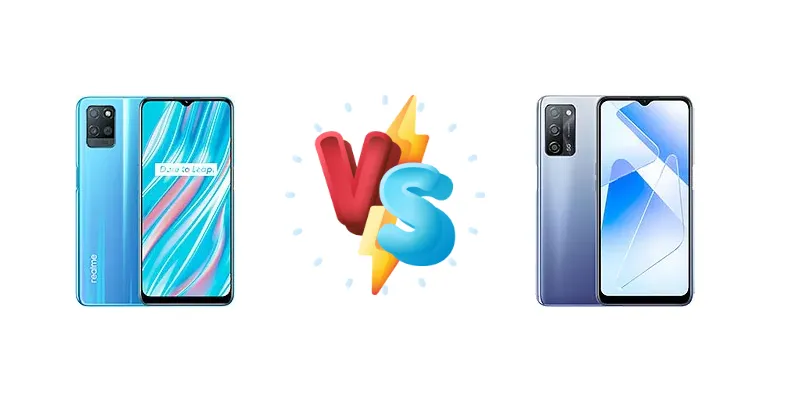
Both the Realme V11 5G and Oppo A55 5G target the increasingly competitive budget 5G market. While appearing similar on paper, a closer look reveals a key difference: charging speed. This comparison dissects their shared Mediatek Dimensity 700 platform and highlights where each phone excels, helping you determine which best suits your daily usage.
🏆 Quick Verdict
For most users, the Realme V11 5G emerges as the better choice. Its 18W charging significantly reduces downtime compared to the Oppo A55 5G’s 10W charging, a crucial advantage for those who rely heavily on their smartphones throughout the day. The performance is identical, making the faster charging a clear win.
| Network |
|---|
| 2G bands | GSM 850 / 900 / 1800 / 1900 | GSM 850 / 900 / 1800 / 1900 |
| 3G bands | HSDPA 850 / 900 / 1700(AWS) / 1900 / 2100 | HSDPA 800 / 850 / 900 / 1700(AWS) / 1900 / 2100 |
| 4G bands | 1, 3, 4, 5, 7, 8, 34, 38, 39, 40, 41 | 1, 3, 5, 8, 34, 38, 39, 40, 41 |
| 5G bands | 1, 41, 77, 78, 79 SA/NSA | 1, 28, 41, 77, 78 |
| Speed | HSPA, LTE, 5G | HSPA, LTE |
| Technology | GSM / CDMA / HSPA / EVDO / LTE / 5G | GSM / CDMA / HSPA / LTE / 5G |
| | CDMA2000 1xEV-DO | CDMA 800 |
| Launch |
|---|
| Announced | 2021, February 05 | 2021, January 25 |
| Status | Available. Released 2021, February 05 | Available. Released 2021, January 25 |
| Body |
|---|
| Dimensions | 8.4 mm thickness | 163.9 x 75.7 x 8.4 mm (6.45 x 2.98 x 0.33 in) |
| SIM | Nano-SIM + Nano-SIM | Nano-SIM + Nano-SIM |
| Weight | 186 g (6.56 oz) | 186 g (6.56 oz) |
| Display |
|---|
| Resolution | 720 x 1600 pixels, 20:9 ratio (~270 ppi density) | 720 x 1600 pixels, 20:9 ratio (~270 ppi density) |
| Size | 6.5 inches, 102.0 cm2 | 6.5 inches, 102.0 cm2 (~82.2% screen-to-body ratio) |
| Type | IPS LCD | IPS LCD, 480 nits (peak) |
| Platform |
|---|
| CPU | Octa-core (2x2.2 GHz Cortex-A76 & 6x2.0 GHz Cortex-A55) | Octa-core (2x2.2 GHz Cortex-A76 & 6x2.0 GHz Cortex-A55) |
| Chipset | Mediatek Dimensity 700 (7 nm) | Mediatek Dimensity 700 (7 nm) |
| GPU | Mali-G57 MC2 | Mali-G57 MC2 |
| OS | Android 11, Realme UI 2.0 | Android 11, ColorOS 11.1 |
| Memory |
|---|
| Card slot | No | microSDXC |
| Internal | 128GB 4GB RAM, 128GB 6GB RAM | 128GB 4GB RAM, 128GB 6GB RAM, 128GB 8GB RAM |
| Main Camera |
|---|
| Dual | 13 MP, f/2.2, 26mm (wide), PDAF
Auxiliary lens | - |
| Features | LED flash, HDR, panorama | LED flash, HDR, panorama |
| Single | 8 MP, f/2.0, 26mm (wide) | - |
| Triple | - | 13 MP, f/2.2, 25mm (wide), 1/3.06", 1.12µm, PDAF
2 MP (macro)
Auxiliary lens |
| Video | 4K@30/60fps, 1080p@30/60fps | 1080p@30fps |
| Selfie camera |
|---|
| Features | HDR | HDR |
| Single | 8 MP, f/2.0, 26mm (wide) | 8 MP, f/2.0, (wide) |
| Video | 1080p@30fps | 1080p@30fps |
| Sound |
|---|
| 3.5mm jack | Yes | Yes |
| 35mm jack | Yes | Yes |
| Loudspeaker | Yes | Yes |
| Comms |
|---|
| Bluetooth | 5.1, A2DP, LE | 5.1, A2DP, LE, aptX HD |
| NFC | No | No |
| Positioning | GPS, GLONASS, GALILEO, BDS | GPS, GLONASS, GALILEO, BDS, QZSS |
| Radio | No | No |
| USB | USB Type-C 2.0 | USB Type-C 2.0, OTG |
| WLAN | Wi-Fi 802.11 a/b/g/n/ac, dual-band, Wi-Fi Direct | Wi-Fi 802.11 a/b/g/n/ac, dual-band, Wi-Fi Direct |
| Features |
|---|
| Sensors | Fingerprint (side-mounted), accelerometer proximity, compass | Fingerprint (side-mounted), accelerometer, gyro, proximity, compass |
| Battery |
|---|
| Charging | 18W wired | 10W wired |
| Type | 5000 mAh | Li-Po 5000 mAh |
| Misc |
|---|
| Colors | Black, Blue | Black, Blue, Gold |
| Models | RMX3121, RMX3122 | PEMM00, PEMM20, PEMT00, PEMT20 |
| Price | About 160 EUR | About 200 EUR |
Realme V11 5G
- Faster 18W charging for quicker top-ups
- Potentially better sustained performance due to Realme’s cooling
- Identical chipset to Oppo A55 5G for comparable core performance
- May be slightly more expensive than the Oppo A55 5G
- Limited information on display specifications
Oppo A55 5G
- Likely more affordable than the Realme V11 5G
- Identical chipset to Realme V11 5G for comparable core performance
- Standard 5000mAh battery capacity (estimated)
- Significantly slower 10W charging
- Potentially less effective thermal management
- Limited information on display specifications
Display Comparison
Neither Realme nor Oppo provide display specifications beyond the basic panel type. Given their price point, both likely utilize LCD panels with a 60Hz refresh rate. The absence of higher refresh rates or advanced panel technologies like LTPO is typical for this segment. Bezels are expected to be moderate, prioritizing affordability over an immersive edge-to-edge experience. Color accuracy is likely standard for budget devices, focusing on acceptable reproduction rather than professional-grade fidelity.
Camera Comparison
Camera details are sparse, but both phones likely feature a multi-camera setup with a primary sensor. The real-world image quality will depend heavily on the image processing algorithms employed by Realme and Oppo. Given the market segment, expect a focus on computational photography to enhance image clarity and dynamic range. The inclusion of 2MP macro or depth sensors is probable, but their utility is limited due to their small sensor size and lack of optical image stabilization (OIS). The Dimensity 700’s ISP capabilities are identical on both devices, meaning the primary difference in camera performance will stem from software optimization.
Performance
Both the Realme V11 5G and Oppo A55 5G are powered by the Mediatek Dimensity 700 (7nm). This chipset features an octa-core CPU configuration – 2x2.2 GHz Cortex-A76 and 6x2.0 GHz Cortex-A55. This means identical CPU performance for everyday tasks like browsing, social media, and light gaming. The GPU performance will also be the same. However, thermal management could differ slightly based on internal design; Realme’s cooling solutions are often more aggressive, potentially leading to sustained performance under load, though this is speculative without teardowns. RAM speed (likely LPDDR4X) is not specified, but will be similar, impacting multitasking capabilities.
Battery Life
Battery capacity is not specified for either device, but both likely house batteries in the 5000mAh range, typical for this price bracket. The critical difference lies in charging speed. The Realme V11 5G supports 18W wired charging, while the Oppo A55 5G is limited to 10W. This translates to a significantly faster 0-100% charge time for the Realme V11 5G – potentially under 2 hours versus over 3 hours for the Oppo A55 5G. For users who frequently need to top up their battery, the 18W charging is a substantial advantage, offsetting any potential minor differences in battery capacity.
Buying Guide
Buy the Realme V11 5G if you prioritize minimizing charging time and need a phone that can quickly top up between uses. This is ideal for commuters, travelers, or anyone who dislikes being tethered to a wall charger. Buy the Oppo A55 5G if you are on an extremely tight budget and can tolerate slower charging speeds, prioritizing potential cost savings over convenience. It's a viable option for light users who don't mind overnight charging.
Frequently Asked Questions
❓ Will the Dimensity 700 in either phone struggle with demanding games like PUBG Mobile?
The Dimensity 700 is capable of running PUBG Mobile, but expect to play on medium settings for a smooth experience. Both phones share the same chipset, so gaming performance will be virtually identical. Frame rate stability may vary depending on thermal throttling, but neither device is designed for high-end gaming.
❓ Is the 10W charging on the Oppo A55 5G realistically usable for daily charging?
While usable, the 10W charging is slow. Expect a full charge to take over 3 hours. This is best suited for overnight charging or topping up when the phone isn't actively in use. Users who frequently need to charge during the day will find it inconvenient.
❓ Do either of these phones support VoLTE or VoWiFi for improved call quality?
Support for VoLTE and VoWiFi depends on the carrier and region. Check with your mobile provider to confirm compatibility with either the Realme V11 5G or Oppo A55 5G before purchasing, as these features are crucial for modern network connectivity.