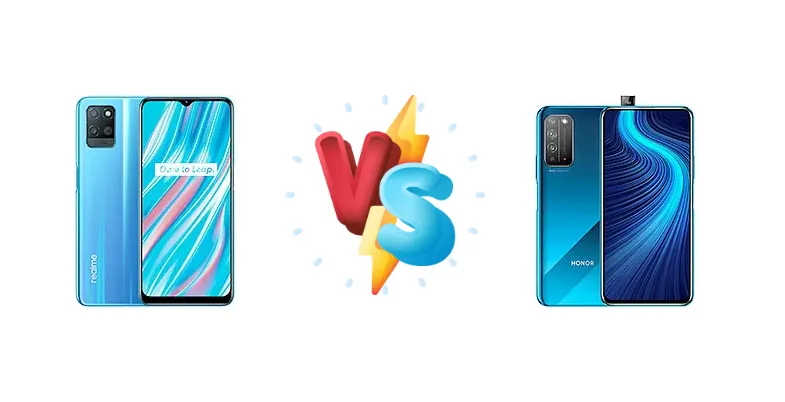
The Realme V11 5G and Honor X10 5G represent compelling options in the increasingly crowded mid-range 5G smartphone market. While both aim to deliver 5G connectivity at an accessible price point, they diverge significantly in their core hardware, particularly in their respective chipsets. This comparison will dissect these differences to determine which device offers the best overall package.
🏆 Quick Verdict
For the average user prioritizing sustained performance and faster charging, the Honor X10 5G emerges as the stronger contender. Its Kirin 820 chipset offers a noticeable performance advantage over the Realme V11 5G’s Dimensity 700, and the 22.5W charging is a welcome addition, despite a similar battery capacity.
| Network |
|---|
| 2G bands | GSM 850 / 900 / 1800 / 1900 | GSM 850 / 900 / 1800 / 1900 |
| 3G bands | HSDPA 850 / 900 / 1700(AWS) / 1900 / 2100 | HSDPA 800 / 850 / 900 / 1700(AWS) / 1900 / 2100 |
| 4G bands | 1, 3, 4, 5, 7, 8, 34, 38, 39, 40, 41 | 1, 2, 3, 4, 5, 8, 18, 19, 26, 34, 38, 39, 40, 41 |
| 5G bands | 1, 41, 77, 78, 79 SA/NSA | 1, 3, 38, 41, 77, 78, 79, 80, 84 SA/NSA |
| Speed | HSPA, LTE, 5G | HSPA 42.2/5.76 Mbps, LTE (4CA) Cat12 600/50 Mbps, 5G 2.3 Gbps DL |
| Technology | GSM / CDMA / HSPA / EVDO / LTE / 5G | GSM / CDMA / HSPA / EVDO / LTE / 5G |
| | CDMA2000 1xEV-DO | CDMA2000 1xEV-DO |
| Launch |
|---|
| Announced | 2021, February 05 | 2020, May 20. Released 2020, May 26 |
| Status | Available. Released 2021, February 05 | Discontinued |
| Body |
|---|
| Build | - | Glass front (Aluminosilicate glass) |
| Dimensions | 8.4 mm thickness | 163.7 x 76.5 x 8.8 mm (6.44 x 3.01 x 0.35 in) |
| SIM | Nano-SIM + Nano-SIM | Nano-SIM + Nano-SIM |
| Weight | 186 g (6.56 oz) | 203 g (7.16 oz) |
| Display |
|---|
| Protection | - | Aluminosilicate glass |
| Resolution | 720 x 1600 pixels, 20:9 ratio (~270 ppi density) | 1080 x 2400 pixels, 20:9 ratio (~397 ppi density) |
| Size | 6.5 inches, 102.0 cm2 | 6.63 inches, 106.1 cm2 (~84.7% screen-to-body ratio) |
| Type | IPS LCD | IPS LCD, 90Hz |
| Platform |
|---|
| CPU | Octa-core (2x2.2 GHz Cortex-A76 & 6x2.0 GHz Cortex-A55) | Octa-core (1x2.36 GHz Cortex-A76 & 3x2.22 GHz Cortex-A76 & 4x1.84 GHz Cortex-A55) |
| Chipset | Mediatek Dimensity 700 (7 nm) | Kirin 820 5G (7 nm) |
| GPU | Mali-G57 MC2 | Mali-G57 (6-core) |
| OS | Android 11, Realme UI 2.0 | Android 10, Magic UI 3.1, no Google Play Services |
| Memory |
|---|
| Card slot | No | Nano Memory (uses shared SIM slot) |
| Internal | 128GB 4GB RAM, 128GB 6GB RAM | 64GB 6GB RAM, 128GB 6GB RAM, 128GB 8GB RAM |
| Main Camera |
|---|
| Dual | 13 MP, f/2.2, 26mm (wide), PDAF
Auxiliary lens | - |
| Features | LED flash, HDR, panorama | LED flash, panorama, HDR |
| Single | 8 MP, f/2.0, 26mm (wide) | - |
| Triple | - | 40 MP, f/1.8, 26mm (wide), 1/1.7", PDAF
8 MP, f/2.4, 17mm, 120˚ (ultrawide)
Auxiliary lens |
| Video | 4K@30/60fps, 1080p@30/60fps | 4K@30fps, 1080p@30fps, 720p@960fps, gyro-EIS |
| Selfie camera |
|---|
| Features | HDR | HDR |
| Single | 8 MP, f/2.0, 26mm (wide) | Motorized pop-up 16 MP, f/2.2, 24mm (wide), 1/3.06", 1.0µm |
| Video | 1080p@30fps | 1080p@30fps |
| Sound |
|---|
| 3.5mm jack | Yes | Yes |
| 35mm jack | Yes | Yes |
| Loudspeaker | Yes | Yes |
| Comms |
|---|
| Bluetooth | 5.1, A2DP, LE | 5.1, A2DP, LE |
| NFC | No | No |
| Positioning | GPS, GLONASS, GALILEO, BDS | GPS, GLONASS, BDS |
| Radio | No | No |
| USB | USB Type-C 2.0 | USB Type-C 2.0, OTG |
| WLAN | Wi-Fi 802.11 a/b/g/n/ac, dual-band, Wi-Fi Direct | Wi-Fi 802.11 a/b/g/n/ac, dual-band, Wi-Fi Direct |
| Features |
|---|
| Sensors | Fingerprint (side-mounted), accelerometer proximity, compass | Fingerprint (side-mounted), accelerometer, gyro, proximity, compass |
| Battery |
|---|
| Charging | 18W wired | 22.5W wired
5W reverse wired |
| Type | 5000 mAh | Li-Po 4300 mAh |
| Misc |
|---|
| Colors | Black, Blue | Blue, Orange, Black, Silver |
| Models | RMX3121, RMX3122 | TEL-AN00, TEL-TN00, TEL-AN00a, TEL-AN10 |
| Price | About 160 EUR | About 250 EUR |
Realme V11 5G
- More affordable price point
- Reliable 5G connectivity
- Streamlined software experience
- Less powerful chipset
- Slower charging speed
- Potentially limited gaming performance
Honor X10 5G
- Superior chipset performance
- Faster 22.5W charging
- Reverse wired charging capability
- Potentially higher price
- Software experience may vary
- May run slightly warmer under heavy load
Display Comparison
Neither device boasts a standout display. While specific display specs (resolution, panel type) are missing, the focus here is on performance. The chipset’s ability to drive the display smoothly is more critical than raw pixel count in this segment. The Honor X10 5G’s more powerful GPU, stemming from the Kirin 820, will likely translate to a more responsive UI and smoother animations, even if the panel itself is comparable.
Camera Comparison
Without detailed camera specifications, a direct comparison is difficult. However, the chipset plays a crucial role in image processing. The Kirin 820’s more powerful ISP (Image Signal Processor) will likely deliver better image quality, particularly in low-light conditions, and faster image processing speeds. The Realme V11 5G will still be capable of taking decent photos, but the Honor X10 5G has the potential for more detailed and vibrant images. We can assume both phones will feature a standard array of cameras, but the Honor’s processing capabilities will be the differentiator.
Performance
The core difference lies in the chipsets. The Honor X10 5G’s Kirin 820 5G (7nm) features a more complex CPU configuration – 1x2.36 GHz Cortex-A76, 3x2.22 GHz Cortex-A76, and 4x1.84 GHz Cortex-A55 – compared to the Realme V11 5G’s Mediatek Dimensity 700 (7nm) with its 2x2.2 GHz Cortex-A76 & 6x2.0 GHz Cortex-A55. The Kirin 820’s additional high-performance cores and higher clock speeds will result in significantly faster processing speeds, particularly in multi-threaded tasks and demanding applications. While both are 7nm chips, the architectural differences give the Kirin 820 a clear edge. The GPU within the Kirin 820 will also provide a superior gaming experience.
Battery Life
Both phones offer adequate battery life for a full day of moderate use. The Realme V11 5G features 18W wired charging, while the Honor X10 5G steps it up to 22.5W. This difference in charging speed is significant; the Honor X10 5G will recharge noticeably faster, minimizing downtime. The Honor X10 5G also includes 5W reverse wired charging, a convenient feature for topping up accessories, which the Realme V11 5G lacks.
Buying Guide
Buy the Realme V11 5G if you need a reliable 5G connection in a streamlined package and are on a very tight budget. It’s a solid choice for basic smartphone tasks and light gaming. Buy the Honor X10 5G if you prioritize smoother multitasking, more demanding gaming experiences, and quicker top-ups thanks to its faster charging capabilities. It’s the better option for users who push their phones harder.
Frequently Asked Questions
❓ Will the Kirin 820 in the Honor X10 5G handle demanding games like Genshin Impact at high settings?
The Kirin 820 is capable of running Genshin Impact, but expect to make some compromises. While it won't deliver a flagship-level experience, you should be able to play at medium to high settings with acceptable frame rates. The Dimensity 700 in the Realme V11 5G will struggle to maintain consistent performance at those settings.
❓ Does the Honor X10 5G’s faster charging generate more heat during the charging process?
Faster charging *can* generate more heat, but the Honor X10 5G likely incorporates thermal management features to mitigate this. While it might feel slightly warmer during charging compared to the Realme V11 5G, it shouldn't reach concerning levels. The convenience of faster charging generally outweighs the minor increase in temperature.
❓ Is the difference in CPU performance between the Kirin 820 and Dimensity 700 noticeable in everyday tasks like browsing and social media?
For basic tasks like browsing and social media, the difference won't be dramatically noticeable. However, when multitasking, switching between apps, or performing more intensive operations like video editing, the Kirin 820’s superior processing power will provide a smoother and more responsive experience.