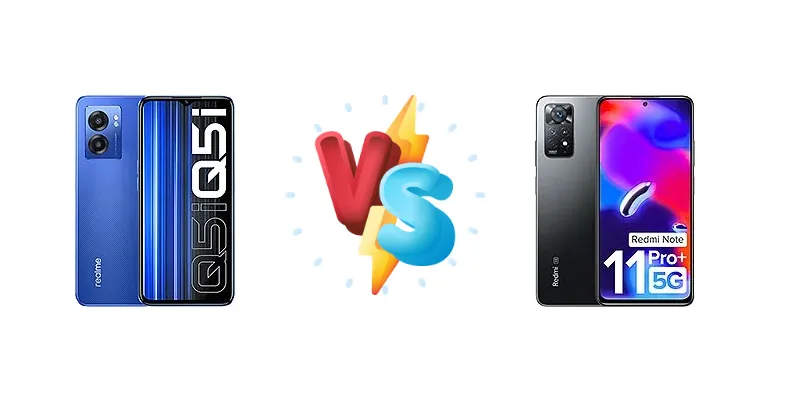
Both the Realme Q5i and the Xiaomi Redmi Note 11 Pro+ 5G (India) target the competitive mid-range 5G market, but they take different approaches. The Q5i prioritizes a streamlined experience with a capable Dimensity 810, while the Redmi Note 11 Pro+ 5G emphasizes rapid charging and a more feature-rich package, albeit with a different chipset. This comparison dissects their key differences to determine which phone offers the best value.
🏆 Quick Verdict
For the average user prioritizing fast charging and a potentially smoother software experience, the Xiaomi Redmi Note 11 Pro+ 5G (India) is the better choice. Its 67W charging significantly reduces downtime, and the Snapdragon 695 offers a solid, if not groundbreaking, performance profile. However, the Realme Q5i remains a compelling option for those on a tighter budget.
| Network |
|---|
| 2G bands | GSM 850 / 900 / 1800 / 1900 | GSM 850 / 900 / 1800 / 1900 - SIM 1 & SIM 2 |
| 3G bands | HSDPA 850 / 900 / 1900 / 2100 | HSDPA 850 / 900 / 1900 / 2100 |
| 4G bands | LTE | 1, 3, 5, 8, 40, 41 |
| 5G bands | SA/NSA | 1, 3, 5, 8, 28, 40, 78 SA/NSA |
| Speed | HSPA, LTE, 5G | HSPA, LTE-A (CA), 5G |
| Technology | GSM / HSPA / LTE / 5G | GSM / HSPA / LTE / 5G |
| Launch |
|---|
| Announced | 2022, April 18 | 2022, March 09 |
| Status | Available. Released 2022, April 18 | Available. Released 2022, March 15 |
| Body |
|---|
| Build | Glass front, plastic frame, plastic back | Glass front (Gorilla Glass 5), glass back |
| Dimensions | 8.1 mm thickness | 164.2 x 76.1 x 8.1 mm (6.46 x 3.00 x 0.32 in) |
| SIM | Nano-SIM + Nano-SIM | Hybrid Dual SIM (Nano-SIM, dual stand-by) |
| Weight | - | 202 g (7.13 oz) |
| | - | IP53, dust and splash resistant |
| Display |
|---|
| Protection | - | Corning Gorilla Glass 5 |
| Resolution | 1080 x 2400 pixels, 20:9 ratio (~401 ppi density) | 1080 x 2400 pixels, 20:9 ratio (~395 ppi density) |
| Size | 6.58 inches, 104.0 cm2 (~84.6% screen-to-body ratio) | 6.67 inches, 107.4 cm2 (~86.0% screen-to-body ratio) |
| Type | IPS LCD, 90Hz, 600 nits | Super AMOLED, 120Hz, 700 nits, 1200 nits (peak) |
| Platform |
|---|
| CPU | Octa-core (2x2.4 GHz Cortex-A76 & 6x2.0 GHz Cortex-A55) | Octa-core (2x2.2 GHz Kryo 660 Gold & 6x1.7 GHz Kryo 660 Silver) |
| Chipset | Mediatek Dimensity 810 (6 nm) | Qualcomm SM6375 Snapdragon 695 5G (6 nm) |
| GPU | Mali-G57 MC2 | Adreno 619 |
| OS | Android 12, Realme UI 3.0 | Android 11, MIUI 13 |
| Memory |
|---|
| Card slot | microSDXC | microSDXC (uses shared SIM slot) |
| Internal | 128GB 4GB RAM, 128GB 6GB RAM | 64GB 6GB RAM, 128GB 6GB RAM, 128GB 8GB RAM, 256GB 8GB RAM |
| | UFS 2.2 | UFS 2.2 |
| Main Camera |
|---|
| Dual | 13 MP, f/2.2, (wide), 1/3.06", 1.12µm, AF
Auxiliary lens | - |
| Features | Dual-LED flash, HDR, panorama | LED flash, HDR, panorama |
| Single | 8 MP, f/2.0, 26mm (wide) | - |
| Triple | - | 108 MP, f/1.9, 26mm (wide), 1/1.52", 0.7µm, PDAF
8 MP, f/2.2, 118˚ (ultrawide)
2 MP, f/2.4, (macro) |
| Video | 1080p@30fps | 1080p@30fps |
| Selfie camera |
|---|
| Single | 8 MP, f/2.0, 26mm (wide) | 16 MP, f/2.5, (wide), 1/3.06" 1.0µm |
| Video | 1080p@30fps | 1080p@30fps |
| Sound |
|---|
| 3.5mm jack | Yes | Yes |
| 35mm jack | Yes | - |
| Loudspeaker | Yes | Yes, with stereo speakers |
| | 24-bit/192kHz audio | 24-bit/192kHz audio |
| Comms |
|---|
| Bluetooth | Yes | 5.1, A2DP, LE |
| Infrared port | - | Yes |
| NFC | Unspecified | No |
| Positioning | GPS, GLONASS, GALILEO, BDS | GPS, GLONASS, BDS, GALILEO |
| Radio | Unspecified | Unspecified |
| USB | USB Type-C 2.0 | USB Type-C 2.0, OTG |
| WLAN | Yes | Wi-Fi 802.11 a/b/g/n/ac, dual-band, Wi-Fi Direct |
| Features |
|---|
| Sensors | Fingerprint (side-mounted), unspecified sensors | Fingerprint (side-mounted), accelerometer, gyro, proximity, compass |
| Battery |
|---|
| Charging | 33W wired | 67W wired, PD3.0, QC3, 50% in 15 min, 100% in 42 min (advertised) |
| Type | 5000 mAh | Li-Po 5000 mAh, non-removable |
| Misc |
|---|
| Colors | Blue, Black | Mirage Blue, Phantom White, Stealth Black |
| Models | RMX3574 | 2201116SI |
| Price | About 180 EUR | About 250 EUR |
Realme Q5i
- Potentially stronger single-core CPU performance with Dimensity 810
- More affordable price point
- Decent 5G connectivity
- Slower 33W charging
- Potentially less optimized software experience
- GPU may be less capable for demanding games
Xiaomi Redmi Note 11 Pro+ 5G (India)
- Significantly faster 67W charging with PD3.0 and QC3 support
- Qualcomm Snapdragon 695 offers good all-around performance
- Potentially better software optimization and updates
- Slightly weaker CPU performance compared to the Q5i
- Higher price tag
- May experience thermal throttling under sustained load
Display Comparison
Neither device boasts a flagship-level display, but details are limited. Assuming both utilize IPS LCD panels (typical for this price bracket), the display experience will likely be similar in terms of color accuracy and viewing angles. The absence of high refresh rate information suggests both are likely 60Hz. The real difference will come down to peak brightness, which isn't specified, and software calibration. Bezels are also likely comparable, given the similar overall phone sizes.
Camera Comparison
Without detailed camera specs beyond the main chipsets, a direct comparison is difficult. Both phones likely feature multi-camera setups, but the image processing algorithms will be key differentiators. Xiaomi’s image processing tends to be more saturated and contrast-boosted, while Realme often aims for a more natural look. The Redmi Note 11 Pro+ 5G’s potential for better ISP (Image Signal Processor) capabilities within the Snapdragon 695 could translate to improved dynamic range and low-light performance, assuming a comparable sensor size. The presence of a 2MP macro lens on either device is largely irrelevant for serious photography.
Performance
The core difference lies in the chipsets. The Realme Q5i’s Mediatek Dimensity 810 (6nm) features a more powerful CPU configuration – 2x2.4 GHz Cortex-A76 cores versus the Redmi Note 11 Pro+ 5G’s 2x2.2 GHz Kryo 660 Gold cores. This suggests the Q5i will exhibit stronger single-core performance, beneficial for responsive app launching and general UI navigation. However, the Snapdragon 695 (6nm) in the Redmi Note 11 Pro+ 5G often benefits from Qualcomm’s software optimizations and potentially more efficient power management. While both use 6nm fabrication, the Snapdragon’s Adreno 619 GPU is generally considered more capable than the Mali-G57 MC2 in the Dimensity 810, offering a slight edge in gaming. RAM speed is not specified, but LPDDR4X is likely on both devices.
Battery Life
The Redmi Note 11 Pro+ 5G’s 67W charging is a significant advantage. Advertised figures claim 50% charge in 15 minutes and 100% in 42 minutes, drastically reducing charging times compared to the Realme Q5i’s 33W charging. While battery capacity isn’t specified, the faster charging speed effectively mitigates any potential capacity difference. The Snapdragon 695’s potentially better power efficiency could also contribute to longer real-world battery life, despite the faster charging.
Buying Guide
Buy the Realme Q5i if you need a reliable 5G phone with decent performance for everyday tasks and prioritize value above all else. It's ideal for users who don't heavily game or require the fastest possible charging. Buy the Xiaomi Redmi Note 11 Pro+ 5G (India) if you prefer a faster charging experience, potentially better software optimization, and are willing to spend a bit more for those benefits. This phone suits users who frequently use their phone throughout the day and need to quickly top up the battery.
Frequently Asked Questions
❓ Will the Snapdragon 695 in the Redmi Note 11 Pro+ 5G overheat during prolonged gaming sessions?
The Snapdragon 695 is generally efficient, but it's not a flagship chipset. Expect some thermal throttling during extended gaming, especially with demanding titles. The phone's cooling solution will play a crucial role, but it's unlikely to match the sustained performance of higher-end processors.
❓ Is the 33W charging on the Realme Q5i slow compared to the Redmi Note 11 Pro+ 5G's 67W?
Yes, the difference is substantial. While 33W is still considered fast charging, 67W can significantly reduce charging times. The Redmi Note 11 Pro+ 5G can go from 0-100% in approximately 42 minutes, while the Q5i will take considerably longer.
❓ Does the Realme Q5i support carrier aggregation for improved 5G speeds?
Carrier aggregation support depends on the specific variant and carrier. While the Dimensity 810 supports carrier aggregation, it's crucial to check with your mobile carrier to confirm compatibility and supported bands in your region.
❓ How does the software experience differ between Realme UI and Xiaomi's MIUI?
MIUI is known for its extensive customization options and feature set, but it can also be more resource-intensive and include pre-installed bloatware. Realme UI aims for a cleaner, more streamlined experience, often prioritizing speed and responsiveness. Both offer regular updates, but Xiaomi generally has a faster update cycle.