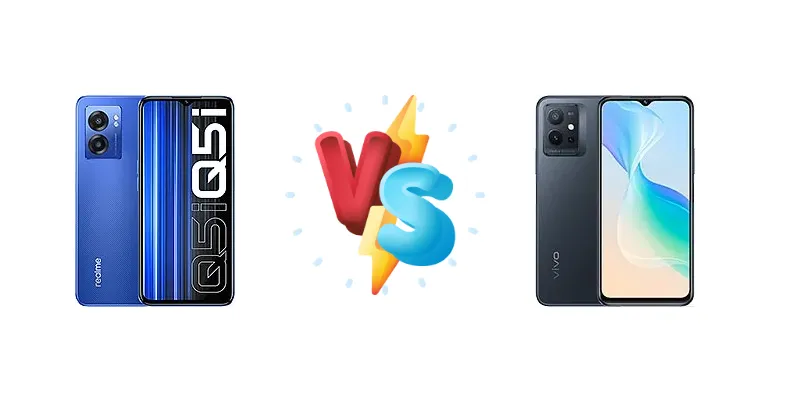
The Realme Q5i and vivo T1 5G represent compelling options in the increasingly competitive budget 5G smartphone market. Both devices aim to deliver a smooth experience without breaking the bank, but they achieve this through different approaches – namely, differing chipsets and charging implementations. This comparison dissects those key differences to determine which phone best suits your needs.
🏆 Quick Verdict
For the average user prioritizing sustained performance and faster charging, the Realme Q5i emerges as the stronger contender. Its Dimensity 810 chipset, while not a flagship, generally offers a slight edge in CPU-intensive tasks and gaming compared to the Snapdragon 695 found in the vivo T1 5G, coupled with significantly faster 33W charging.
| Network |
|---|
| 2G bands | GSM 850 / 900 / 1800 / 1900 | GSM 850 / 900 / 1800 / 1900 |
| 3G bands | HSDPA 850 / 900 / 1900 / 2100 | HSDPA 850 / 900 / 2100 |
| 4G bands | LTE | 1, 3, 5, 8, 38, 40, 41 - India |
| 5G bands | SA/NSA | 77, 78 SA/NSA - India |
| Speed | HSPA, LTE, 5G | HSPA, LTE, 5G |
| Technology | GSM / HSPA / LTE / 5G | GSM / HSPA / LTE / 5G |
| | - | 1, 3, 40 SA/NSA - Indonesia |
| Launch |
|---|
| Announced | 2022, April 18 | 2022, February 09 |
| Status | Available. Released 2022, April 18 | Available. Released 2022, February 14 |
| Body |
|---|
| Build | Glass front, plastic frame, plastic back | Glass front, plastic frame, plastic back |
| Dimensions | 8.1 mm thickness | 164 x 75.8 x 8.3 mm (6.46 x 2.98 x 0.33 in) |
| SIM | Nano-SIM + Nano-SIM | Nano-SIM + Nano-SIM |
| Weight | - | 187 g (6.60 oz) |
| Display |
|---|
| Resolution | 1080 x 2400 pixels, 20:9 ratio (~401 ppi density) | 1080 x 2408 pixels, 20:9 ratio (~401 ppi density) |
| Size | 6.58 inches, 104.0 cm2 (~84.6% screen-to-body ratio) | 6.58 inches, 104.3 cm2 (~83.9% screen-to-body ratio) |
| Type | IPS LCD, 90Hz, 600 nits | IPS LCD, 120Hz |
| Platform |
|---|
| CPU | Octa-core (2x2.4 GHz Cortex-A76 & 6x2.0 GHz Cortex-A55) | Octa-core (2x2.2 GHz Kryo 660 Gold & 6x1.7 GHz Kryo 660 Silver)Octa-core (2x2.4 GHz Cortex-A76 & 6x2.0 GHz Cortex-A55) - Indonesia |
| Chipset | Mediatek Dimensity 810 (6 nm) | Qualcomm SM6375 Snapdragon 695 5G (6 nm)Mediatek Dimensity 810 (6 nm) - Indonesia |
| GPU | Mali-G57 MC2 | Adreno 619Mali-G57 MC2 - Indonesia |
| OS | Android 12, Realme UI 3.0 | Android 11, Funtouch 12 |
| Memory |
|---|
| Card slot | microSDXC | microSDXC (uses shared SIM slot) |
| Internal | 128GB 4GB RAM, 128GB 6GB RAM | 128GB 4GB RAM, 128GB 6GB RAM, 128GB 8GB RAM, 256GB 8GB RAM |
| | UFS 2.2 | UFS 2.2 - India |
| Main Camera |
|---|
| Dual | 13 MP, f/2.2, (wide), 1/3.06", 1.12µm, AF
Auxiliary lens | - |
| Features | Dual-LED flash, HDR, panorama | Dual-LED flash, HDR, panorama |
| Single | 8 MP, f/2.0, 26mm (wide) | 16 MP, f/2.0, (wide) |
| Triple | - | 50 MP, f/1.8, 26mm (wide), PDAF
2 MP (macro)
Auxiliary lens |
| Video | 1080p@30fps | 1080p@30fps |
| Selfie camera |
|---|
| Single | 8 MP, f/2.0, 26mm (wide) | 16 MP, f/2.0, (wide) |
| Video | 1080p@30fps | 1080p@30fps |
| Sound |
|---|
| 3.5mm jack | Yes | Yes |
| 35mm jack | Yes | Yes |
| Loudspeaker | Yes | Yes |
| | 24-bit/192kHz audio | - |
| Comms |
|---|
| Bluetooth | Yes | 5.1, A2DP, LE |
| NFC | Unspecified | Yes (market/region dependent) |
| Positioning | GPS, GLONASS, GALILEO, BDS | GPS, GLONASS, GALILEO, BDS, QZSS |
| Radio | Unspecified | FM radio |
| USB | USB Type-C 2.0 | USB Type-C 2.0, OTG |
| WLAN | Yes | Wi-Fi 802.11 a/b/g/n/ac, dual-band, Wi-Fi Direct |
| Features |
|---|
| Sensors | Fingerprint (side-mounted), unspecified sensors | Fingerprint (side-mounted), accelerometer, proximity, compass |
| Battery |
|---|
| Charging | 33W wired | 18W wired |
| Type | 5000 mAh | 5000 mAh |
| Misc |
|---|
| Colors | Blue, Black | Starlight Black, Rainbow Fantasy |
| Models | RMX3574 | V2141, V2157 |
| Price | About 180 EUR | About 180 EUR |
Realme Q5i
- Faster 33W charging for quicker top-ups.
- Dimensity 810 offers a slight CPU performance edge.
- Potentially more advanced ISP for image processing.
- Realme’s software can be more heavily customized.
- Camera details are unknown, potentially limiting image quality.
vivo T1 5G
- Qualcomm’s Snapdragon 695 offers efficient power management.
- Potentially more stable software experience.
- Strong 5G modem performance.
- Slower 18W charging.
- Snapdragon 695 CPU performance is slightly lower than Dimensity 810.
Display Comparison
Neither Realme nor vivo provide display specifications beyond the basic details. Assuming both utilize standard IPS LCD panels common in this price bracket, the display experience will likely be similar. The absence of high refresh rates or advanced features like LTPO suggests a focus on cost optimization. Bezels are expected to be moderate, and color accuracy will likely be adequate for everyday use but not ideal for professional content creation.
Camera Comparison
Detailed camera specifications are unavailable. Given the price point, both phones likely feature a primary sensor paired with depth or macro lenses of limited utility. Image processing will be a key differentiator, with Realme often leaning towards vibrant, saturated colors, while vivo typically aims for more natural tones. Without specific sensor details, it’s difficult to definitively declare a winner; however, the image signal processor (ISP) within the Dimensity 810 *may* offer slightly more advanced processing capabilities.
Performance
The core difference lies in the chipsets. The Realme Q5i boasts the Mediatek Dimensity 810 (6nm), featuring an octa-core configuration with 2x2.4 GHz Cortex-A76 and 6x2.0 GHz Cortex-A55 cores. The vivo T1 5G, however, utilizes the Qualcomm Snapdragon 695 5G (6nm) with 2x2.2 GHz Kryo 660 Gold and 6x1.7 GHz Kryo 660 Silver cores. While both are 6nm chips, the Dimensity 810’s Cortex-A76 cores generally offer a performance advantage in CPU benchmarks. The Snapdragon 695 excels in modem efficiency, potentially leading to better 5G connectivity and power consumption. However, the Q5i’s CPU architecture provides a slight edge in demanding applications. Both phones likely feature similar RAM configurations, impacting multitasking capabilities.
Battery Life
The Realme Q5i’s 33W wired charging is a significant advantage over the vivo T1 5G’s 18W charging. This translates to substantially faster 0-100% charging times, a crucial benefit for users who prioritize convenience. While battery capacity isn’t specified, the faster charging of the Q5i effectively mitigates any potential disadvantage from a slightly smaller battery size. The Snapdragon 695’s power efficiency *could* offset this, but the charging speed difference is substantial.
Buying Guide
Buy the Realme Q5i if you need a phone that can handle moderate gaming and multitasking with a bit more headroom, and if you value quicker top-ups thanks to its 33W charging. Buy the vivo T1 5G if you prioritize Qualcomm's typically efficient power management and a potentially more stable software experience, and are less concerned with maximizing raw processing power or charging speed.
Frequently Asked Questions
❓ Will the Dimensity 810 in the Realme Q5i struggle with graphically demanding games like PUBG or Call of Duty?
While not a flagship chipset, the Dimensity 810 is capable of running PUBG and Call of Duty at medium settings with reasonable frame rates. Expect some frame drops during intense action, but it should provide a playable experience. Optimizing in-game graphics settings is crucial for sustained performance.
❓ How long will it take to fully charge the vivo T1 5G with its 18W charging?
Given the 18W charging speed, a full 0-100% charge on the vivo T1 5G is estimated to take around 2-2.5 hours, depending on usage during charging. This is considerably slower than the Realme Q5i’s 33W charging, which can achieve a full charge in approximately 1 hour.
❓ Does the Snapdragon 695 in the vivo T1 5G offer better 5G connectivity than the Dimensity 810?
Qualcomm’s Snapdragon modems are generally known for their strong 5G connectivity and efficiency. The Snapdragon 695 likely provides a more stable and power-efficient 5G experience compared to the Dimensity 810, particularly in areas with weaker 5G signals.