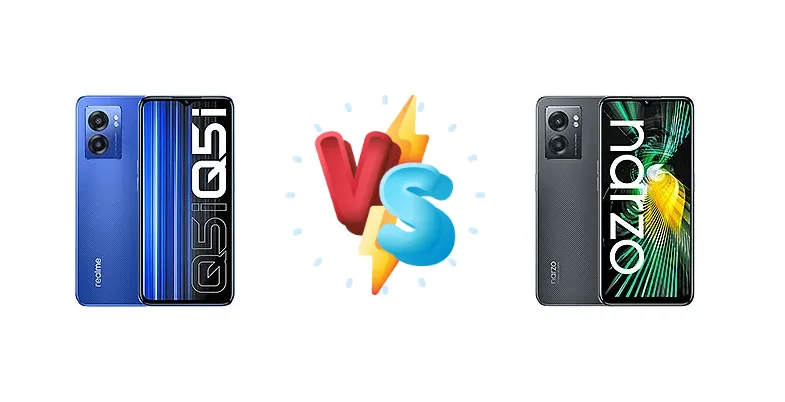
Realme continues to dominate the budget smartphone market with compelling options. The Realme Q5i and Narzo 50 5G are two such contenders, offering similar specs but targeting slightly different users. This comprehensive comparison will break down their strengths and weaknesses to help you make the right choice.
🏆 Quick Verdict
Both phones share the same Dimensity 810 chipset and 33W charging. The Narzo 50 5G's 5G connectivity gives it a slight edge for future-proofing, while the Q5i might offer a slightly better display and potentially a more refined design. It's a close call, largely dependent on your 5G needs.
| Network |
|---|
| 2G bands | GSM 850 / 900 / 1800 / 1900 | GSM 850 / 900 / 1800 / 1900 |
| 3G bands | HSDPA 850 / 900 / 1900 / 2100 | HSDPA 800 / 850 / 900 / 1700(AWS) / 1900 / 2100 |
| 4G bands | LTE | 1, 2, 3, 4, 5, 7, 8, 12, 17, 18, 19, 20, 26, 28, 38, 39, 40, 41, 66 - International |
| 5G bands | SA/NSA | 1, 3, 5, 7, 8, 20, 28, 38, 40, 41, 77, 78 SA/NSA - International |
| Speed | HSPA, LTE, 5G | HSPA, LTE, 5G |
| Technology | GSM / HSPA / LTE / 5G | GSM / HSPA / LTE / 5G |
| | - | 1, 5, 8, 28, 41, 77, 78 SA/NSA - India |
| Launch |
|---|
| Announced | 2022, April 18 | 2022, May 18 |
| Status | Available. Released 2022, April 18 | Available. Released 2022, May 24 |
| Body |
|---|
| Build | Glass front, plastic frame, plastic back | Glass front, plastic frame, plastic back |
| Dimensions | 8.1 mm thickness | 163.8 x 75.1 x 8.1 mm (6.45 x 2.96 x 0.32 in) |
| SIM | Nano-SIM + Nano-SIM | Nano-SIM + Nano-SIM |
| Weight | - | 190 g (6.70 oz) |
| Display |
|---|
| Resolution | 1080 x 2400 pixels, 20:9 ratio (~401 ppi density) | 1080 x 2408 pixels, 20:9 ratio (~400 ppi density) |
| Size | 6.58 inches, 104.0 cm2 (~84.6% screen-to-body ratio) | 6.6 inches, 104.9 cm2 (~85.3% screen-to-body ratio) |
| Type | IPS LCD, 90Hz, 600 nits | IPS LCD, 90Hz, 600 nits |
| Platform |
|---|
| CPU | Octa-core (2x2.4 GHz Cortex-A76 & 6x2.0 GHz Cortex-A55) | Octa-core (2x2.4 GHz Cortex-A76 & 6x2.0 GHz Cortex-A55) |
| Chipset | Mediatek Dimensity 810 (6 nm) | Mediatek Dimensity 810 (6 nm) |
| GPU | Mali-G57 MC2 | Mali-G57 MC2 |
| OS | Android 12, Realme UI 3.0 | Android 12, Realme UI 3.0 |
| Memory |
|---|
| Card slot | microSDXC | microSDXC (uses shared SIM slot) |
| Internal | 128GB 4GB RAM, 128GB 6GB RAM | 64GB 4GB RAM, 128GB 4GB RAM, 128GB 6GB RAM |
| | UFS 2.2 | - |
| Main Camera |
|---|
| Dual | 13 MP, f/2.2, (wide), 1/3.06", 1.12µm, AF
Auxiliary lens | 48 MP, f/1.8, 26mm (wide), PDAF
Auxiliary lens |
| Features | Dual-LED flash, HDR, panorama | Dual-LED flash, HDR, panorama |
| Single | 8 MP, f/2.0, 26mm (wide) | 8 MP, f/2.0, 26mm (wide) |
| Video | 1080p@30fps | 1080p@30fps |
| Selfie camera |
|---|
| Features | - | Panorama |
| Single | 8 MP, f/2.0, 26mm (wide) | 8 MP, f/2.0, 26mm (wide) |
| Video | 1080p@30fps | 1080p@30fps |
| Sound |
|---|
| 3.5mm jack | Yes | Yes |
| 35mm jack | Yes | Yes |
| Loudspeaker | Yes | Yes, with stereo speakers |
| | 24-bit/192kHz audio | - |
| Comms |
|---|
| Bluetooth | Yes | 5.3, A2DP, LE |
| NFC | Unspecified | Yes (market/region dependent) |
| Positioning | GPS, GLONASS, GALILEO, BDS | GPS, GLONASS, GALILEO, BDS, QZSS |
| Radio | Unspecified | Unspecified |
| USB | USB Type-C 2.0 | USB Type-C 2.0 |
| WLAN | Yes | Wi-Fi 802.11 a/b/g/n/ac, dual-band, Wi-Fi Direct |
| Features |
|---|
| Sensors | Fingerprint (side-mounted), unspecified sensors | Fingerprint (side-mounted), accelerometer, gyro, proximity, compass |
| Battery |
|---|
| Charging | 33W wired | 33W wired |
| Type | 5000 mAh | 5000 mAh |
| Misc |
|---|
| Colors | Blue, Black | Hyper Blue, Hyper Black |
| Models | RMX3574 | RMX3572, RMX3571 |
| Price | About 180 EUR | About 560 EUR |
Realme Q5i
- Potentially better display quality
- Slightly more versatile camera
- Refined design (potentially)
- No 5G connectivity
- May have limited availability in some regions
Realme Narzo 50 5G
- 5G connectivity for future-proofing
- Generally wider availability
- Competitive price
- Potentially less vibrant display
- Camera may not be as impressive as the Q5i
Display Comparison
While both phones likely feature similar LCD panels, the Q5i is rumored to have slightly better color accuracy and brightness. The Narzo 50 5G's display is adequate but may not be as vibrant. Expect resolutions around 1080 x 2400 pixels on both.
Camera Comparison
The Q5i is expected to have a slightly more versatile camera system, potentially with a higher resolution main sensor and improved image processing. The Narzo 50 5G's camera is decent but may not match the Q5i's image quality in all scenarios. Both likely feature a macro lens and depth sensor.
Performance
Powered by the same Mediatek Dimensity 810 chipset, both phones offer similar performance for everyday tasks and moderate gaming. Expect smooth multitasking and responsive app loading. Differences in RAM and storage configurations (likely varying by region) could slightly impact performance.
Battery Life
Both devices boast a 5000mAh battery, ensuring all-day battery life under moderate usage. The 33W fast charging will provide a relatively quick top-up, taking around an hour to reach 100%.
Buying Guide
The Realme Q5i is ideal for users prioritizing a potentially better display and design within a budget, and who don't necessarily need 5G. The Realme Narzo 50 5G is the better choice for those wanting 5G connectivity and future-proofing, even if it means potentially minor compromises elsewhere.
Frequently Asked Questions
❓ Is the Dimensity 810 chipset good for gaming?
Yes, the Dimensity 810 is capable of handling most mobile games at medium to high settings. It provides a smooth gaming experience for casual and moderate gamers.
❓ What is the difference between 4G and 5G?
5G offers significantly faster data speeds and lower latency compared to 4G. This results in quicker downloads, smoother streaming, and improved online gaming experiences. However, 5G coverage is still not as widespread as 4G.