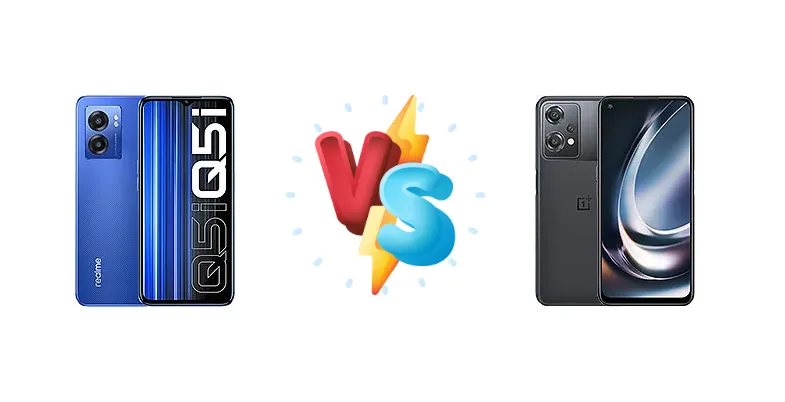
Both the Realme Q5i and OnePlus Nord CE 2 Lite 5G target the competitive budget 5G smartphone market. While both offer 5G connectivity and 33W fast charging, they diverge significantly in their core processing power, relying on different chipsets from MediaTek and Qualcomm. This comparison dives deep into the nuances of each device to determine which offers the best experience for your money.
🏆 Quick Verdict
For the average user prioritizing consistent performance and a slightly more refined software experience, the OnePlus Nord CE 2 Lite 5G emerges as the better choice. Its Snapdragon 695 chipset, while not a performance leader, offers a more balanced and efficient experience than the Realme Q5i’s Dimensity 810, especially in sustained workloads.
| Network |
|---|
| 2G bands | GSM 850 / 900 / 1800 / 1900 | GSM 850 / 900 / 1800 / 1900 |
| 3G bands | HSDPA 850 / 900 / 1900 / 2100 | HSDPA 800 / 850 / 900 / 1700(AWS) / 1900 / 2100 |
| 4G bands | LTE | 1, 2, 3, 4, 5, 7, 8, 12, 13, 17, 18, 19, 20, 26, 28, 38, 39, 40, 41, 66 - Europe |
| 5G bands | SA/NSA | 1, 3, 5, 7, 8, 20, 28, 38, 40, 41, 66, 77, 78 SA/NSA - Europe |
| Speed | HSPA, LTE, 5G | HSPA, LTE, 5G |
| Technology | GSM / HSPA / LTE / 5G | GSM / HSPA / LTE / 5G |
| Launch |
|---|
| Announced | 2022, April 18 | 2022, April 28 |
| Status | Available. Released 2022, April 18 | Available. Released 2022, April 30 |
| Body |
|---|
| Build | Glass front, plastic frame, plastic back | Glass front, plastic frame, plastic back |
| Dimensions | 8.1 mm thickness | 164.3 x 75.6 x 8.5 mm (6.47 x 2.98 x 0.33 in) |
| SIM | Nano-SIM + Nano-SIM | Nano-SIM + Nano-SIM |
| Weight | - | 195 g (6.88 oz) |
| Display |
|---|
| Resolution | 1080 x 2400 pixels, 20:9 ratio (~401 ppi density) | 1080 x 2412 pixels, 20:9 ratio (~401 ppi density) |
| Size | 6.58 inches, 104.0 cm2 (~84.6% screen-to-body ratio) | 6.59 inches, 104.5 cm2 (~84.1% screen-to-body ratio) |
| Type | IPS LCD, 90Hz, 600 nits | IPS LCD, 120Hz |
| Platform |
|---|
| CPU | Octa-core (2x2.4 GHz Cortex-A76 & 6x2.0 GHz Cortex-A55) | Octa-core (2x2.2 GHz Kryo 660 Gold & 6x1.7 GHz Kryo 660 Silver) |
| Chipset | Mediatek Dimensity 810 (6 nm) | Qualcomm SM6375 Snapdragon 695 5G (6 nm) |
| GPU | Mali-G57 MC2 | Adreno 619 |
| OS | Android 12, Realme UI 3.0 | Android 12, upgradable to Android 13, OxygenOS 13 |
| Memory |
|---|
| Card slot | microSDXC | microSDXC (uses shared SIM slot) |
| Internal | 128GB 4GB RAM, 128GB 6GB RAM | 128GB 6GB RAM, 128GB 8GB RAM |
| | UFS 2.2 | - |
| Main Camera |
|---|
| Dual | 13 MP, f/2.2, (wide), 1/3.06", 1.12µm, AF
Auxiliary lens | - |
| Features | Dual-LED flash, HDR, panorama | LED flash, HDR, panorama |
| Single | 8 MP, f/2.0, 26mm (wide) | - |
| Triple | - | 64 MP, f/1.7, 26mm (wide), 0.7µm, PDAF
2 MP (macro)
Auxiliary lens |
| Video | 1080p@30fps | 1080p@30fps |
| Selfie camera |
|---|
| Features | - | HDR |
| Single | 8 MP, f/2.0, 26mm (wide) | 16 MP, f/2.0, (wide), 1/3.0", 1.0µm |
| Video | 1080p@30fps | 1080p@30fps |
| Sound |
|---|
| 3.5mm jack | Yes | Yes |
| 35mm jack | Yes | Yes |
| Loudspeaker | Yes | Yes |
| | 24-bit/192kHz audio | - |
| Comms |
|---|
| Bluetooth | Yes | 5.2, A2DP, LE, aptX HD |
| NFC | Unspecified | Yes (market/region dependent) |
| Positioning | GPS, GLONASS, GALILEO, BDS | GPS, GLONASS, GALILEO, BDS, QZSS |
| Radio | Unspecified | Unspecified |
| USB | USB Type-C 2.0 | USB Type-C 2.0, OTG |
| WLAN | Yes | Wi-Fi 802.11 a/b/g/n/ac, dual-band, Wi-Fi Direct |
| Features |
|---|
| Sensors | Fingerprint (side-mounted), unspecified sensors | Fingerprint (side-mounted), accelerometer, gyro, proximity, compass |
| Battery |
|---|
| Charging | 33W wired | 33W wired |
| Type | 5000 mAh | Li-Po 5000 mAh |
| Misc |
|---|
| Colors | Blue, Black | Black Dusk, Blue Tide |
| Models | RMX3574 | CPH2381, CPH2409 |
| Price | About 180 EUR | About 220 EUR |
| SAR | - | 1.19 W/kg (head) 0.71 W/kg (body) |
Realme Q5i
- Potentially higher peak CPU performance for demanding tasks.
- Competitive 33W fast charging.
- 6nm process node for reasonable efficiency.
- Dimensity 810 may throttle under sustained load.
- Potentially less refined software experience.
- GPU performance likely lags behind the Snapdragon 695.
OnePlus Nord CE 2 Lite 5G
- More efficient Snapdragon 695 chipset.
- Qualcomm’s optimized ISP for better image processing.
- OxygenOS software offers a cleaner experience.
- Slightly lower peak CPU clock speeds.
- GPU performance is good, but not class-leading.
- May be slightly more expensive than the Realme Q5i.
Display Comparison
Both devices are expected to feature LCD panels, typical for this price bracket. However, detailed display specs like resolution and refresh rate are missing. The focus here is on processing power, so display differences are less critical. Bezels are likely comparable, and color accuracy will be standard for budget LCDs. Without specific data, it's difficult to declare a clear winner.
Camera Comparison
Detailed camera specs are unavailable, but both phones likely feature a multi-camera setup with a primary sensor and supporting lenses. The Snapdragon 695’s ISP (Image Signal Processor) is a key advantage for the Nord CE 2 Lite 5G, enabling better image processing, noise reduction, and dynamic range. While the Realme Q5i’s Dimensity 810 also has an ISP, Qualcomm’s are generally considered more advanced. Without knowing sensor sizes and apertures, it’s difficult to definitively say which phone will capture better photos, but the Nord CE 2 Lite 5G has a processing advantage.
Performance
The core difference lies in the chipsets. The Realme Q5i utilizes the MediaTek Dimensity 810 (6nm), featuring a 2x2.4 GHz Cortex-A76 and 6x2.0 GHz Cortex-A55 configuration. The OnePlus Nord CE 2 Lite 5G employs the Qualcomm Snapdragon 695 5G (6nm) with a 2x2.2 GHz Kryo 660 Gold and 6x1.7 GHz Kryo 660 Silver setup. While the Dimensity 810 boasts slightly higher clock speeds on its prime cores, the Snapdragon 695 benefits from Qualcomm’s optimized architecture and ISP. This translates to better sustained performance and potentially superior image processing. The Snapdragon 695’s Adreno 619 GPU is also likely to offer a more consistent gaming experience than the Mali-G52 MC2 in the Q5i, especially in graphically demanding titles. The 6nm process node is shared, suggesting similar power efficiency, but Qualcomm’s optimizations often give it an edge in thermal management.
Battery Life
Both devices feature 33W wired charging, promising relatively quick top-ups. Actual 0-100% charging times will likely be similar, around 60-70 minutes. Battery capacity is unknown for both devices, but the Snapdragon 695’s greater efficiency could translate to slightly longer battery life for the Nord CE 2 Lite 5G, even with a comparable battery size. The 33W charging is a significant benefit over slower charging solutions found in some budget phones.
Buying Guide
Buy the Realme Q5i if you prioritize raw CPU performance for tasks like video editing or running multiple apps simultaneously, and are comfortable with potentially more aggressive thermal throttling. Buy the OnePlus Nord CE 2 Lite 5G if you prefer a smoother, more consistent experience for everyday tasks, gaming, and photography, and value the OnePlus OxygenOS software experience.
Frequently Asked Questions
❓ Will the Realme Q5i overheat during extended gaming sessions?
The Dimensity 810, while capable, is known to throttle under sustained load. Expect performance to decrease over time during long gaming sessions, and the phone may become noticeably warm. The OnePlus Nord CE 2 Lite 5G’s Snapdragon 695 is better equipped to handle thermal management.
❓ Does the OnePlus Nord CE 2 Lite 5G support advanced 5G features like carrier aggregation?
The Snapdragon 695 supports 5G carrier aggregation, allowing for faster and more stable 5G connections where available. This is a significant advantage over some budget chipsets that lack this feature, resulting in a better 5G experience in areas with strong network infrastructure.
❓ Is the difference in CPU performance between the Dimensity 810 and Snapdragon 695 noticeable in everyday tasks?
For typical everyday tasks like browsing, social media, and messaging, the difference in CPU performance will be minimal. Both chipsets are more than capable of handling these workloads. The Snapdragon 695’s advantage becomes more apparent in demanding applications and multitasking.