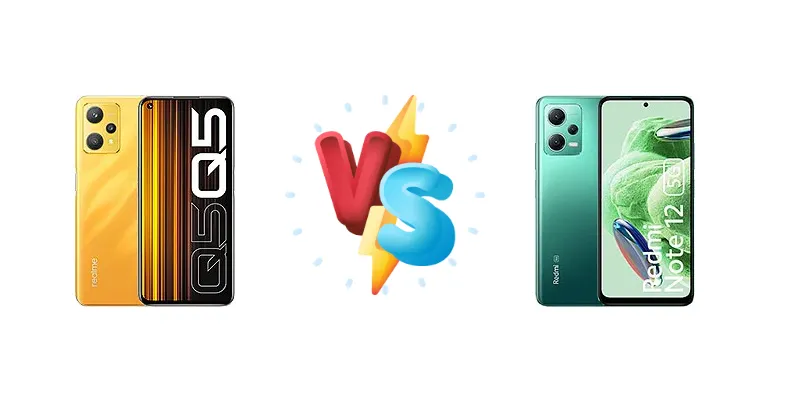
The budget smartphone market is fiercely competitive, and the Realme Q5 and Xiaomi Redmi Note 12 are two strong contenders. Both offer compelling features at attractive price points, but which one truly delivers the best overall experience? Let's dive into a detailed comparison to help you decide.
🏆 Quick Verdict
The Realme Q5 takes the lead with its significantly faster charging and more powerful Snapdragon 695 chipset. However, the Redmi Note 12 boasts exceptional battery life and a potentially better display. Ultimately, the Q5 is for performance seekers, while the Note 12 prioritizes longevity.
| Network |
|---|
| 2G bands | GSM 850 / 900 / 1800 / 1900 | GSM 850 / 900 / 1800 / 1900 |
| 3G bands | HSDPA 800 / 850 / 900 / 1700(AWS) / 1900 / 2100 | HSDPA 850 / 900 / 2100 |
| 4G bands | 1, 3, 4, 5, 7, 8, 19, 28, 34, 38, 39, 40, 41 | 1, 3, 5, 8, 40, 41 |
| 5G bands | 1, 28, 41, 77, 78 SA/NSA | 1, 3, 5, 8, 28, 40, 78 SA/NSA |
| Speed | HSPA, LTE, 5G | HSPA, LTE, 5G |
| Technology | GSM / HSPA / LTE / 5G | GSM / HSPA / LTE / 5G |
| Launch |
|---|
| Announced | 2022, April 20 | 2022, October 27 |
| Status | Available. Released 2022, April 28 | Available. Released 2023, January 11 |
| Body |
|---|
| Dimensions | 164.3 x 75.6 x 8.5 mm (6.47 x 2.98 x 0.33 in) | 165.9 x 76.2 x 8 mm (6.53 x 3.00 x 0.31 in) |
| SIM | Nano-SIM + Nano-SIM | Nano-SIM + Nano-SIM |
| Weight | 195 g (6.88 oz) | 188 g (6.63 oz) |
| | - | IP53, dust and splash resistant |
| Display |
|---|
| Protection | - | Corning Gorilla Glass 3 |
| Resolution | 1080 x 2412 pixels, 20:9 ratio (~400 ppi density) | 1080 x 2400 pixels, 20:9 ratio (~395 ppi density) |
| Size | 6.6 inches, 104.8 cm2 (~84.4% screen-to-body ratio) | 6.67 inches, 107.4 cm2 (~85.0% screen-to-body ratio) |
| Type | IPS LCD, 120Hz, 600 nits (peak) | AMOLED, 120Hz, 1200 nits (peak) |
| Platform |
|---|
| CPU | Octa-core (2x2.2 GHz Kryo 660 Gold & 6x1.7 GHz Kryo 660 Silver) | Octa-core (2x2.0 GHz Cortex-A78 & 6x1.8 GHz Cortex-A55) |
| Chipset | Qualcomm SM6375 Snapdragon 695 5G (6 nm) | Qualcomm SM4375 Snapdragon 4 Gen 1 (6 nm) |
| GPU | Adreno 619 | Adreno 619 |
| OS | Android 12, Realme UI 3.0 | Android 12, MIUI 14 (International), MIUI 13 (India) |
| Memory |
|---|
| Card slot | microSDXC (uses shared SIM slot) | microSDXC (uses shared SIM slot) |
| Internal | 128GB 6GB RAM, 128GB 8GB RAM, 256GB 8GB RAM | 128GB 4GB RAM, 128GB 6GB RAM, 256GB 8GB RAM |
| | - | UFS 2.2 |
| Main Camera |
|---|
| Features | LED flash, HDR, panorama | Dual-LED dual-tone flash, HDR, panorama |
| Single | 16 MP, f/2.1, 26mm (wide), 1/3.09", 1.0µm | - |
| Triple | 50 MP, f/1.8, 27mm (wide), 1/1.56", 1.0µm, PDAF
2 MP (macro)
Auxiliary lens | 48 MP, f/1.8, (wide), PDAF
8 MP, f/2.2, 120˚ (ultrawide), 1/4.0", 1.12µm
2 MP (macro) |
| Video | 1080p@30fps | 1080p@30fps |
| Selfie camera |
|---|
| Features | HDR, panorama | HDR |
| Single | 16 MP, f/2.1, 26mm (wide), 1/3.09", 1.0µm | 13 MP, f/2.5, (wide), 1/3.0" |
| Video | 1080p@30fps | 1080p@30fps |
| Sound |
|---|
| 3.5mm jack | Yes | Yes |
| 35mm jack | Yes | Yes |
| Loudspeaker | Yes | Yes |
| | 24-bit/192kHz audio | 24-bit/192kHz audio |
| Comms |
|---|
| Bluetooth | 5.1, A2DP, LE, aptX HD | 5.1, A2DP, LE |
| Infrared port | - | Yes |
| NFC | No | Yes (market/region dependent) |
| Positioning | GPS, GLONASS, BDS | GPS, GLONASS |
| Radio | No | Unspecified |
| USB | USB Type-C 2.0, OTG | USB Type-C 2.0, OTG |
| WLAN | Wi-Fi 802.11 a/b/g/n/ac, dual-band | Wi-Fi 802.11 a/b/g/n/ac, dual-band |
| Features |
|---|
| Sensors | Fingerprint (side-mounted), accelerometer, gyro, proximity, compass | Fingerprint (side-mounted), accelerometer, gyro, proximity, compass |
| Battery |
|---|
| Charging | 65W wired, 100% in 48 min | 33W wired, 50% in 22 min |
| Type | 5000 mAh | Li-Po 5000 mAh |
| Misc |
|---|
| Colors | Black, Silver, Yellow | Frosted Green, Matte Black, Mystique Blue |
| Models | RMX3478 | 22111317I, 22111317G |
| Price | About 200 EUR | € 151.99 / $ 219.99 / ₹ 11,999 |
| SAR | - | 1.09 W/kg (head) 1.05 W/kg (body) |
| SAR EU | - | 0.68 W/kg (head) 0.91 W/kg (body) |
| Tests |
|---|
| Battery life | - |
Endurance rating 101h
|
| Camera | - |
Photo / Video |
| Display | - |
Contrast ratio: Infinite (nominal) |
| Loudspeaker | - |
-28.0 LUFS (Good)
|
| Performance | - |
AnTuTu: 360745 (v9)
GeekBench: 1998 (v5.1), 2017 (v6) |
Realme Q5
- Faster Processor (Snapdragon 695)
- 65W Fast Charging
- Potentially better gaming performance
- Sleek Design (assumed)
- Battery life likely shorter than Redmi Note 12
- Display brightness data missing
- Camera details unknown
Xiaomi Redmi Note 12
- Exceptional Battery Life
- Bright Display (706 nits)
- Reliable Performance
- Good Value
- Slower Processor (Snapdragon 4 Gen 1)
- 33W Charging (slower than Q5)
- Camera details unknown
Display Comparison
The Redmi Note 12's 706 nits max brightness gives it an edge in outdoor visibility. While the 'infinite' contrast ratio is a nominal claim, it suggests good image quality. The Realme Q5 likely has a good display, but lacks specific brightness data. We'll assume a standard brightness for the Q5.
Camera Comparison
Both phones feature 'Photo / Video' capabilities, but detailed camera specs are missing. We'll assume both offer decent image quality for their price range. Real-world testing would be needed to determine a clear winner, but the Q5's more powerful processor *could* lead to slightly better image processing.
Performance
The Snapdragon 695 in the Realme Q5 is noticeably more powerful than the Snapdragon 4 Gen 1 in the Redmi Note 12. Expect smoother performance in demanding apps and games on the Q5. The Q5's Kryo 660 cores offer a performance advantage.
Battery Life
The Redmi Note 12 shines here. Its endurance rating of 101h is exceptional, and active use lasting 10:58h is impressive. The Realme Q5, while having 65W fast charging, likely has a smaller battery capacity and won't match the Note 12's longevity.
Buying Guide
The Realme Q5 is ideal for users who prioritize performance and fast charging, such as gamers or those who frequently multitask. The Xiaomi Redmi Note 12 is a great choice for users who value long battery life, a bright display, and a reliable all-around experience.
Frequently Asked Questions
❓ Which phone is better for gaming?
The Realme Q5 is generally better for gaming due to its more powerful Snapdragon 695 chipset.
❓ Which phone will last longer on a single charge?
The Xiaomi Redmi Note 12 offers significantly better battery life, easily lasting a full day and beyond.
❓ Is the 'infinite' contrast ratio on the Redmi Note 12 accurate?
The 'infinite' contrast ratio is a marketing term and not a measurable value. It suggests good image quality, but shouldn't be taken literally.