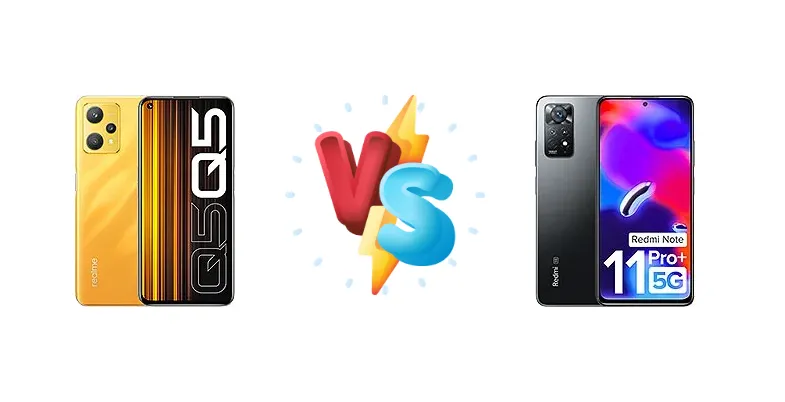
The Realme Q5 and Xiaomi Redmi Note 11 Pro+ 5G (India) occupy a fiercely competitive space: the affordable 5G smartphone market. Both devices are powered by the Qualcomm Snapdragon 695 5G, making a direct comparison of core performance less about raw power and more about optimization, features, and charging speeds. This analysis dives deep into the nuances separating these two contenders.
🏆 Quick Verdict
For the average user prioritizing rapid charging and broader compatibility, the Xiaomi Redmi Note 11 Pro+ 5G (India) is the better choice. Its 67W charging, completing a full charge in 42 minutes, offers a tangible advantage over the Realme Q5’s 65W, which takes 48 minutes. While performance is identical, the Redmi’s charging ecosystem is more versatile.
| Network |
|---|
| 2G bands | GSM 850 / 900 / 1800 / 1900 | GSM 850 / 900 / 1800 / 1900 |
| 3G bands | HSDPA 800 / 850 / 900 / 1700(AWS) / 1900 / 2100 | HSDPA 850 / 900 / 1900 / 2100 |
| 4G bands | 1, 3, 4, 5, 7, 8, 19, 28, 34, 38, 39, 40, 41 | 1, 3, 5, 8, 40, 41 |
| 5G bands | 1, 28, 41, 77, 78 SA/NSA | 1, 3, 5, 8, 28, 40, 78 SA/NSA |
| Speed | HSPA, LTE, 5G | HSPA, LTE, 5G |
| Technology | GSM / HSPA / LTE / 5G | GSM / HSPA / LTE / 5G |
| Launch |
|---|
| Announced | 2022, April 20 | 2022, March 09 |
| Status | Available. Released 2022, April 28 | Available. Released 2022, March 15 |
| Body |
|---|
| Build | - | Glass front (Gorilla Glass 5), glass back |
| Dimensions | 164.3 x 75.6 x 8.5 mm (6.47 x 2.98 x 0.33 in) | 164.2 x 76.1 x 8.1 mm (6.46 x 3.00 x 0.32 in) |
| SIM | Nano-SIM + Nano-SIM | Nano-SIM + Nano-SIM |
| Weight | 195 g (6.88 oz) | 202 g (7.13 oz) |
| Display |
|---|
| Protection | - | Corning Gorilla Glass 5 |
| Resolution | 1080 x 2412 pixels, 20:9 ratio (~400 ppi density) | 1080 x 2400 pixels, 20:9 ratio (~395 ppi density) |
| Size | 6.6 inches, 104.8 cm2 (~84.4% screen-to-body ratio) | 6.67 inches, 107.4 cm2 (~86.0% screen-to-body ratio) |
| Type | IPS LCD, 120Hz, 600 nits (peak) | Super AMOLED, 120Hz, 700 nits, 1200 nits (peak) |
| Platform |
|---|
| CPU | Octa-core (2x2.2 GHz Kryo 660 Gold & 6x1.7 GHz Kryo 660 Silver) | Octa-core (2x2.2 GHz Kryo 660 Gold & 6x1.7 GHz Kryo 660 Silver) |
| Chipset | Qualcomm SM6375 Snapdragon 695 5G (6 nm) | Qualcomm SM6375 Snapdragon 695 5G (6 nm) |
| GPU | Adreno 619 | Adreno 619 |
| OS | Android 12, Realme UI 3.0 | Android 11, MIUI 13 |
| Memory |
|---|
| Card slot | microSDXC (uses shared SIM slot) | microSDXC (uses shared SIM slot) |
| Internal | 128GB 6GB RAM, 128GB 8GB RAM, 256GB 8GB RAM | 64GB 6GB RAM, 128GB 6GB RAM, 128GB 8GB RAM, 256GB 8GB RAM |
| Main Camera |
|---|
| Features | LED flash, HDR, panorama | LED flash, HDR, panorama |
| Single | 16 MP, f/2.1, 26mm (wide), 1/3.09", 1.0µm | - |
| Triple | 50 MP, f/1.8, 27mm (wide), 1/1.56", 1.0µm, PDAF
2 MP (macro)
Auxiliary lens | 108 MP, f/1.9, 26mm (wide), 1/1.52", 0.7µm, PDAF
8 MP, f/2.2, 118˚ (ultrawide)
2 MP (macro) |
| Video | 1080p@30fps | 1080p@30fps |
| Selfie camera |
|---|
| Features | HDR, panorama | - |
| Single | 16 MP, f/2.1, 26mm (wide), 1/3.09", 1.0µm | 16 MP, f/2.5, (wide), 1/3.06" 1.0µm |
| Video | 1080p@30fps | 1080p@30fps |
| Sound |
|---|
| 3.5mm jack | Yes | - |
| 35mm jack | Yes | Yes |
| Loudspeaker | Yes | Yes, with stereo speakers |
| | 24-bit/192kHz audio | - |
| Comms |
|---|
| Bluetooth | 5.1, A2DP, LE, aptX HD | 5.1, A2DP, LE |
| Infrared port | - | Yes |
| NFC | No | No |
| Positioning | GPS, GLONASS, BDS | GPS, GLONASS, BDS, GALILEO |
| Radio | No | Unspecified |
| USB | USB Type-C 2.0, OTG | USB Type-C 2.0, OTG |
| WLAN | Wi-Fi 802.11 a/b/g/n/ac, dual-band | Wi-Fi 802.11 a/b/g/n/ac, dual-band, Wi-Fi Direct |
| Features |
|---|
| Sensors | Fingerprint (side-mounted), accelerometer, gyro, proximity, compass | Fingerprint (side-mounted), accelerometer, gyro, proximity, compass |
| Battery |
|---|
| Charging | 65W wired, 100% in 48 min | 67W wired, PD3.0, QC3, 50% in 15 min, 100% in 42 min |
| Type | 5000 mAh | Li-Po 5000 mAh |
| Misc |
|---|
| Colors | Black, Silver, Yellow | Mirage Blue, Phantom White, Stealth Black |
| Models | RMX3478 | 2201116SI |
| Price | About 200 EUR | About 250 EUR |
Realme Q5
- Potentially lower price point
- 65W fast charging
- Qualcomm Snapdragon 695 5G
- Slightly slower charging than Redmi
- Limited fast charging standard support
Xiaomi Redmi Note 11 Pro+ 5G (India)
- Faster 67W charging with PD3.0/QC3
- Broader fast charging compatibility
- Qualcomm Snapdragon 695 5G
- Potentially higher price
- MIUI software can be resource intensive
Display Comparison
Both devices are expected to feature LCD panels, typical for this price bracket. While specific display specs like resolution and refresh rate aren't provided, the focus here is on charging. The absence of LTPO technology means neither phone will offer adaptive refresh rates for power saving. Bezels are likely comparable, and color accuracy will depend on software calibration, a known strength for Xiaomi's MIUI.
Camera Comparison
Without detailed camera specifications, a direct comparison is limited. Both phones likely feature multi-camera setups, but the quality will hinge on sensor size and image processing. The Redmi Note series historically emphasizes camera capabilities, potentially offering more refined image processing algorithms. The presence of a 2MP macro camera on either device is largely a marketing feature with limited practical utility. The main sensor quality will be the deciding factor, but that information is unavailable.
Performance
The core of both phones is the Qualcomm SM6375 Snapdragon 695 5G (6 nm) chipset, featuring an octa-core CPU configuration with 2x2.2 GHz Kryo 660 Gold and 6x1.7 GHz Kryo 660 Silver cores. This means CPU performance will be virtually identical. The GPU performance will also be the same. RAM speed (likely LPDDR4X in both) isn't specified, but thermal management will be crucial. The 6nm process node offers reasonable efficiency, but sustained gaming will likely lead to some throttling, a common trait in this segment.
Battery Life
The battery capacity isn't specified for either device, but the charging speeds are a key differentiator. The Xiaomi Redmi Note 11 Pro+ 5G (India) boasts 67W wired charging with support for PD3.0 and QC3, achieving a 50% charge in 15 minutes and a full charge in 42 minutes. The Realme Q5 offers 65W charging, taking 48 minutes for a full charge. This 6-minute difference, coupled with the broader compatibility of the Redmi’s charging standards, gives it a clear advantage for users who frequently need to top up their battery quickly.
Buying Guide
Buy the Realme Q5 if you prioritize a potentially lower price point and are comfortable with a slightly slower charging experience. Buy the Xiaomi Redmi Note 11 Pro+ 5G (India) if you value faster charging speeds, support for PD3.0 and QC3 standards, and a more comprehensive fast-charging ecosystem. Both phones deliver similar performance for everyday tasks and moderate gaming.
Frequently Asked Questions
❓ Does the Snapdragon 695 in either phone struggle with demanding games like PUBG or Genshin Impact?
The Snapdragon 695 is a capable chipset for casual gaming, but demanding titles like PUBG or Genshin Impact will require reduced graphics settings and may still experience occasional frame drops. Thermal throttling will also become a factor during extended gaming sessions, impacting sustained performance on both devices.
❓ Is the 67W charging on the Redmi Note 11 Pro+ 5G (India) compatible with my existing USB-C Power Delivery chargers?
Yes, the Redmi Note 11 Pro+ 5G (India) supports USB Power Delivery (PD) 3.0, meaning it will work with most modern USB-C PD chargers. This provides flexibility and allows you to use chargers you may already own.
❓ How does the software experience differ between Realme UI and Xiaomi's MIUI?
Realme UI is generally considered closer to stock Android, offering a cleaner and more streamlined experience. MIUI, on the other hand, is heavily customized with numerous features and pre-installed apps. Some users prefer MIUI's extensive customization options, while others find it bloated and less efficient.