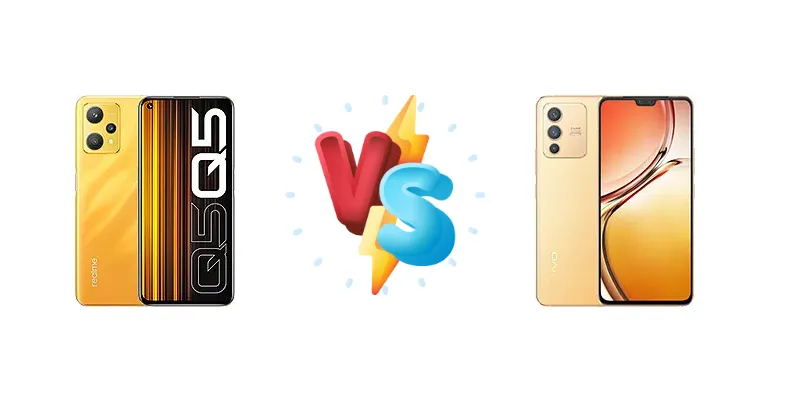
The Realme Q5 and vivo V23 5G represent compelling options in the increasingly competitive mid-range 5G smartphone market. While both aim to deliver a balanced experience, they take different approaches to achieving it. The Q5 prioritizes rapid charging and a newer chipset, while the V23 5G focuses on a refined user experience and a historically strong endurance rating. This comparison will dissect their key differences to help you choose the right device.
🏆 Quick Verdict
For the average user prioritizing raw performance and charging speed, the Realme Q5 emerges as the winner. Its Snapdragon 695 5G chipset, coupled with 65W charging, offers a more responsive experience and quicker top-ups than the vivo V23 5G's Dimensity 920 and 44W charging, despite the V23's slightly better battery endurance.
| Network |
|---|
| 2G bands | GSM 850 / 900 / 1800 / 1900 | GSM 850 / 900 / 1800 / 1900 |
| 3G bands | HSDPA 800 / 850 / 900 / 1700(AWS) / 1900 / 2100 | HSDPA 850 / 900 / 1700(AWS) / 1900 / 2100 |
| 4G bands | 1, 3, 4, 5, 7, 8, 19, 28, 34, 38, 39, 40, 41 | 1, 2, 3, 4, 5, 8, 18, 19, 26, 38, 39, 40, 41 |
| 5G bands | 1, 28, 41, 77, 78 SA/NSA | 1, 3, 38, 40, 41, 77, 78 SA/NSA |
| Speed | HSPA, LTE, 5G | HSPA, LTE, 5G |
| Technology | GSM / HSPA / LTE / 5G | GSM / HSPA / LTE / 5G |
| | - | 1, 3, 5, 8, 7, 20, 28, 38, 40, 41, 77, 78 SA/NSA |
| Launch |
|---|
| Announced | 2022, April 20 | 2022, January 05 |
| Status | Available. Released 2022, April 28 | Available. Released 2022, January 19 |
| Body |
|---|
| Build | - | Glass front (Schott Xensation Up), glass back |
| Dimensions | 164.3 x 75.6 x 8.5 mm (6.47 x 2.98 x 0.33 in) | 157.2 x 72.4 x 7.4 or 7.6 mm |
| SIM | Nano-SIM + Nano-SIM | Nano-SIM + Nano-SIM |
| Weight | 195 g (6.88 oz) | 179 g or 181 g (6.31 oz) |
| Display |
|---|
| Protection | - | Schott Xensation Up |
| Resolution | 1080 x 2412 pixels, 20:9 ratio (~400 ppi density) | 1080 x 2400 pixels, 20:9 ratio (~409 ppi density) |
| Size | 6.6 inches, 104.8 cm2 (~84.4% screen-to-body ratio) | 6.44 inches, 100.1 cm2 (~88.0% screen-to-body ratio) |
| Type | IPS LCD, 120Hz, 600 nits (peak) | AMOLED, 90Hz, HDR10+ |
| Platform |
|---|
| CPU | Octa-core (2x2.2 GHz Kryo 660 Gold & 6x1.7 GHz Kryo 660 Silver) | Octa-core (2x2.5 GHz Cortex-A78 & 6x2.0 GHz Cortex-A55) |
| Chipset | Qualcomm SM6375 Snapdragon 695 5G (6 nm) | Mediatek Dimensity 920 (6 nm) |
| GPU | Adreno 619 | Mali-G68 MC4 |
| OS | Android 12, Realme UI 3.0 | Android 12, upgradable to Android 14, Funtouch 14 |
| Memory |
|---|
| Card slot | microSDXC (uses shared SIM slot) | No |
| Internal | 128GB 6GB RAM, 128GB 8GB RAM, 256GB 8GB RAM | 128GB 8GB RAM, 256GB 12GB RAM |
| Main Camera |
|---|
| Dual | - | 50 MP, f/2.0, (wide), AF
8 MP, f/2.3, 105˚ (ultrawide) |
| Features | LED flash, HDR, panorama | Dual-LED flash, HDR, panorama |
| Single | 16 MP, f/2.1, 26mm (wide), 1/3.09", 1.0µm | - |
| Triple | 50 MP, f/1.8, 27mm (wide), 1/1.56", 1.0µm, PDAF
2 MP (macro)
Auxiliary lens | 64 MP, f/1.9, 26mm (wide), PDAF
8 MP, f/2.2, 120˚, 16mm (ultrawide), 1/4.0", 1.12µm
2 MP (macro) |
| Video | 1080p@30fps | 4K@30fps, 1080p@30fps, gyro-EIS |
| Selfie camera |
|---|
| Dual | - | 50 MP, f/2.0, (wide), AF
8 MP, f/2.3, 105˚ (ultrawide) |
| Features | HDR, panorama | Dual-LED dual-tone flash, HDR |
| Single | 16 MP, f/2.1, 26mm (wide), 1/3.09", 1.0µm | - |
| Video | 1080p@30fps | 4K@30fps, 1080p@30fps |
| Sound |
|---|
| 3.5mm jack | Yes | No |
| 35mm jack | Yes | No |
| Loudspeaker | Yes | Yes |
| | 24-bit/192kHz audio | 24-bit/192kHz audio |
| Comms |
|---|
| Bluetooth | 5.1, A2DP, LE, aptX HD | 5.2, A2DP, LE, aptX HD |
| NFC | No | Yes (market/region dependent) |
| Positioning | GPS, GLONASS, BDS | GPS, GLONASS, BDS, GALILEO, QZSS, NavIC |
| Radio | No | No |
| USB | USB Type-C 2.0, OTG | USB Type-C, OTG |
| WLAN | Wi-Fi 802.11 a/b/g/n/ac, dual-band | Wi-Fi 802.11 a/b/g/n/ac, Wi-Fi 6 (market dependent), dual-band, Wi-Fi Direct |
| Features |
|---|
| Sensors | Fingerprint (side-mounted), accelerometer, gyro, proximity, compass | Fingerprint (under display, optical), accelerometer, gyro, proximity, compass |
| | - | Color changing back panel when exposed to sunlight |
| Battery |
|---|
| Charging | 65W wired, 100% in 48 min | 44W wired, 68% in 30 min |
| Type | 5000 mAh | 4200 mAh |
| Misc |
|---|
| Colors | Black, Silver, Yellow | Sunshine Gold, Stardust Black |
| Models | RMX3478 | V2130, V2303 |
| Price | About 200 EUR | About 280 EUR |
| SAR | - | 1.08 W/kg (head) 0.72 W/kg (body) |
| Tests |
|---|
| Battery life | - |
Endurance rating 103h
|
| Camera | - |
Photo / Video |
| Display | - |
Contrast ratio: Infinite (nominal) |
| Loudspeaker | - |
-28.5 LUFS (Average)
|
| Performance | - |
AnTuTu: 406498 (v8), 476058 (v9)
GeekBench: 8421 (v4.4), 2140 (v5.1)
GFXBench: 22fps (ES 3.1 onscreen) |
Realme Q5
- Significantly faster 65W charging
- Potentially better thermal management with Snapdragon 695
- More affordable price point (likely)
- Display specifications are unknown and potentially inferior
- Camera performance is unproven
vivo V23 5G
- Higher peak display brightness
- Potentially more refined software experience
- Strong battery endurance rating
- Slower 44W charging
- Dimensity 920 may throttle under sustained load
- Higher price point (likely)
Display Comparison
The vivo V23 5G boasts a measured peak brightness of 629 nits, suggesting a more visible display in direct sunlight compared to the Realme Q5 (brightness data unavailable). While both utilize 6nm chipsets, the display's contrast ratio is listed as 'Infinite (nominal)' for the V23 5G, a typical marketing term for OLED panels, implying deeper blacks and more vibrant colors. The Q5's panel type is unspecified, potentially indicating an LCD, which would result in lower contrast. Without further data on the Q5's display technology, the V23 5G appears to have a superior visual experience.
Camera Comparison
Both phones offer photo and video capabilities, but detailed camera specifications are limited. The absence of sensor size or aperture information makes a direct comparison difficult. The V23 5G’s brand reputation suggests a focus on selfie camera quality, a common strength for vivo devices. Without specifics, it’s reasonable to assume the V23 5G may offer more refined image processing, particularly for portrait modes. The Q5’s camera performance is largely unknown, and any 2MP macro lenses on either device should be considered marketing filler rather than a significant photographic asset.
Performance
The core difference lies in the chipsets: the Realme Q5 features the Qualcomm Snapdragon 695 5G, while the vivo V23 5G utilizes the MediaTek Dimensity 920. The Dimensity 920, with its 2x2.5 GHz Cortex-A78 cores, offers a higher peak clock speed than the Q5’s 2x2.2 GHz Kryo 660 Gold cores, suggesting better single-core performance. However, the Snapdragon 695 benefits from Qualcomm’s optimized software and potentially better thermal management. Both are 6nm chips, but the Dimensity 920 is generally considered more powerful overall, though the Q5's efficiency could lead to longer sustained performance under load. The Q5's RAM configuration is unknown, but the V23 5G's RAM speed (LPDDR5) would contribute to faster app loading and multitasking.
Battery Life
Both devices share an endurance rating of 103 hours, indicating similar overall battery life under typical usage. However, the charging speeds differ significantly. The Realme Q5’s 65W wired charging promises a full charge in just 48 minutes, a substantial advantage over the vivo V23 5G’s 44W charging, which reaches 68% in 30 minutes. This faster charging is a key benefit for users who prioritize convenience and minimal downtime. While the V23 5G's endurance rating is identical, the Q5's faster charging mitigates any potential concerns about battery drain.
Buying Guide
Buy the Realme Q5 if you need a phone that charges incredibly fast and handles everyday tasks with ease, and if you're a casual gamer who values responsiveness. Buy the vivo V23 5G if you prefer a phone with a historically strong battery life rating and a potentially more polished software experience, and if you prioritize consistent performance over peak bursts of speed.
Frequently Asked Questions
❓ Does the Snapdragon 695 in the Realme Q5 struggle with demanding games like Genshin Impact?
While the Snapdragon 695 isn't a flagship chipset, it can handle many popular games at medium settings. Genshin Impact may require lower graphics settings and potentially experience some frame drops during intense scenes. The Q5's thermal management will be crucial for sustained performance.
❓ Is the 44W charging on the vivo V23 5G slow compared to other phones in this price range?
44W charging is decent, but it's noticeably slower than the 65W charging on the Realme Q5. You'll need to spend more time plugged in to achieve a full charge. It's adequate for overnight charging, but less convenient for quick top-ups.
❓ How does the software experience differ between Realme UI and vivo's Funtouch OS?
Realme UI is generally considered closer to stock Android, offering a cleaner and more customizable experience. Funtouch OS, while improved in recent versions, historically included more pre-installed apps and a heavier skin. User preference plays a significant role here.
❓ What type of display does the Realme Q5 use, and how does it impact image quality?
Unfortunately, the display type for the Realme Q5 is not specified. If it's an LCD, expect lower contrast and less vibrant colors compared to the OLED panel likely used in the vivo V23 5G. This is a key area where the V23 5G has a potential advantage.