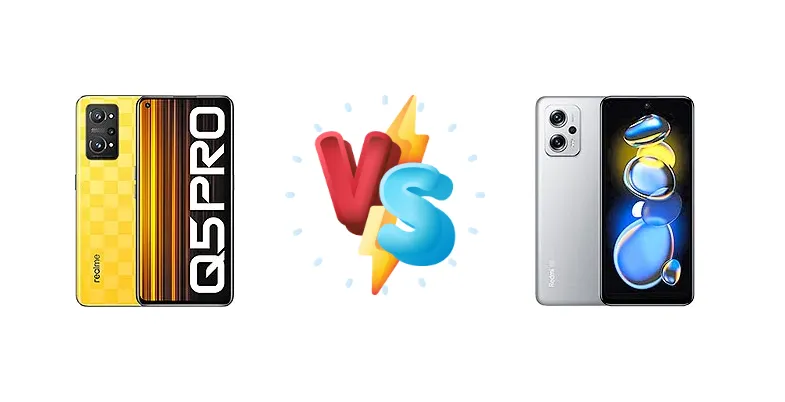
The mid-range smartphone market is fiercely competitive, and two contenders vying for your attention are the Realme Q5 Pro and the Xiaomi Redmi Note 11T Pro+. Both offer impressive features, but cater to slightly different needs. Let's dive into a comprehensive comparison to help you decide which one is right for you.
🏆 Quick Verdict
The Redmi Note 11T Pro+ takes the crown with its blazing-fast 120W charging and the powerful Dimensity 8100 chipset. While the Q5 Pro boasts a Snapdragon 870, the Redmi's charging speed and overall performance edge make it the better choice for most users.
| Network |
|---|
| 2G bands | GSM 850 / 900 / 1800 / 1900 | GSM 850 / 900 / 1800 / 1900 - SIM 1 & SIM 2 |
| 3G bands | HSDPA 800 / 850 / 900 / 1700(AWS) / 1900 / 2100 | HSDPA 800 / 850 / 900 / 2100 |
| 4G bands | 1, 2, 3, 4, 5, 7, 8, 18, 19, 26, 28, 34, 38, 39, 40, 41 | 1, 3, 5, 8, 19, 34, 38, 39, 40, 41, 42 |
| 5G bands | 1, 3, 5, 8, 28, 41, 77, 78 SA/NSA | 1, 3, 5, 8, 28, 38, 41, 77, 78 SA/NSA |
| Speed | HSPA, LTE, 5G | HSPA, LTE-A (CA), 5G |
| Technology | GSM / CDMA / HSPA / CDMA2000 / LTE / 5G | GSM / CDMA / HSPA / EVDO / LTE / 5G |
| | CDMA2000 1x | CDMA2000 1xEV-DO |
| Launch |
|---|
| Announced | 2022, April 20 | 2022, May 24 |
| Status | Available. Released 2022, April 28 | Available. Released 2022, May 31 |
| Body |
|---|
| Dimensions | 162.9 x 75.8 x 8.7 mm (6.41 x 2.98 x 0.34 in) | 163.6 x 74.3 x 8.9 mm (6.44 x 2.93 x 0.35 in) |
| SIM | Nano-SIM + Nano-SIM | Dual SIM (Nano-SIM, dual stand-by) |
| Weight | 194.5 g (6.88 oz) | 198 g (6.98 oz) |
| | - | IP53, dust and splash resistant |
| Display |
|---|
| Resolution | 1080 x 2400 pixels, 20:9 ratio (~398 ppi density) | 1080 x 2460 pixels (~407 ppi density) |
| Size | 6.62 inches, 105.8 cm2 (~85.7% screen-to-body ratio) | 6.6 inches, 103.4 cm2 (~85.1% screen-to-body ratio) |
| Type | AMOLED, 120Hz, HDR10+, 1300 nits (peak) | IPS LCD, 144Hz, HDR10, Dolby Vision, 650 nits (typ) |
| Platform |
|---|
| CPU | Octa-core (1x3.2 GHz Kryo 585 & 3x2.42 GHz Kryo 585 & 4x1.80 GHz Kryo 585) | Octa-core (4x2.85 GHz Cortex-A78 & 4x2.0 GHz Cortex-A55) |
| Chipset | Qualcomm SM8250-AC Snapdragon 870 5G (7 nm) | Mediatek Dimensity 8100 (5 nm) |
| GPU | Adreno 650 | Mali-G610 MC6 |
| OS | Android 12, Realme UI 3.0 | Android 12, MIUI 13 |
| Memory |
|---|
| Card slot | No | No |
| Internal | 128GB 6GB RAM, 128GB 8GB RAM, 256GB 8GB RAM | 128GB 8GB RAM, 256GB 8GB RAM, 512GB 8GB RAM |
| | UFS 3.1 | UFS 3.1 |
| Main Camera |
|---|
| Features | LED flash, HDR, panorama | LED flash, HDR, panorama |
| Single | 16 MP, f/2.5, 26mm (wide), 1/3.09", 1.0µm | 16 MP, (wide) |
| Triple | 64 MP, f/1.8, 25mm (wide), 1/1.73", 0.8µm, PDAF
8 MP, f/2.3, 16mm, 119˚ (ultrawide), 1/4.0", 1.12µm
2 MP (macro) | 64 MP, (wide), 1/1.72", 0.8µm, PDAF
8 MP, 120˚, (ultrawide)
2 MP, (macro) |
| Video | 4K@30/60fps, 1080p@30fps, gyro-EIS | 4K@30fps, 1080p@30/60/120fps, 720p@960fps |
| Selfie camera |
|---|
| Features | HDR, panorama | - |
| Single | 16 MP, f/2.5, 26mm (wide), 1/3.09", 1.0µm | 16 MP, (wide) |
| Video | 1080p@30fps, gyro-EIS | 1080p@30/60fps |
| Sound |
|---|
| 3.5mm jack | No | Yes |
| 35mm jack | No | - |
| Loudspeaker | Yes, with stereo speakers | Yes, with stereo speakers |
| | 24-bit/192kHz audio | 24-bit/192kHz audio |
| Comms |
|---|
| Bluetooth | 5.2, A2DP, LE, aptX HD | 5.3, A2DP, LE |
| Infrared port | - | Yes |
| NFC | No | Yes |
| Positioning | GPS (L1+L5), GLONASS, BDS, GALILEO, QZSS, NavIC | GPS (L1), GLONASS (G1), BDS (B1I+B1c), GALILEO (E1), QZSS (L1) |
| Radio | No | No |
| USB | USB Type-C 2.0 | USB Type-C 2.0, OTG |
| WLAN | Wi-Fi 802.11 a/b/g/n/ac/6, dual-band, Wi-Fi Direct | Wi-Fi 802.11 a/b/g/n/ac/6, dual-band, Wi-Fi Direct |
| Features |
|---|
| Sensors | Fingerprint (under display, optical), accelerometer, gyro, proximity, compass | Fingerprint (side-mounted), accelerometer, proximity, gyro, compass, color spectrum |
| Battery |
|---|
| Charging | 80W wired | 120W wired, PD3.0, 50% in 10 min, 100% in 19 min (advertised) |
| Type | 5000 mAh | Li-Po 4400 mAh, non-removable |
| Misc |
|---|
| Colors | Black, White, Yellow | Blue, Silver, Black |
| Models | RMX3372 | 22041216UC |
| Price | About 330 EUR | About 300 EUR |
Realme Q5 Pro
- Proven Snapdragon 870 chipset
- Good value for money
- Solid build quality
- Decent camera performance
- Slower charging compared to the competition
- Performance slightly behind the Redmi Note 11T Pro+
Xiaomi Redmi Note 11T Pro+
- Blazing-fast 120W charging
- Powerful Dimensity 8100 chipset
- High refresh rate display
- Excellent value
- Software experience can be polarizing
- Camera processing might not appeal to everyone
Display Comparison
Both phones feature vibrant AMOLED displays, but the Redmi Note 11T Pro+ often has a slightly higher refresh rate (144Hz vs 120Hz on the Q5 Pro), resulting in smoother scrolling and animations. Screen size and resolution are generally comparable, offering excellent viewing experiences.
Camera Comparison
The Redmi Note 11T Pro+ typically features a higher resolution main camera (108MP vs 64MP on the Q5 Pro), potentially capturing more detail. Image processing and overall camera quality are competitive, with both phones capable of producing good photos in various lighting conditions. Video recording capabilities are also comparable.
Performance
The Dimensity 8100 in the Redmi Note 11T Pro+ generally outperforms the Snapdragon 870 in the Q5 Pro in benchmarks and real-world usage, particularly in graphics-intensive tasks. Both offer smooth multitasking and handle demanding apps with ease, but the Redmi has a slight edge.
Battery Life
The Redmi Note 11T Pro+'s 120W charging is a game-changer, allowing for incredibly fast top-ups. The Q5 Pro's 80W charging is still fast, but significantly slower. Battery capacity is similar, so charging speed is the key differentiator here.
Buying Guide
The Realme Q5 Pro is ideal for users prioritizing a proven chipset and a slightly more balanced experience. The Xiaomi Redmi Note 11T Pro+ is perfect for those who demand incredibly fast charging and top-tier performance in a mid-range package.
Frequently Asked Questions
❓ Is the Snapdragon 870 still a good chipset?
Yes, the Snapdragon 870 is still a very capable chipset, offering excellent performance for most users. However, the Dimensity 8100 generally provides a slight performance boost.
❓ Which phone has better battery life?
Both phones have similar battery capacities, but the Redmi Note 11T Pro+'s significantly faster charging means it will spend less time plugged in.