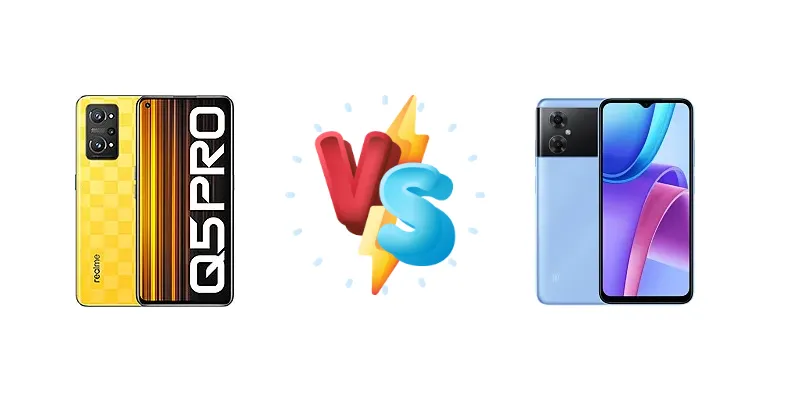
The mid-range smartphone market is fiercely competitive, offering incredible value for your money. Today, we're pitting two contenders against each other: the Realme Q5 Pro and the Xiaomi Redmi Note 11R. Both promise a lot, but which one delivers the best overall experience?
🏆 Quick Verdict
The Realme Q5 Pro is the clear winner thanks to its significantly more powerful Snapdragon 870 chipset and blazing-fast 80W charging. While the Redmi Note 11R offers a more budget-friendly price, the Q5 Pro's performance advantage makes it the better choice for most users.
| Network |
|---|
| 2G bands | GSM 850 / 900 / 1800 / 1900 | GSM 850 / 900 / 1800 / 1900 |
| 3G bands | HSDPA 800 / 850 / 900 / 1700(AWS) / 1900 / 2100 | HSDPA 850 / 900 / 1900 / 2100 |
| 4G bands | 1, 2, 3, 4, 5, 7, 8, 18, 19, 26, 28, 34, 38, 39, 40, 41 | 1, 3, 5, 7, 8, 34, 38, 39, 40, 41 |
| 5G bands | 1, 3, 5, 8, 28, 41, 77, 78 SA/NSA | 1, 5, 8, 28, 41, 78 |
| Speed | HSPA, LTE, 5G | HSPA, LTE, 5G |
| Technology | GSM / CDMA / HSPA / CDMA2000 / LTE / 5G | GSM / CDMA / HSPA / LTE / 5G |
| | CDMA2000 1x | CDMA 800 |
| Launch |
|---|
| Announced | 2022, April 20 | 2022, September 30 |
| Status | Available. Released 2022, April 28 | Available. Released 2022, September 30 |
| Body |
|---|
| Build | - | Glass front, plastic frame, plastic back |
| Dimensions | 162.9 x 75.8 x 8.7 mm (6.41 x 2.98 x 0.34 in) | 164 x 76.1 x 8.9 mm (6.46 x 3.00 x 0.35 in) |
| SIM | Nano-SIM + Nano-SIM | Nano-SIM + Nano-SIM |
| Weight | 194.5 g (6.88 oz) | 201 g (7.09 oz) |
| Display |
|---|
| Resolution | 1080 x 2400 pixels, 20:9 ratio (~398 ppi density) | 1080 x 2408 pixels, 20:9 ratio (~401 ppi density) |
| Size | 6.62 inches, 105.8 cm2 (~85.7% screen-to-body ratio) | 6.58 inches, 104.3 cm2 (~83.6% screen-to-body ratio) |
| Type | AMOLED, 120Hz, HDR10+, 1300 nits (peak) | IPS LCD, 90Hz, 400 nits (typ) |
| Platform |
|---|
| CPU | Octa-core (1x3.2 GHz Kryo 585 & 3x2.42 GHz Kryo 585 & 4x1.80 GHz Kryo 585) | Octa-core (2x2.2 GHz Cortex-A76 & 6x2.0 GHz Cortex-A55) |
| Chipset | Qualcomm SM8250-AC Snapdragon 870 5G (7 nm) | Mediatek Dimensity 700 (7 nm) |
| GPU | Adreno 650 | Mali-G57 MC2 |
| OS | Android 12, Realme UI 3.0 | Android 12, MIUI 13 |
| Memory |
|---|
| Card slot | No | microSDXC (dedicated slot) |
| Internal | 128GB 6GB RAM, 128GB 8GB RAM, 256GB 8GB RAM | 128GB 4GB RAM, 128GB 6GB RAM, 128GB 8GB RAM |
| | UFS 3.1 | UFS 2.2 |
| Main Camera |
|---|
| Dual | - | 13 MP, f/2.2, (wide), PDAF
Auxiliary lens |
| Features | LED flash, HDR, panorama | LED flash, HDR, panorama |
| Single | 16 MP, f/2.5, 26mm (wide), 1/3.09", 1.0µm | - |
| Triple | 64 MP, f/1.8, 25mm (wide), 1/1.73", 0.8µm, PDAF
8 MP, f/2.3, 16mm, 119˚ (ultrawide), 1/4.0", 1.12µm
2 MP (macro) | - |
| Video | 4K@30/60fps, 1080p@30fps, gyro-EIS | 1080p@30fps |
| Selfie camera |
|---|
| Features | HDR, panorama | HDR |
| Single | 16 MP, f/2.5, 26mm (wide), 1/3.09", 1.0µm | 5 MP, f/2.2, (wide) |
| Video | 1080p@30fps, gyro-EIS | 1080p@30fps |
| Sound |
|---|
| 3.5mm jack | No | Yes |
| 35mm jack | No | Yes |
| Loudspeaker | Yes, with stereo speakers | Yes |
| | 24-bit/192kHz audio | 24-bit/192kHz audio |
| Comms |
|---|
| Bluetooth | 5.2, A2DP, LE, aptX HD | 5.1, A2DP, LE |
| Infrared port | - | Yes |
| NFC | No | No |
| Positioning | GPS (L1+L5), GLONASS, BDS, GALILEO, QZSS, NavIC | GPS, GLONASS, GALILEO, BDS |
| Radio | No | No |
| USB | USB Type-C 2.0 | USB Type-C 2.0, OTG |
| WLAN | Wi-Fi 802.11 a/b/g/n/ac/6, dual-band, Wi-Fi Direct | Wi-Fi 802.11 a/b/g/n/ac, dual-band, Wi-Fi Direct |
| Features |
|---|
| Sensors | Fingerprint (under display, optical), accelerometer, gyro, proximity, compass | Fingerprint (side-mounted), accelerometer, proximity, compass |
| Battery |
|---|
| Charging | 80W wired | 18W wired |
| Type | 5000 mAh | Li-Po 5000 mAh |
| Misc |
|---|
| Colors | Black, White, Yellow | Black, Blue, Gray |
| Models | RMX3372 | 22095RA98C |
| Price | About 330 EUR | About 160 EUR |
Realme Q5 Pro
- Significantly faster performance (Snapdragon 870)
- Blazing-fast 80W charging
- Higher refresh rate display (120Hz)
- Likely better camera processing
- Potentially higher price
- May have slightly less RAM/storage options than some Redmi models
Xiaomi Redmi Note 11R
- More affordable
- Decent battery life
- Good for everyday tasks
- Slower performance (Dimensity 700)
- Slow 18W charging
- Less smooth display (90Hz)
- Inferior camera performance compared to Q5 Pro
Display Comparison
The Redmi Note 11R likely features a standard 6.43-inch FHD+ AMOLED display with a 90Hz refresh rate. The Realme Q5 Pro is expected to have a 6.62-inch FHD+ AMOLED display with a 120Hz refresh rate. The Realme's higher refresh rate will provide a smoother visual experience, especially when scrolling and gaming. Both offer vibrant colors and good viewing angles.
Camera Comparison
The Redmi Note 11R is expected to have a 50MP main camera, an 8MP ultrawide, and a 2MP macro lens. The Realme Q5 Pro is expected to have a 64MP main camera, an 8MP ultrawide, and a 2MP macro lens. While the megapixel count is similar, the Snapdragon 870's image signal processor (ISP) will likely result in better image processing and overall photo quality on the Q5 Pro. Both phones will likely offer decent selfie cameras.
Performance
This is where the Realme Q5 Pro truly shines. The Snapdragon 870 is a flagship-level chipset that offers significantly better performance than the Redmi Note 11R's Dimensity 700. Expect smoother multitasking, faster app loading times, and a much better gaming experience on the Q5 Pro. The Dimensity 700 is adequate for everyday tasks, but struggles with demanding games.
Battery Life
The Redmi Note 11R likely has a 5000mAh battery, while the Realme Q5 Pro is expected to have a similar capacity. However, the Realme Q5 Pro's 80W fast charging is a game-changer, allowing it to charge from 0% to 100% in around 30-40 minutes. The Redmi Note 11R's 18W charging is considerably slower.
Buying Guide
The Realme Q5 Pro is ideal for gamers, power users, and anyone who values smooth performance and fast charging. The Xiaomi Redmi Note 11R is a good option for budget-conscious users who prioritize affordability and a decent all-around experience, but are less concerned about raw power.
Frequently Asked Questions
❓ Is the Snapdragon 870 chipset still good in 2024?
Yes, the Snapdragon 870 is still a very capable chipset, offering excellent performance for everyday tasks and gaming. It's a flagship-level chip from a couple of years ago, and still outperforms many mid-range processors.
❓ How much faster is 80W charging compared to 18W?
80W charging is significantly faster. It can fully charge the phone in around 30-40 minutes, while 18W charging will take over 2 hours.