
Realme Q5 Pro vs Xiaomi Redmi K40: A Snapdragon 870 Showdown
| Phones Images | |||||
|---|---|---|---|---|---|
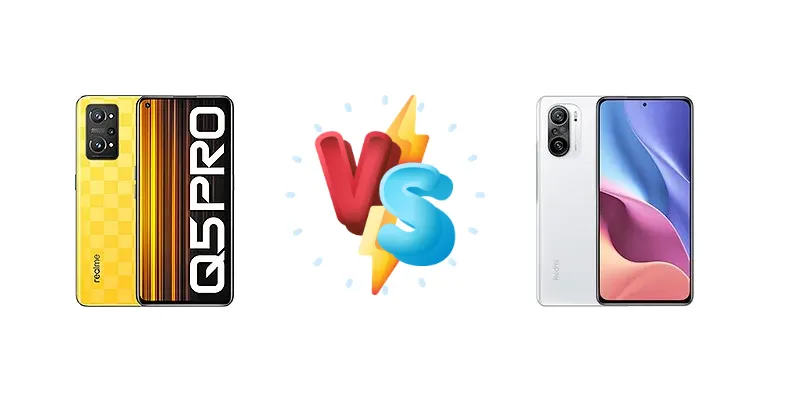
|
🏆 Quick Verdict
The Redmi K40 edges out the Q5 Pro thanks to its faster charging and potentially better display technology (AMOLED vs. likely LCD on the Q5 Pro). Both offer excellent performance thanks to the Snapdragon 870, but the K40's overall refinement gives it a slight advantage.
| PHONES | ||
|---|---|---|
| Phone Names | Realme Q5 Pro | Xiaomi Redmi K40 |
| Network | ||
|---|---|---|
| 2G bands | GSM 850 / 900 / 1800 / 1900 | GSM 850 / 900 / 1800 / 1900 |
| 3G bands | HSDPA 800 / 850 / 900 / 1700(AWS) / 1900 / 2100 | HSDPA 850 / 900 / 1700(AWS) / 1900 / 2100 |
| 4G bands | 1, 2, 3, 4, 5, 7, 8, 18, 19, 26, 28, 34, 38, 39, 40, 41 | 1, 2, 3, 4, 5, 7, 8, 18, 19, 26, 28, 34, 38, 39, 40, 41, 42 |
| 5G bands | 1, 3, 5, 8, 28, 41, 77, 78 SA/NSA | 1, 3, 28, 41, 77, 78 SA/NSA/Sub6 |
| Speed | HSPA, LTE, 5G | HSPA, LTE, 5G |
| Technology | GSM / CDMA / HSPA / CDMA2000 / LTE / 5G | GSM / CDMA / HSPA / CDMA2000 / LTE / 5G |
| CDMA2000 1x | CDMA2000 1x | |
| Launch | ||
|---|---|---|
| Announced | 2022, April 20 | 2021, February 25 |
| Status | Available. Released 2022, April 28 | Available. Released 2021, March 04 |
| Body | ||
|---|---|---|
| Dimensions | 162.9 x 75.8 x 8.7 mm (6.41 x 2.98 x 0.34 in) | 163.7 x 76.4 x 7.8 mm (6.44 x 3.01 x 0.31 in) |
| SIM | Nano-SIM + Nano-SIM | Nano-SIM + Nano-SIM |
| Weight | 194.5 g (6.88 oz) | 196 g (6.91 oz) |
| Display | ||
|---|---|---|
| Protection | - | Corning Gorilla Glass 5 |
| Resolution | 1080 x 2400 pixels, 20:9 ratio (~398 ppi density) | 1080 x 2400 pixels, 20:9 ratio (~395 ppi density) |
| Size | 6.62 inches, 105.8 cm2 (~85.7% screen-to-body ratio) | 6.67 inches, 107.4 cm2 (~85.9% screen-to-body ratio) |
| Type | AMOLED, 120Hz, HDR10+, 1300 nits (peak) | Super AMOLED, 120Hz, HDR10+, 1300 nits (peak) |
| Platform | ||
|---|---|---|
| CPU | Octa-core (1x3.2 GHz Kryo 585 & 3x2.42 GHz Kryo 585 & 4x1.80 GHz Kryo 585) | Octa-core (1x3.2 GHz Kryo 585 & 3x2.42 GHz Kryo 585 & 4x1.80 GHz Kryo 585) |
| Chipset | Qualcomm SM8250-AC Snapdragon 870 5G (7 nm) | Qualcomm SM8250-AC Snapdragon 870 5G (7 nm) |
| GPU | Adreno 650 | Adreno 650 |
| OS | Android 12, Realme UI 3.0 | Android 11, MIUI 12 |
| Memory | ||
|---|---|---|
| Card slot | No | No |
| Internal | 128GB 6GB RAM, 128GB 8GB RAM, 256GB 8GB RAM | 128GB 6GB RAM, 128GB 8GB RAM, 256GB 8GB RAM, 256GB 12GB RAM |
| UFS 3.1 | UFS 3.1 | |
| Main Camera | ||
|---|---|---|
| Features | LED flash, HDR, panorama | Color spectrum sensor, LED flash, HDR, panorama |
| Single | 16 MP, f/2.5, 26mm (wide), 1/3.09", 1.0µm | 20 MP, f/2.5, (wide), 1/3.4", 0.8µm |
| Triple | 64 MP, f/1.8, 25mm (wide), 1/1.73", 0.8µm, PDAF 8 MP, f/2.3, 16mm, 119˚ (ultrawide), 1/4.0", 1.12µm 2 MP (macro) | 48 MP, f/1.8, 26mm (wide), 1/2.0", 0.8µm, PDAF 8 MP, f/2.2, 119˚ (ultrawide) 5 MP, f/2.4, 50mm (macro) |
| Video | 4K@30/60fps, 1080p@30fps, gyro-EIS | 4K@30fps, 1080p@30/60/120/240/960fps, gyro-EIS |
| Selfie camera | ||
|---|---|---|
| Features | HDR, panorama | HDR |
| Single | 16 MP, f/2.5, 26mm (wide), 1/3.09", 1.0µm | 20 MP, f/2.5, (wide), 1/3.4", 0.8µm |
| Video | 1080p@30fps, gyro-EIS | 1080p@30fps, 720p@120fps |
| Sound | ||
|---|---|---|
| 3.5mm jack | No | No |
| 35mm jack | No | No |
| Loudspeaker | Yes, with stereo speakers | Yes, with stereo speakers |
| 24-bit/192kHz audio | 24-bit/192kHz audio | |
| Comms | ||
|---|---|---|
| Bluetooth | 5.2, A2DP, LE, aptX HD | 5.1, A2DP, LE |
| Infrared port | - | Yes |
| NFC | No | Yes |
| Positioning | GPS (L1+L5), GLONASS, BDS, GALILEO, QZSS, NavIC | GPS (L1+L5), GLONASS (G1), BDS (B1I+B2a), GALILEO (E1+E5a), QZSS (L1+L5), NavIC |
| Radio | No | No |
| USB | USB Type-C 2.0 | USB Type-C 2.0, OTG |
| WLAN | Wi-Fi 802.11 a/b/g/n/ac/6, dual-band, Wi-Fi Direct | Wi-Fi 802.11 a/b/g/n/ac/6, dual-band, Wi-Fi Direct |
| Features | ||
|---|---|---|
| Sensors | Fingerprint (under display, optical), accelerometer, gyro, proximity, compass | Fingerprint (side-mounted), accelerometer, gyro, proximity, compass |
| Battery | ||
|---|---|---|
| Charging | 80W wired | 33W wired, PD3.0, QC3, 100% in 52 min |
| Type | 5000 mAh | Li-Po 4520 mAh |
| Misc | ||
|---|---|---|
| Colors | Black, White, Yellow | Black, White, Aurora |
| Models | RMX3372 | M2012K11AC |
| Price | About 330 EUR | About 280 EUR |
Realme Q5 Pro
- Faster Charging (80W)
- Potentially more affordable
- Solid Performance (Snapdragon 870)
- Likely LCD display
- Slower charging overall (considering battery size)
- Camera potentially not as refined
Xiaomi Redmi K40
- AMOLED Display
- Faster Charging (33W with PD3.0, QC3)
- Potentially better camera system
- Refined Software Experience
- May be slightly more expensive
- Charging speed not as fast as Q5 Pro (but faster overall considering battery size)
Display Comparison
The Redmi K40 typically features an AMOLED display with a 120Hz refresh rate, offering vibrant colors and deep blacks. The Realme Q5 Pro likely uses an LCD panel, which while still good, won't match the AMOLED's visual quality. Both phones offer a 120Hz refresh rate for smooth scrolling and gaming.
Camera Comparison
The Redmi K40 generally boasts a versatile camera system, often including a high-resolution primary sensor, ultrawide lens, and macro lens. The Realme Q5 Pro's camera setup is likely competitive, but Xiaomi often has an edge in image processing and overall camera quality. Specific sensor details would need further investigation.
Performance
Both phones are powered by the Snapdragon 870, ensuring flagship-level performance. Expect smooth multitasking, responsive gaming, and effortless handling of demanding apps. Real-world performance differences will likely be minimal.
Battery Life
The Redmi K40's 33W charging is significantly faster than the Q5 Pro's 80W. While the Q5 Pro charges quicker, the Redmi K40's battery capacity might be slightly larger, potentially leading to longer overall battery life despite the slower charging speed.
Buying Guide
The Realme Q5 Pro is a good choice for those prioritizing raw performance and potentially a slightly more affordable price point. The Xiaomi Redmi K40 is ideal for users who value faster charging, a vibrant AMOLED display, and a more polished software experience.