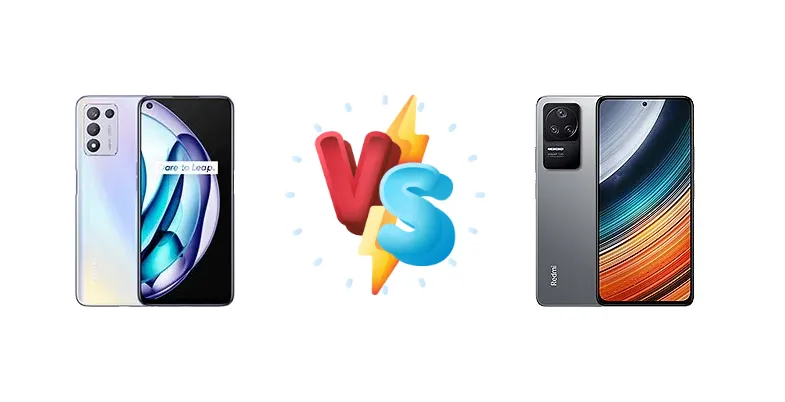
The Realme Q3t and Xiaomi Redmi K40S represent compelling options in the increasingly competitive mid-range smartphone market. Both devices aim to deliver a strong feature set without breaking the bank, but they take different approaches. The Q3t leverages the efficient Snapdragon 778G, while the K40S steps up to the more powerful Snapdragon 870. This comparison will dissect their key differences to determine which phone best suits your needs.
🏆 Quick Verdict
For the average user prioritizing balanced performance and value, the Xiaomi Redmi K40S emerges as the stronger contender. Its Snapdragon 870 chipset provides a noticeable performance uplift, especially in demanding tasks, and the 67W charging significantly reduces downtime. While the Q3t offers respectable performance, the K40S delivers a more future-proof experience.
| Network |
|---|
| 2G bands | GSM 850 / 900 / 1800 / 1900 | GSM 850 / 900 / 1800 / 1900 |
| 3G bands | HSDPA 850 / 900 / 1700(AWS) / 1900 / 2100 | HSDPA 850 / 900 / 1700(AWS) / 1900 / 2100 |
| 4G bands | LTE | 1, 2, 3, 4, 5, 8, 18, 19, 26, 34, 38, 39, 40, 41, 42 |
| 5G bands | SA/NSA | 1, 3, 5, 8, 28, 38, 40, 41, 77, 78 SA/NSA |
| Speed | HSPA, LTE, 5G | HSPA, LTE, 5G |
| Technology | GSM / CDMA / HSPA / EVDO / LTE / 5G | GSM / CDMA / HSPA / CDMA2000 / LTE / 5G |
| | CDMA2000 1xEV-DO | CDMA2000 1x |
| Launch |
|---|
| Announced | 2021, November 10 | 2022, March 17 |
| Status | Available. Released 2021, November 15 | Available. Released 2022, March 17 |
| Body |
|---|
| Build | - | Glass front (Gorilla Glass 5), plastic back |
| Dimensions | - | 163.2 x 76 x 7.7 mm (6.43 x 2.99 x 0.30 in) |
| SIM | Nano-SIM + Nano-SIM | Nano-SIM + Nano-SIM |
| Weight | - | 195 g (6.88 oz) |
| | - | Splash resistant |
| Display |
|---|
| Protection | - | Corning Gorilla Glass 5 |
| Resolution | 1080 x 2412 pixels, 20:9 ratio (~400 ppi density) | 1080 x 2400 pixels, 20:9 ratio (~395 ppi density) |
| Size | 6.6 inches, 104.8 cm2 | 6.67 inches, 107.4 cm2 (~86.6% screen-to-body ratio) |
| Type | IPS LCD, 144Hz, 600 nits | AMOLED, 120Hz, HDR10+, 1300 nits (peak) |
| Platform |
|---|
| CPU | Octa-core (1x2.4 GHz Cortex-A78 & 3x2.2 GHz Cortex-A78 & 4x1.9 GHz Cortex-A55) | Octa-core (1x3.2 GHz Kryo 585 & 3x2.42 GHz Kryo 585 & 4x1.80 GHz Kryo 585) |
| Chipset | Qualcomm SM7325 Snapdragon 778G 5G (6 nm) | Qualcomm SM8250-AC Snapdragon 870 5G (7 nm) |
| GPU | Adreno 642L | Adreno 650 |
| OS | Android 11, Realme UI 2.0 | Android 12, MIUI 13 |
| Memory |
|---|
| Card slot | Unspecified | No |
| Internal | 256GB 8GB RAM | 128GB 6GB RAM, 128GB 8GB RAM, 256GB 8GB RAM, 256GB 12GB RAM |
| | - | UFS 3.1 |
| Main Camera |
|---|
| Features | LED flash, HDR, panorama | Color spectrum sensor, Dual-LED dual-tone flash, HDR, panorama |
| Single | 16 MP, f/2.1, 26mm (wide) | 20 MP, (wide) |
| Triple | 48 MP, f/1.8, 26mm (wide), PDAF
2 MP (macro)
Auxiliary lens | 48 MP, f/1.8, (wide), 1/2.0", 0.8µm, PDAF, OIS
8 MP, 119˚ (ultrawide)
2 MP (macro) |
| Video | 4K@30fps, 1080p@30/60fps | 4K@30fps, 1080p@30/60/120fps, 720p@960fps; gyro-EIS |
| Selfie camera |
|---|
| Features | HDR, panorama | - |
| Single | 16 MP, f/2.1, 26mm (wide) | 20 MP, (wide) |
| Video | 1080p@30fps | 1080p@30/120fps |
| Sound |
|---|
| 3.5mm jack | Yes | No |
| 35mm jack | Yes | No |
| Loudspeaker | Yes | Yes, with stereo speakers |
| | 24-bit/192kHz audio | 24-bit/192kHz audio |
| Comms |
|---|
| Bluetooth | 5.2, A2DP, LE | 5.2, A2DP, LE |
| NFC | No | Yes |
| Positioning | GPS, GLONASS, BDS, GALILEO, QZSS | GPS (L1+L5), GLONASS (L1), BDS (B1I+B1c+B2a), GALILEO (E1+E5a), QZSS (L1+L5), NavIC (L5) |
| Radio | No | No |
| USB | USB Type-C 2.0, OTG | USB Type-C 2.0, OTG |
| WLAN | Wi-Fi 802.11 a/b/g/n/ac/6, dual-band, Wi-Fi Direct | Wi-Fi 802.11 a/b/g/n/ac/6, dual-band, Wi-Fi Direct |
| Features |
|---|
| Sensors | Fingerprint (side-mounted), accelerometer, gyro, proximity, compass | Fingerprint (side-mounted), accelerometer, gyro, proximity, compass |
| Battery |
|---|
| Charging | 30W wired, 50% in 25 min | 67W wired, PD3.0, QC3, 100% in 38 min |
| Type | 5000 mAh | Li-Po 4500 mAh |
| Misc |
|---|
| Colors | Aurora, Dark Blue | Black, Gray, Blue, Green |
| Price | About 290 EUR | About 260 EUR |
Realme Q3t
- More power-efficient Snapdragon 778G chipset.
- Potentially lower price point.
- Sleek design (assumed based on Realme's design language).
- Slower 30W charging.
- Less powerful processor for demanding tasks.
- Potentially lower camera performance.
Xiaomi Redmi K40S
- Significantly faster 67W charging.
- More powerful Snapdragon 870 processor.
- Likely superior camera performance due to ISP.
- PD3.0 and QC3 fast charging support.
- Potentially slightly lower battery life due to more powerful processor.
- May be slightly more expensive.
Display Comparison
While both phones likely feature similar LCD panels (data not provided), the core difference lies in the processing power driving them. The Snapdragon 870 in the K40S will ensure smoother animations and faster response times, particularly noticeable when scrolling through content or playing games. The absence of detailed display specs necessitates focusing on the chipset's impact on the user experience. Expect both to offer adequate viewing angles and color reproduction for their price point.
Camera Comparison
Without detailed camera specifications, a direct comparison is limited. However, the Redmi K40S, positioned slightly higher in the market, likely benefits from a more sophisticated image signal processor (ISP) integrated within the Snapdragon 870. This could result in better dynamic range, noise reduction, and overall image quality. The Realme Q3t’s ISP, while capable, is tied to the less powerful 778G. Both phones likely include standard features like portrait mode and night mode, but the K40S has the potential to deliver more refined results.
Performance
The Xiaomi Redmi K40S’s Snapdragon 870 (7nm) is the clear winner here. Its octa-core configuration, peaking at 3.2 GHz with Kryo 585 cores, offers a substantial performance advantage over the Realme Q3t’s Snapdragon 778G (6nm). The 778G, while efficient, features a Cortex-A78 prime core clocked at 2.4 GHz. The 870’s higher clock speeds and more powerful core architecture translate to faster app loading times, smoother multitasking, and significantly improved gaming performance. The 7nm process node of the 870 also allows for potentially better sustained performance under load, minimizing thermal throttling compared to the 6nm 778G.
Battery Life
The Redmi K40S’s 67W charging is a game-changer, achieving a full charge in just 38 minutes. This is a significant advantage over the Realme Q3t’s 30W charging, which takes considerably longer. While battery capacity isn’t specified, the faster charging speed of the K40S effectively mitigates any potential capacity difference. The K40S also supports PD3.0 and QC3 standards, offering wider compatibility with chargers. The Q3t’s 30W charging is adequate, but the K40S provides a much more convenient charging experience for users on the go.
Buying Guide
Buy the Realme Q3t if you prioritize a slightly more power-efficient chipset for all-day use and are comfortable with slower charging speeds. It’s ideal for users who primarily browse, use social media, and engage in casual gaming. Buy the Xiaomi Redmi K40S if you demand higher performance for gaming, multitasking, and content creation, and value the convenience of incredibly fast 67W charging. This phone is geared towards power users and those who want a device that can handle anything they throw at it.
Frequently Asked Questions
❓ Will the Redmi K40S get noticeably hotter than the Realme Q3t during extended gaming sessions?
The Snapdragon 870 in the K40S is more powerful and will generate more heat under sustained load. However, Xiaomi typically implements effective thermal management solutions. While it may get warmer, it shouldn't reach throttling temperatures unless under extreme conditions. The Q3t's 778G will run cooler, but at the cost of performance.
❓ Is the 67W charging of the Redmi K40S safe for the battery's long-term health?
Yes, modern smartphones employ sophisticated charging algorithms that protect the battery from overcharging and overheating. 67W charging is a fast and safe technology, and Xiaomi includes safeguards to ensure the battery's longevity. The K40S's charging system will intelligently adjust the charging rate as the battery nears full capacity.
❓ Does the Snapdragon 870 in the Redmi K40S offer a significant improvement in multitasking compared to the Q3t?
Absolutely. The Snapdragon 870's more powerful CPU and GPU, combined with potentially faster RAM (though not specified), result in a noticeably smoother multitasking experience. Switching between apps will be quicker and more responsive on the K40S, especially when running demanding applications simultaneously.