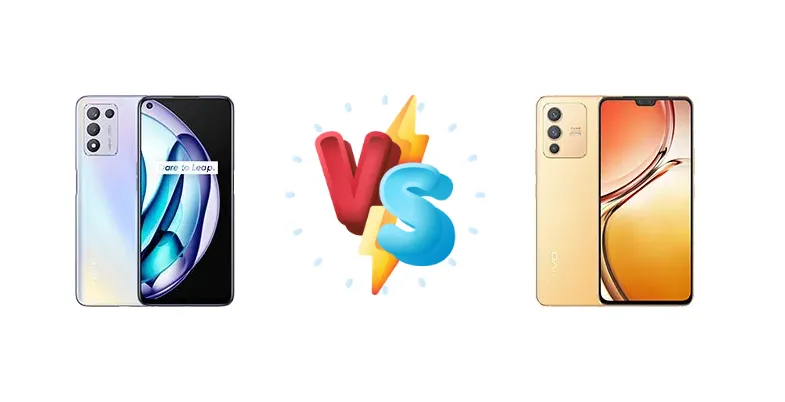
The Realme Q3t and vivo V23 5G represent compelling options in the increasingly competitive mid-range 5G smartphone market. While both aim to deliver a balanced experience, they diverge in their core components – the Q3t leveraging Qualcomm’s Snapdragon 778G, and the V23 5G opting for MediaTek’s Dimensity 920. This comparison dissects these differences to determine which device offers the best value for specific user needs.
🏆 Quick Verdict
For the average user prioritizing sustained performance and gaming, the Realme Q3t emerges as the stronger choice. Its Snapdragon 778G, while utilizing a slightly older architecture, offers a more consistent experience under load. The vivo V23 5G counters with faster 44W charging, but the performance trade-off isn't ideal for demanding tasks.
| Network |
|---|
| 2G bands | GSM 850 / 900 / 1800 / 1900 | GSM 850 / 900 / 1800 / 1900 |
| 3G bands | HSDPA 850 / 900 / 1700(AWS) / 1900 / 2100 | HSDPA 850 / 900 / 1700(AWS) / 1900 / 2100 |
| 4G bands | LTE | 1, 2, 3, 4, 5, 8, 18, 19, 26, 38, 39, 40, 41 |
| 5G bands | SA/NSA | 1, 3, 38, 40, 41, 77, 78 SA/NSA |
| Speed | HSPA, LTE, 5G | HSPA, LTE, 5G |
| Technology | GSM / CDMA / HSPA / EVDO / LTE / 5G | GSM / HSPA / LTE / 5G |
| | CDMA2000 1xEV-DO | 1, 3, 5, 8, 7, 20, 28, 38, 40, 41, 77, 78 SA/NSA |
| Launch |
|---|
| Announced | 2021, November 10 | 2022, January 05 |
| Status | Available. Released 2021, November 15 | Available. Released 2022, January 19 |
| Body |
|---|
| Build | - | Glass front (Schott Xensation Up), glass back |
| Dimensions | - | 157.2 x 72.4 x 7.4 or 7.6 mm |
| SIM | Nano-SIM + Nano-SIM | Nano-SIM + Nano-SIM |
| Weight | - | 179 g or 181 g (6.31 oz) |
| Display |
|---|
| Protection | - | Schott Xensation Up |
| Resolution | 1080 x 2412 pixels, 20:9 ratio (~400 ppi density) | 1080 x 2400 pixels, 20:9 ratio (~409 ppi density) |
| Size | 6.6 inches, 104.8 cm2 | 6.44 inches, 100.1 cm2 (~88.0% screen-to-body ratio) |
| Type | IPS LCD, 144Hz, 600 nits | AMOLED, 90Hz, HDR10+ |
| Platform |
|---|
| CPU | Octa-core (1x2.4 GHz Cortex-A78 & 3x2.2 GHz Cortex-A78 & 4x1.9 GHz Cortex-A55) | Octa-core (2x2.5 GHz Cortex-A78 & 6x2.0 GHz Cortex-A55) |
| Chipset | Qualcomm SM7325 Snapdragon 778G 5G (6 nm) | Mediatek Dimensity 920 (6 nm) |
| GPU | Adreno 642L | Mali-G68 MC4 |
| OS | Android 11, Realme UI 2.0 | Android 12, upgradable to Android 14, Funtouch 14 |
| Memory |
|---|
| Card slot | Unspecified | No |
| Internal | 256GB 8GB RAM | 128GB 8GB RAM, 256GB 12GB RAM |
| Main Camera |
|---|
| Dual | - | 50 MP, f/2.0, (wide), AF
8 MP, f/2.3, 105˚ (ultrawide) |
| Features | LED flash, HDR, panorama | Dual-LED flash, HDR, panorama |
| Single | 16 MP, f/2.1, 26mm (wide) | - |
| Triple | 48 MP, f/1.8, 26mm (wide), PDAF
2 MP (macro)
Auxiliary lens | 64 MP, f/1.9, 26mm (wide), PDAF
8 MP, f/2.2, 120˚, 16mm (ultrawide), 1/4.0", 1.12µm
2 MP (macro) |
| Video | 4K@30fps, 1080p@30/60fps | 4K@30fps, 1080p@30fps, gyro-EIS |
| Selfie camera |
|---|
| Dual | - | 50 MP, f/2.0, (wide), AF
8 MP, f/2.3, 105˚ (ultrawide) |
| Features | HDR, panorama | Dual-LED dual-tone flash, HDR |
| Single | 16 MP, f/2.1, 26mm (wide) | - |
| Video | 1080p@30fps | 4K@30fps, 1080p@30fps |
| Sound |
|---|
| 3.5mm jack | Yes | No |
| 35mm jack | Yes | No |
| Loudspeaker | Yes | Yes |
| | 24-bit/192kHz audio | 24-bit/192kHz audio |
| Comms |
|---|
| Bluetooth | 5.2, A2DP, LE | 5.2, A2DP, LE, aptX HD |
| NFC | No | Yes (market/region dependent) |
| Positioning | GPS, GLONASS, BDS, GALILEO, QZSS | GPS, GLONASS, BDS, GALILEO, QZSS, NavIC |
| Radio | No | No |
| USB | USB Type-C 2.0, OTG | USB Type-C, OTG |
| WLAN | Wi-Fi 802.11 a/b/g/n/ac/6, dual-band, Wi-Fi Direct | Wi-Fi 802.11 a/b/g/n/ac, Wi-Fi 6 (market dependent), dual-band, Wi-Fi Direct |
| Features |
|---|
| Sensors | Fingerprint (side-mounted), accelerometer, gyro, proximity, compass | Fingerprint (under display, optical), accelerometer, gyro, proximity, compass |
| | - | Color changing back panel when exposed to sunlight |
| Battery |
|---|
| Charging | 30W wired, 50% in 25 min | 44W wired, 68% in 30 min |
| Type | 5000 mAh | 4200 mAh |
| Misc |
|---|
| Colors | Aurora, Dark Blue | Sunshine Gold, Stardust Black |
| Models | - | V2130, V2303 |
| Price | About 290 EUR | About 280 EUR |
| SAR | - | 1.08 W/kg (head) 0.72 W/kg (body) |
| Tests |
|---|
| Battery life | - |
Endurance rating 103h
|
| Camera | - |
Photo / Video |
| Display | - |
Contrast ratio: Infinite (nominal) |
| Loudspeaker | - |
-28.5 LUFS (Average)
|
| Performance | - |
AnTuTu: 406498 (v8), 476058 (v9)
GeekBench: 8421 (v4.4), 2140 (v5.1)
GFXBench: 22fps (ES 3.1 onscreen) |
Realme Q3t
- Stronger CPU and GPU performance with Snapdragon 778G
- Potentially better thermal management for sustained gaming
- More efficient chipset architecture
- Slower charging speed (30W vs 44W)
- Display specifications are unknown
vivo V23 5G
- Faster 44W wired charging
- Brighter display (629 nits)
- Potentially more vibrant AMOLED panel
- Dimensity 920 may throttle under sustained load
- Likely lower GPU performance
Display Comparison
The vivo V23 5G boasts a measured peak brightness of 629 nits, suggesting a more visible display in direct sunlight compared to the Q3t (brightness data unavailable). While both utilize 6nm chipsets, the V23 5G’s ‘Infinite’ contrast ratio (nominal) indicates a typical AMOLED panel, offering vibrant colors and deep blacks. However, without detailed color accuracy data for either device, it’s difficult to assess which provides a more color-accurate viewing experience. The Q3t’s display specifications are missing, making a direct comparison challenging, but its market positioning suggests a focus on value rather than display extravagance.
Camera Comparison
Both phones feature photo and video capabilities, but detailed sensor information is lacking. Without knowing the main sensor resolution or aperture, a direct comparison is difficult. The V23 5G’s marketing often emphasizes its camera, but the presence of a likely low-resolution 2MP macro lens suggests a focus on quantity over quality. The Q3t’s camera system is less prominently advertised, implying a more pragmatic approach. Image processing styles will also differ – vivo typically favors brighter, more saturated images, while Realme often aims for a more natural look. Without sample images, it’s impossible to determine which device produces more pleasing results.
Performance
The core difference lies in the chipsets. The Realme Q3t’s Snapdragon 778G 5G features a 1x2.4 GHz Cortex-A78 prime core, complemented by 3x2.2 GHz Cortex-A78 cores and 4x1.9 GHz Cortex-A55 efficiency cores. The vivo V23 5G’s Dimensity 920 utilizes 2x2.5 GHz Cortex-A78 cores and 6x2.0 GHz Cortex-A55 cores. While the Dimensity 920 has a higher clock speed on its prime cores, the Snapdragon 778G’s architecture, and Qualcomm’s optimization, often translates to better sustained performance and thermal management. The Q3t’s Adreno 642L GPU is also generally considered more capable than the Mali-G68 MC4 found in the V23 5G, making it a better choice for mobile gaming. Both devices utilize 6nm fabrication, but Qualcomm’s process optimization often yields better efficiency.
Battery Life
Both the Realme Q3t and vivo V23 5G achieve an endurance rating of 103 hours, suggesting similar overall battery life despite differing battery capacities (not specified). However, charging speeds diverge significantly. The Q3t supports 30W wired charging, reaching 50% in 25 minutes, while the V23 5G boasts 44W charging, achieving 68% in 30 minutes. This faster charging on the V23 5G is a clear advantage for users who prioritize quick top-ups, even if the overall endurance is comparable. The lack of battery capacity data makes it difficult to assess the efficiency of each device.
Buying Guide
Buy the Realme Q3t if you need a phone that can reliably handle gaming and multitasking without significant throttling. It’s ideal for users who prioritize raw processing power and a smoother overall experience. Buy the vivo V23 5G if you value faster charging speeds and a potentially brighter display, and your usage primarily revolves around social media, streaming, and casual photography. It’s a better fit for users who prioritize convenience and aesthetic appeal over peak performance.
Frequently Asked Questions
❓ Does the Dimensity 920 in the vivo V23 5G experience significant thermal throttling during extended gaming sessions?
While the Dimensity 920 is a capable chipset, it's known to generate more heat under sustained load compared to the Snapdragon 778G. This can lead to thermal throttling, reducing performance during long gaming sessions. The Q3t, with its Snapdragon 778G, is generally better equipped to maintain consistent performance over extended periods.
❓ Is the 44W charging on the vivo V23 5G a substantial improvement over the 30W charging on the Realme Q3t in real-world usage?
Yes, the 44W charging on the V23 5G provides a noticeable advantage. Reaching 68% charge in 30 minutes is significantly faster than the Q3t’s 50% in 25 minutes. This is particularly beneficial for users who frequently need to quickly top up their battery.
❓ How does the GPU performance of the Snapdragon 778G in the Realme Q3t compare to the Mali-G68 MC4 in the vivo V23 5G for demanding games like Genshin Impact?
The Snapdragon 778G’s Adreno 642L GPU generally outperforms the Mali-G68 MC4 in graphically intensive games like Genshin Impact. You can expect higher frame rates and smoother gameplay on the Q3t, even at higher settings. The V23 5G may require lower graphics settings to achieve comparable performance.