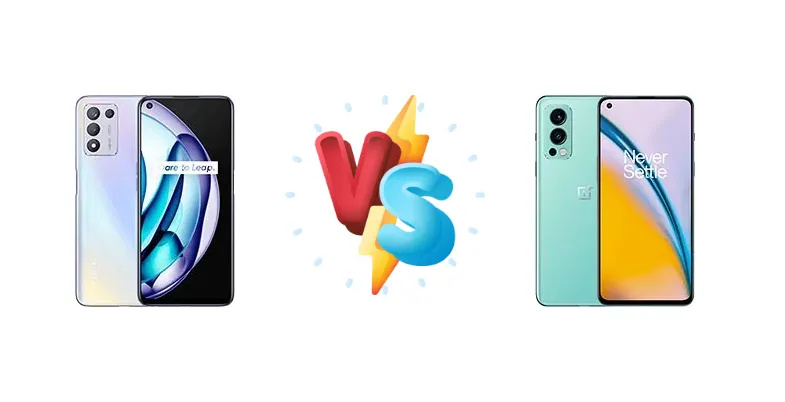
The Realme Q3t and OnePlus Nord 2 5G represent compelling options in the increasingly competitive mid-range 5G smartphone market. While both leverage 6nm chipsets for efficient performance, they diverge in key areas like charging technology, display capabilities, and overall user experience. This comparison dissects these differences to help you choose the right device.
🏆 Quick Verdict
For the average user prioritizing rapid charging and a brighter display, the OnePlus Nord 2 5G is the superior choice. Its 65W charging fully replenishes the battery in 30 minutes, and the 633 nit display offers better visibility. However, the Q3t presents a strong value proposition if budget is a primary concern.
| Network |
|---|
| 2G bands | GSM 850 / 900 / 1800 / 1900 | GSM 850 / 900 / 1800 / 1900 |
| 3G bands | HSDPA 850 / 900 / 1700(AWS) / 1900 / 2100 | HSDPA 800 / 850 / 900 / 1700(AWS) / 1800 / 1900 / 2100 |
| 4G bands | LTE | 1, 2, 3, 4, 5, 7, 8, 12, 17, 18, 19, 20, 26, 28, 32, 34, 38, 39, 40, 41, 66 - EU |
| 5G bands | SA/NSA | 1, 3, 7, 8, 20, 28, 38, 41, 66, 78 SA/NSA - EU |
| Speed | HSPA, LTE, 5G | HSPA 42.2/5.76 Mbps, LTE Cat18 1200/150 Mbps, 5G |
| Technology | GSM / CDMA / HSPA / EVDO / LTE / 5G | GSM / HSPA / LTE / 5G |
| | CDMA2000 1xEV-DO | - |
| Launch |
|---|
| Announced | 2021, November 10 | 2021, July 22 |
| Status | Available. Released 2021, November 15 | Available. Released 2021, July 28 |
| Body |
|---|
| Build | - | Glass front (Gorilla Glass 5), glass back (Gorilla Glass 5), plastic frame |
| Dimensions | - | 159.1 x 73.3 x 8.3 mm (6.26 x 2.89 x 0.33 in) |
| SIM | Nano-SIM + Nano-SIM | Nano-SIM + Nano-SIM |
| Weight | - | 189 g (6.67 oz) |
| Display |
|---|
| Protection | - | Corning Gorilla Glass 5 |
| Resolution | 1080 x 2412 pixels, 20:9 ratio (~400 ppi density) | 1080 x 2400 pixels, 20:9 ratio (~409 ppi density) |
| Size | 6.6 inches, 104.8 cm2 | 6.43 inches, 99.8 cm2 (~85.6% screen-to-body ratio) |
| Type | IPS LCD, 144Hz, 600 nits | Fluid AMOLED, 90Hz, HDR10+ |
| Platform |
|---|
| CPU | Octa-core (1x2.4 GHz Cortex-A78 & 3x2.2 GHz Cortex-A78 & 4x1.9 GHz Cortex-A55) | Octa-core (1x3.0 GHz Cortex-A78 & 3x2.6 GHz Cortex-A78 & 4x2.0 GHz Cortex-A55) |
| Chipset | Qualcomm SM7325 Snapdragon 778G 5G (6 nm) | Mediatek Dimensity 1200 (6 nm) |
| GPU | Adreno 642L | Mali-G77 MC9 |
| OS | Android 11, Realme UI 2.0 | Android 11, upgradable to Android 13, OxygenOS 13 |
| Memory |
|---|
| Card slot | Unspecified | No |
| Internal | 256GB 8GB RAM | 128GB 6GB RAM, 128GB 8GB RAM, 256GB 8GB RAM, 256GB 12GB RAM |
| Main Camera |
|---|
| Features | LED flash, HDR, panorama | Dual-LED flash, HDR, panorama |
| Single | 16 MP, f/2.1, 26mm (wide) | - |
| Triple | 48 MP, f/1.8, 26mm (wide), PDAF
2 MP (macro)
Auxiliary lens | 50 MP, f/1.9, 24mm (wide), 1/1.56", 1.0µm, PDAF, OIS
8 MP, f/2.3, 120˚ (ultrawide)
Auxiliary lens |
| Video | 4K@30fps, 1080p@30/60fps | 4K@30fps, 1080p@30/60/120fps, gyro-EIS |
| Selfie camera |
|---|
| Features | HDR, panorama | Auto HDR |
| Single | 16 MP, f/2.1, 26mm (wide) | 32 MP, f/2.5, (wide), 1/2.8", 0.8µm |
| Video | 1080p@30fps | 1080p@30fps, gyro-EIS |
| Sound |
|---|
| 3.5mm jack | Yes | No |
| 35mm jack | Yes | No |
| Loudspeaker | Yes | Yes, with stereo speakers |
| | 24-bit/192kHz audio | - |
| Comms |
|---|
| Bluetooth | 5.2, A2DP, LE | 5.2, A2DP, LE, aptX HD |
| NFC | No | Yes |
| Positioning | GPS, GLONASS, BDS, GALILEO, QZSS | GPS, GLONASS, GALILEO, BDS, SBAS, NavIC |
| Radio | No | No |
| USB | USB Type-C 2.0, OTG | USB Type-C 2.0, OTG |
| WLAN | Wi-Fi 802.11 a/b/g/n/ac/6, dual-band, Wi-Fi Direct | Wi-Fi 802.11 a/b/g/n/ac/6, dual-band, Wi-Fi Direct |
| Features |
|---|
| Sensors | Fingerprint (side-mounted), accelerometer, gyro, proximity, compass | Fingerprint (under display, optical), accelerometer, gyro, proximity, compass |
| Battery |
|---|
| Charging | 30W wired, 50% in 25 min | 65W wired, PD, 100% in 30 min |
| Type | 5000 mAh | Li-Po 4500 mAh |
| Misc |
|---|
| Colors | Aurora, Dark Blue | Gray Sierra, Blue Haze, Green Wood, Pac-Man Edition |
| Models | - | DN2101, DN2103 |
| Price | About 290 EUR | € 189.00 / $ 219.99 / £ 148.00 |
| Tests |
|---|
| Battery life | - |
Endurance rating 102h
|
| Camera | - |
Photo / Video |
| Display | - |
Contrast ratio: Infinite (nominal) |
| Loudspeaker | - |
-24.3 LUFS (Very good)
|
| Performance | - |
AnTuTu: 512164 (v8) | 598022 (v9)
GeekBench: 2792 (v5.1)
GFXBench: 38fps (ES 3.1 onscreen) |
Realme Q3t
- Potentially lower price point
- Capable Snapdragon 778G performance
- Solid 5G connectivity
- Slower 30W charging
- Less detailed display specifications
- Potentially less refined software experience
OnePlus Nord 2 5G
- Faster 65W charging with PD
- Brighter 633 nit display
- More powerful Dimensity 1200 chipset
- Higher price tag
- May require more careful thermal management due to higher performance
- Software bloat (typical of OnePlus)
Display Comparison
The OnePlus Nord 2 5G boasts a significantly brighter display, reaching a measured 633 nits, compared to an unspecified brightness for the Realme Q3t. This translates to better outdoor visibility. While both phones likely utilize AMOLED panels (based on brand history), the Nord 2’s higher peak brightness and infinite contrast ratio suggest a more visually immersive experience. The Q3t’s display specs are less defined, making it difficult to assess its color accuracy or HDR capabilities.
Camera Comparison
Both phones feature photo and video capabilities, but detailed camera specifications are limited. Without sensor size or aperture information, a direct comparison is challenging. However, OnePlus typically focuses on image processing algorithms to enhance photo quality, while Realme often prioritizes hardware. The absence of specific details suggests neither phone is a standout camera performer, likely targeting competent but not exceptional image capture.
Performance
Both devices employ 6nm chipsets, but the Mediatek Dimensity 1200 in the Nord 2 5G holds a performance advantage over the Qualcomm Snapdragon 778G 5G in the Q3t. The Dimensity 1200’s CPU configuration – a 1x3.0 GHz Cortex-A78 core alongside 3x2.6 GHz Cortex-A78 cores – is clocked higher than the Q3t’s 1x2.4 GHz Cortex-A78 and 3x2.2 GHz Cortex-A78 setup. This difference will be noticeable in demanding tasks like video editing and graphically intensive games. While both use Cortex-A55 efficiency cores (4x1.9 GHz in the Q3t vs 4x2.0 GHz in the Nord 2), the overall CPU performance favors the Nord 2. The GPU within the Dimensity 1200 also provides a more substantial graphical uplift.
Battery Life
Both the Realme Q3t and OnePlus Nord 2 5G share an endurance rating of 102 hours, suggesting similar real-world battery life despite potentially different battery capacities (not specified). However, the charging speeds are drastically different. The Nord 2 5G’s 65W wired charging, with PD support, can fully charge the battery in 30 minutes. The Q3t’s 30W charging takes longer, reaching 50% in 25 minutes, but requiring more time to reach 100%. This charging speed difference is a significant advantage for the Nord 2 5G, catering to users who value convenience.
Buying Guide
Buy the Realme Q3t if you need a capable 5G phone with solid performance for everyday tasks and light gaming, and you're willing to compromise on charging speed and display brightness to save money. Buy the OnePlus Nord 2 5G if you prioritize faster charging, a brighter and more vibrant display, and a slightly more refined overall experience, even at a higher price point.
Frequently Asked Questions
❓ Does the Dimensity 1200 in the OnePlus Nord 2 5G tend to overheat during prolonged gaming sessions?
While the Dimensity 1200 is a powerful chipset, it can generate more heat than the Snapdragon 778G. OnePlus typically implements thermal management solutions, but sustained gaming at maximum settings may lead to some throttling. Monitoring temperatures during gameplay is recommended.
❓ Is the 30W charging on the Realme Q3t slow enough to be a significant inconvenience?
Compared to the Nord 2 5G’s 65W charging, 30W is considerably slower. While it can reach 50% in 25 minutes, a full charge will take significantly longer. This is a trade-off for the potentially lower price of the Q3t, and may not be a major issue for users who charge their phones overnight.
❓ How does the CPU core configuration difference (Snapdragon vs Dimensity) translate to real-world app loading times?
The Dimensity 1200's higher clocked Cortex-A78 cores will result in faster app launch speeds, particularly for demanding applications. While the difference may not be dramatic for everyday apps, users will notice a performance boost when opening resource-intensive games or editing software.