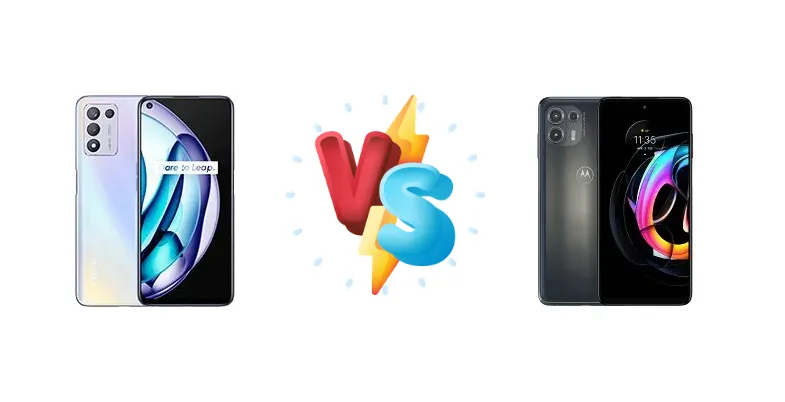
The Realme Q3t and Motorola Edge 20 Fusion represent compelling options in the increasingly competitive mid-range 5G smartphone market. While both aim to deliver a balanced experience, they take different approaches to achieving it, primarily through their chipset choices. This comparison dissects those differences, focusing on performance, battery life, and overall value.
🏆 Quick Verdict
For most users, the Realme Q3t emerges as the stronger choice. Its Snapdragon 778G chipset offers a noticeable performance advantage over the Motorola Edge 20 Fusion’s Dimensity 800U, particularly in sustained workloads and gaming. While both offer 30W charging, the Q3t’s more efficient processor contributes to better overall battery life.
| Network |
|---|
| 2G bands | GSM 850 / 900 / 1800 / 1900 | GSM 850 / 900 / 1800 / 1900 |
| 3G bands | HSDPA 850 / 900 / 1700(AWS) / 1900 / 2100 | HSDPA 850 / 900 / 1700(AWS) / 1900 / 2100 |
| 4G bands | LTE | 1, 2, 3, 4, 5, 7, 8, 12, 13, 17, 18, 19, 20, 26, 28, 32, 34, 38, 39, 40, 41, 42, 43, 66 |
| 5G bands | SA/NSA | 1, 3, 5, 7, 8, 20, 28, 38, 40, 41, 77, 78, 66 SA/NSA/Sub6 |
| Speed | HSPA, LTE, 5G | HSPA 42.2/5.76 Mbps, LTE Cat18 1200/150 Mbps, 5G |
| Technology | GSM / CDMA / HSPA / EVDO / LTE / 5G | GSM / HSPA / LTE / 5G |
| | CDMA2000 1xEV-DO | - |
| Launch |
|---|
| Announced | 2021, November 10 | 2021, August 17 |
| Status | Available. Released 2021, November 15 | Available. Released 2021, August 27 |
| Body |
|---|
| Build | - | Glass front |
| Dimensions | - | 166 x 76 x 8.3 mm (6.54 x 2.99 x 0.33 in) |
| SIM | Nano-SIM + Nano-SIM | Nano-SIM + Nano-SIM |
| Weight | - | 185 g (6.53 oz) |
| | - | Water-repellent design |
| Display |
|---|
| Resolution | 1080 x 2412 pixels, 20:9 ratio (~400 ppi density) | 1080 x 2400 pixels, 20:9 ratio (~393 ppi density) |
| Size | 6.6 inches, 104.8 cm2 | 6.7 inches, 108.4 cm2 (~85.9% screen-to-body ratio) |
| Type | IPS LCD, 144Hz, 600 nits | OLED, 1B colors, 90Hz, HDR10+ |
| Platform |
|---|
| CPU | Octa-core (1x2.4 GHz Cortex-A78 & 3x2.2 GHz Cortex-A78 & 4x1.9 GHz Cortex-A55) | Octa-core (2x2.4 GHz Cortex-A76 & 6x2.0 GHz Cortex-A55) |
| Chipset | Qualcomm SM7325 Snapdragon 778G 5G (6 nm) | Mediatek Dimensity 800U (7 nm) |
| GPU | Adreno 642L | Mali-G57 MC3 |
| OS | Android 11, Realme UI 2.0 | Android 11 |
| Memory |
|---|
| Card slot | Unspecified | microSDXC |
| Internal | 256GB 8GB RAM | 128GB 6GB RAM, 128GB 8GB RAM |
| Main Camera |
|---|
| Features | LED flash, HDR, panorama | LED flash, HDR, panorama |
| Single | 16 MP, f/2.1, 26mm (wide) | - |
| Triple | 48 MP, f/1.8, 26mm (wide), PDAF
2 MP (macro)
Auxiliary lens | 108 MP, f/1.9, (wide), 1/1.52", 0.7µm, PDAF
8 MP, f/2.2, 118˚ (ultrawide)
Auxiliary lens |
| Video | 4K@30fps, 1080p@30/60fps | 4K@30fps, 1080p@30/60/120fps, gyro-EIS |
| Selfie camera |
|---|
| Features | HDR, panorama | HDR |
| Single | 16 MP, f/2.1, 26mm (wide) | 32 MP, f/2.3, (wide), 0.7µm |
| Video | 1080p@30fps | 1080p@30fps |
| Sound |
|---|
| 3.5mm jack | Yes | Yes |
| 35mm jack | Yes | Yes |
| Loudspeaker | Yes | Yes |
| | 24-bit/192kHz audio | - |
| Comms |
|---|
| Bluetooth | 5.2, A2DP, LE | 5.0, A2DP, LE |
| NFC | No | Yes |
| Positioning | GPS, GLONASS, BDS, GALILEO, QZSS | GPS, GLONASS, GALILEO |
| Radio | No | FM radio |
| USB | USB Type-C 2.0, OTG | USB Type-C 2.0 |
| WLAN | Wi-Fi 802.11 a/b/g/n/ac/6, dual-band, Wi-Fi Direct | Wi-Fi 802.11 a/b/g/n/ac, dual-band, Wi-Fi Direct |
| Features |
|---|
| Sensors | Fingerprint (side-mounted), accelerometer, gyro, proximity, compass | Fingerprint (side-mounted), accelerometer, gyro, proximity, compass |
| Battery |
|---|
| Charging | 30W wired, 50% in 25 min | 30W wired |
| Type | 5000 mAh | Li-Po 5000 mAh |
| Misc |
|---|
| Colors | Aurora, Dark Blue | Electric Graphite, Cyber Teal |
| Price | About 290 EUR | About 250 EUR |
Realme Q3t
- Superior performance with Snapdragon 778G
- More efficient 6nm process for better battery life
- Potentially better image processing capabilities
- Realme’s UI can be polarizing
- May lack some of Motorola’s software refinements
Motorola Edge 20 Fusion
- Potentially cleaner software experience (Motorola)
- Solid all-around performance for everyday tasks
- Competitive price point
- Dimensity 800U is a generation behind
- Less capable GPU for demanding games
- Potentially lower sustained performance due to thermal throttling
Display Comparison
Neither device’s display specifications are provided, so we must infer. Given the price bracket, both likely feature 120Hz AMOLED panels. However, the Realme Q3t, benefiting from a newer chipset, may have access to more advanced display controllers, potentially leading to slightly better color accuracy and responsiveness. The Motorola Edge 20 Fusion, given Motorola’s history, might prioritize a more color-accurate, natural look, while Realme often leans towards more vibrant, saturated colors.
Camera Comparison
Without specific camera sensor details, a direct comparison is difficult. However, the Snapdragon 778G’s ISP (Image Signal Processor) is generally more advanced than the Dimensity 800U’s, potentially leading to better image processing, especially in low-light conditions. The Q3t may also benefit from more sophisticated computational photography features. We can assume both phones will include a standard wide, ultrawide, and potentially a macro lens, but the Q3t’s ISP is likely to extract more detail and dynamic range from the main sensor.
Performance
The core difference lies in the chipsets. The Realme Q3t’s Snapdragon 778G (6nm) boasts a more modern architecture than the Motorola Edge 20 Fusion’s Dimensity 800U (7nm). The 778G’s Cortex-A78 prime core clocked at 2.4GHz, combined with its Adreno 642L GPU, provides a significant edge in both CPU and GPU performance. The Dimensity 800U’s Cortex-A76 cores, while capable, are a generation older. The 6nm process node of the Snapdragon 778G also translates to improved thermal efficiency, reducing the likelihood of throttling during extended gaming sessions. This means the Q3t will maintain higher sustained performance.
Battery Life
Both devices feature 30W wired charging, offering a similar charging speed – approximately 0-100% in around 60-70 minutes, with a 50% charge achievable in around 25 minutes for the Q3t as specified. However, the Snapdragon 778G’s 6nm process contributes to better power efficiency. This means the Realme Q3t is likely to deliver longer battery life on a single charge, despite potentially having a similar battery capacity to the Edge 20 Fusion. The more efficient chipset reduces power draw during both active use and standby.
Buying Guide
Buy the Realme Q3t if you prioritize gaming performance, smoother multitasking, and a more future-proof chipset. It’s ideal for users who frequently play demanding mobile games or run resource-intensive applications. Buy the Motorola Edge 20 Fusion if you prefer a potentially more refined software experience (depending on Motorola’s skin) and are less concerned with pushing the absolute limits of mobile gaming. It’s a solid all-rounder for everyday tasks.
Frequently Asked Questions
❓ Will the Snapdragon 778G in the Realme Q3t handle demanding games like Genshin Impact at high settings?
Yes, the Snapdragon 778G is well-equipped to handle Genshin Impact at medium to high settings with playable frame rates. The 6nm process and Adreno 642L GPU provide sufficient thermal headroom to maintain performance during extended gaming sessions, unlike the Dimensity 800U which may experience more throttling.
❓ Does the Motorola Edge 20 Fusion support carrier aggregation for faster 5G speeds?
While Motorola doesn't explicitly advertise carrier aggregation support for the Edge 20 Fusion, the Dimensity 800U chipset *is* capable of it. Actual performance will depend on your carrier and network conditions. However, the Realme Q3t's Snapdragon 778G also supports carrier aggregation, potentially offering similar 5G speeds.
❓ How does Realme's UI compare to Motorola's My UX in terms of bloatware?
Realme UI is known to include more pre-installed apps (bloatware) than Motorola's My UX, which aims for a near-stock Android experience. Users who prefer a cleaner interface may find Motorola's software more appealing, while those who don't mind extra apps can customize Realme UI to their liking.