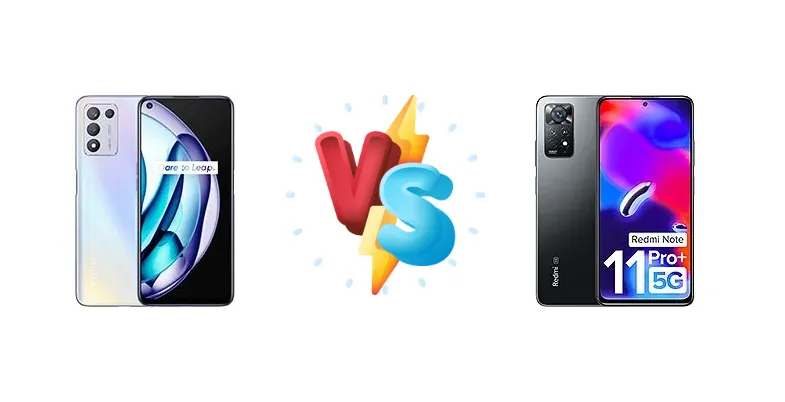
The Realme Q3s and Xiaomi Redmi Note 11 Pro+ 5G (India) represent compelling options in the increasingly competitive mid-range 5G smartphone market. While both aim for a sweet spot of features and affordability, they diverge significantly in their core processing power and charging capabilities, making the choice dependent on user priorities. This comparison dissects these differences to help you determine which device best suits your needs.
🏆 Quick Verdict
For users prioritizing raw performance and a smoother experience, the Realme Q3s, powered by the Snapdragon 778G, is the better choice. However, the Redmi Note 11 Pro+ 5G’s significantly faster 67W charging, achieving a full charge in just 42 minutes, makes it ideal for those who value convenience and minimal downtime.
| Network |
|---|
| 2G bands | GSM 850 / 900 / 1800 / 1900 | GSM 850 / 900 / 1800 / 1900 |
| 3G bands | HSDPA 850 / 900 / 1700(AWS) / 1900 / 2100 | HSDPA 850 / 900 / 1900 / 2100 |
| 4G bands | 1, 3, 4, 5, 7, 8, 19, 28, 34, 38, 39, 40, 41 | 1, 3, 5, 8, 40, 41 |
| 5G bands | 1, 28, 41, 77, 78 SA/NSA | 1, 3, 5, 8, 28, 40, 78 SA/NSA |
| Speed | HSPA, LTE, 5G | HSPA, LTE, 5G |
| Technology | GSM / CDMA / HSPA / EVDO / LTE / 5G | GSM / HSPA / LTE / 5G |
| | CDMA2000 1xEV-DO | - |
| Launch |
|---|
| Announced | 2021, October 19 | 2022, March 09 |
| Status | Available. Released 2021, November 01 | Available. Released 2022, March 15 |
| Body |
|---|
| Build | - | Glass front (Gorilla Glass 5), glass back |
| Dimensions | 164.4 x 75.8 x 8.5 mm (6.47 x 2.98 x 0.33 in) | 164.2 x 76.1 x 8.1 mm (6.46 x 3.00 x 0.32 in) |
| SIM | Nano-SIM + Nano-SIM | Nano-SIM + Nano-SIM |
| Weight | 199 g (7.02 oz) | 202 g (7.13 oz) |
| Display |
|---|
| Protection | - | Corning Gorilla Glass 5 |
| Resolution | 1080 x 2412 pixels, 20:9 ratio (~401 ppi density) | 1080 x 2400 pixels, 20:9 ratio (~395 ppi density) |
| Size | 6.6 inches, 104.3 cm2 (~83.7% screen-to-body ratio) | 6.67 inches, 107.4 cm2 (~86.0% screen-to-body ratio) |
| Type | IPS LCD, 144Hz, 600 nits | Super AMOLED, 120Hz, 700 nits, 1200 nits (peak) |
| Platform |
|---|
| CPU | Octa-core (1x2.4 GHz Cortex-A78 & 3x2.2 GHz Cortex-A78 & 4x1.9 GHz Cortex-A55) | Octa-core (2x2.2 GHz Kryo 660 Gold & 6x1.7 GHz Kryo 660 Silver) |
| Chipset | Qualcomm SM7325 Snapdragon 778G 5G (6 nm) | Qualcomm SM6375 Snapdragon 695 5G (6 nm) |
| GPU | Adreno 642L | Adreno 619 |
| OS | Android 11, Realme UI 2.0 | Android 11, MIUI 13 |
| Memory |
|---|
| Card slot | microSDXC (dedicated slot) | microSDXC (uses shared SIM slot) |
| Internal | 128GB 6GB RAM, 128GB 8GB RAM, 256GB 8GB RAM | 64GB 6GB RAM, 128GB 6GB RAM, 128GB 8GB RAM, 256GB 8GB RAM |
| Main Camera |
|---|
| Features | LED flash, HDR, panorama | LED flash, HDR, panorama |
| Single | 16 MP, f/2.1, 26mm (wide) | - |
| Triple | 48 MP, f/1.8, 26mm (wide), PDAF
2 MP (macro)
Auxiliary lens | 108 MP, f/1.9, 26mm (wide), 1/1.52", 0.7µm, PDAF
8 MP, f/2.2, 118˚ (ultrawide)
2 MP (macro) |
| Video | 4K@30fps, 1080p@30/60fps | 1080p@30fps |
| Selfie camera |
|---|
| Features | HDR, panorama | - |
| Single | 16 MP, f/2.1, 26mm (wide) | 16 MP, f/2.5, (wide), 1/3.06" 1.0µm |
| Video | 1080p@30fps | 1080p@30fps |
| Sound |
|---|
| 3.5mm jack | Yes | - |
| 35mm jack | Yes | Yes |
| Loudspeaker | Yes | Yes, with stereo speakers |
| | 24-bit/192kHz audio | - |
| Comms |
|---|
| Bluetooth | 5.2, A2DP, LE | 5.1, A2DP, LE |
| Infrared port | - | Yes |
| NFC | No | No |
| Positioning | GPS, GLONASS, BDS, GALILEO, QZSS | GPS, GLONASS, BDS, GALILEO |
| Radio | No | Unspecified |
| USB | USB Type-C 2.0, OTG | USB Type-C 2.0, OTG |
| WLAN | Wi-Fi 802.11 a/b/g/n/ac/6, dual-band, Wi-Fi Direct | Wi-Fi 802.11 a/b/g/n/ac, dual-band, Wi-Fi Direct |
| Features |
|---|
| Sensors | Fingerprint (side-mounted), accelerometer, gyro, proximity, compass | Fingerprint (side-mounted), accelerometer, gyro, proximity, compass |
| Battery |
|---|
| Charging | 30W wired, 50% in 25 min | 67W wired, PD3.0, QC3, 50% in 15 min, 100% in 42 min |
| Type | 5000 mAh | Li-Po 5000 mAh |
| Misc |
|---|
| Colors | Aurora, Dark Blue | Mirage Blue, Phantom White, Stealth Black |
| Models | - | 2201116SI |
| Price | About 200 EUR | About 250 EUR |
Realme Q3s
- Superior processing power with Snapdragon 778G
- Better GPU performance for gaming
- More responsive user experience
- Slower charging speed (30W)
- Potentially less advanced camera system
Xiaomi Redmi Note 11 Pro+ 5G (India)
- Ultra-fast 67W charging
- Likely more advanced camera features
- Potentially brighter and more efficient display
- Less powerful Snapdragon 695 processor
- Lower GPU performance for gaming
Display Comparison
While both devices likely feature 6.6-inch displays (based on typical Redmi Note and Q series sizing), the context data doesn't provide specifics on panel technology or resolution. However, the core difference lies beneath the surface. The Redmi Note 11 Pro+ 5G, being a newer model, may benefit from a higher peak brightness and potentially a more efficient AMOLED panel. The Realme Q3s, while likely offering a good viewing experience, will likely fall behind in peak brightness and color accuracy due to its older generation panel.
Camera Comparison
Without detailed camera specifications, a direct comparison is limited. However, given Xiaomi’s recent focus on high-resolution sensors, the Redmi Note 11 Pro+ 5G likely features a more advanced camera system. While the Realme Q3s will likely deliver respectable image quality, the Redmi Note 11 Pro+ 5G may offer better dynamic range and low-light performance, assuming it incorporates features like pixel binning and optical image stabilization (OIS). The absence of details on sensor size and aperture makes a definitive judgment impossible, but Xiaomi’s marketing typically emphasizes camera capabilities.
Performance
The performance gap is the most significant differentiator. The Realme Q3s boasts the Qualcomm SM7325 Snapdragon 778G 5G (6 nm), featuring a prime Cortex-A78 core clocked at 2.4 GHz. This is a substantial upgrade over the Redmi Note 11 Pro+ 5G’s Snapdragon 695 5G (6 nm), which utilizes Kryo 660 Gold cores peaking at 2.2 GHz. The 778G’s architecture, with its more powerful core and superior GPU, translates to noticeably faster app loading times, smoother multitasking, and a more enjoyable gaming experience. The 778G’s Adreno 642L GPU will outperform the 695’s Adreno 619, especially in graphically intensive titles. The Redmi Note 11 Pro+ 5G will be adequate for casual gaming and everyday tasks, but will struggle with demanding titles at higher settings.
Battery Life
The Redmi Note 11 Pro+ 5G takes a clear lead in charging speed. Its 67W wired charging, supporting PD3.0 and QC3, can replenish 50% of the battery in just 15 minutes and achieve a full charge in 42 minutes. The Realme Q3s, with its 30W charging, takes considerably longer, reaching 50% in 25 minutes. While battery capacity isn’t specified, the faster charging of the Redmi Note 11 Pro+ 5G effectively mitigates any potential disadvantage from a slightly smaller battery, offering greater convenience for users who frequently need to top up their devices.
Buying Guide
Buy the Realme Q3s if you need a phone capable of handling demanding games and applications with greater ease, and if you prioritize a more responsive user interface. Buy the Xiaomi Redmi Note 11 Pro+ 5G (India) if you prefer a device that can be rapidly topped up, minimizing charging interruptions, and if your usage is primarily focused on everyday tasks and media consumption.
Frequently Asked Questions
❓ Will the Snapdragon 695 in the Redmi Note 11 Pro+ 5G struggle with demanding games like Genshin Impact?
Yes, the Snapdragon 695 is not ideally suited for graphically intensive games like Genshin Impact. While playable at lower settings, you'll likely experience frame drops and reduced visual fidelity. The Realme Q3s, with its Snapdragon 778G, will provide a significantly smoother and more enjoyable gaming experience.
❓ How much faster is the 67W charging on the Redmi Note 11 Pro+ 5G compared to the 30W charging on the Realme Q3s in real-world usage?
The 67W charging on the Redmi Note 11 Pro+ 5G is substantially faster. While the Realme Q3s takes 25 minutes to reach 50%, the Redmi Note 11 Pro+ 5G achieves the same in just 15 minutes. A full charge takes 42 minutes on the Redmi, compared to a significantly longer time on the Realme Q3s. This difference is crucial for users who need a quick power boost.
❓ Does the Realme Q3s support 5G carrier aggregation, and will this impact its 5G speeds?
The Snapdragon 778G supports 5G carrier aggregation, which allows the phone to combine multiple 5G channels for faster and more stable speeds. This is a significant advantage over devices with limited carrier aggregation support, ensuring a better 5G experience in areas with strong network coverage.