
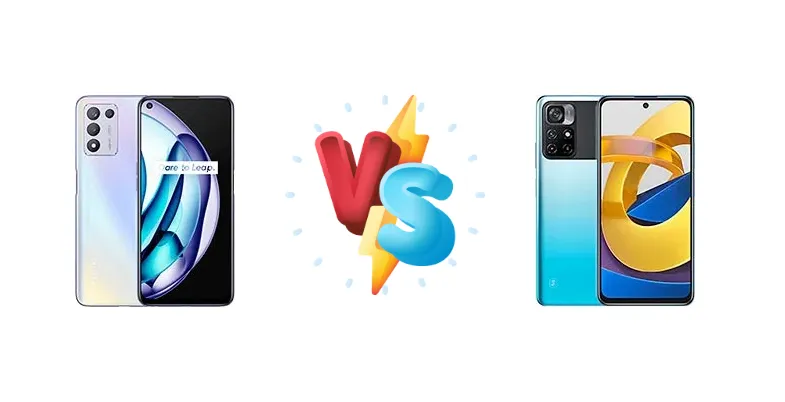
Realme Q3s vs Xiaomi Poco M4 Pro 5G: The Ultimate Showdown
| Phones Images | |||||
|---|---|---|---|---|---|
|
🏆 Quick Verdict
The Poco M4 Pro 5G edges out the Realme Q3s thanks to its slightly faster charging, impressive battery life, and vibrant display. However, the Q3s boasts the Snapdragon 778G, offering a performance advantage for demanding tasks. Ultimately, the choice depends on your priorities.
| PHONES | ||
|---|---|---|
| Phone Names | Realme Q3s | Xiaomi Poco M4 Pro 5G |
| Network | ||
|---|---|---|
| 2G bands | GSM 850 / 900 / 1800 / 1900 | GSM 850 / 900 / 1800 / 1900 |
| 3G bands | HSDPA 850 / 900 / 1700(AWS) / 1900 / 2100 | HSDPA 850 / 900 / 1700(AWS) / 1900 / 2100 - International |
| 4G bands | 1, 3, 4, 5, 7, 8, 19, 28, 34, 38, 39, 40, 41 | 1, 2, 3, 4, 5, 7, 8, 12, 17, 20, 28, 32, 38, 40, 41, 66 - International |
| 5G bands | 1, 28, 41, 77, 78 SA/NSA | 1, 3, 5, 7, 8, 20, 28, 38, 40, 41, 66, 77, 78 SA/NSA - International |
| Speed | HSPA, LTE, 5G | HSPA, LTE, 5G |
| Technology | GSM / CDMA / HSPA / EVDO / LTE / 5G | GSM / HSPA / LTE / 5G |
| CDMA2000 1xEV-DO | 1, 3, 5, 8, 28, 40, 78 SA/NSA - India | |
| Launch | ||
|---|---|---|
| Announced | 2021, October 19 | 2021, November 09 |
| Status | Available. Released 2021, November 01 | Available. Released 2021, November 11 |
| Body | ||
|---|---|---|
| Build | - | Glass front (Gorilla Glass 3), plastic back, plastic frame |
| Dimensions | 164.4 x 75.8 x 8.5 mm (6.47 x 2.98 x 0.33 in) | 163.6 x 75.8 x 8.8 mm (6.44 x 2.98 x 0.35 in) |
| SIM | Nano-SIM + Nano-SIM | Nano-SIM + Nano-SIM |
| Weight | 199 g (7.02 oz) | 195 g (6.88 oz) |
| - | IP53, dust and splash resistant | |
| Display | ||
|---|---|---|
| Protection | - | Corning Gorilla Glass 3 |
| Resolution | 1080 x 2412 pixels, 20:9 ratio (~401 ppi density) | 1080 x 2400 pixels, 20:9 ratio (~399 ppi density) |
| Size | 6.6 inches, 104.3 cm2 (~83.7% screen-to-body ratio) | 6.6 inches, 105.2 cm2 (~84.8% screen-to-body ratio) |
| Type | IPS LCD, 144Hz, 600 nits | IPS LCD, 90Hz, 450 nits (typ) |
| Platform | ||
|---|---|---|
| CPU | Octa-core (1x2.4 GHz Cortex-A78 & 3x2.2 GHz Cortex-A78 & 4x1.9 GHz Cortex-A55) | Octa-core (2x2.4 GHz Cortex-A76 & 6x2.0 GHz Cortex-A55) |
| Chipset | Qualcomm SM7325 Snapdragon 778G 5G (6 nm) | Mediatek Dimensity 810 (6 nm) |
| GPU | Adreno 642L | Mali-G57 MC2 |
| OS | Android 11, Realme UI 2.0 | Android 11, upgradable to Android 12, MIUI 13 |
| Memory | ||
|---|---|---|
| Card slot | microSDXC (dedicated slot) | microSDXC |
| Internal | 128GB 6GB RAM, 128GB 8GB RAM, 256GB 8GB RAM | 64GB 4GB RAM, 64GB 6GB RAM, 128GB 4GB RAM, 128GB 6GB RAM, 128GB 8GB RAM, 256GB 8GB RAM |
| - | UFS 2.2 | |
| Main Camera | ||
|---|---|---|
| Dual | - | 50 MP, f/1.8, 26mm (wide), PDAF 8 MP, f/2.2, 119˚ (ultrawide) |
| Features | LED flash, HDR, panorama | LED flash, HDR, panorama |
| Single | 16 MP, f/2.1, 26mm (wide) | 16 MP, f/2.5, (wide), 1/3.06" 1.0µm |
| Triple | 48 MP, f/1.8, 26mm (wide), PDAF 2 MP (macro) Auxiliary lens | - |
| Video | 4K@30fps, 1080p@30/60fps | 1080p@30/60fps |
| Selfie camera | ||
|---|---|---|
| Features | HDR, panorama | Panorama |
| Single | 16 MP, f/2.1, 26mm (wide) | 16 MP, f/2.5, (wide), 1/3.06" 1.0µm |
| Video | 1080p@30fps | 1080p@30fps |
| Sound | ||
|---|---|---|
| 3.5mm jack | Yes | Yes |
| 35mm jack | Yes | Yes |
| Loudspeaker | Yes | Yes, with stereo speakers |
| 24-bit/192kHz audio | - | |
| Comms | ||
|---|---|---|
| Bluetooth | 5.2, A2DP, LE | 5.1, A2DP, LE |
| Infrared port | - | Yes |
| NFC | No | Yes (market/region dependent) |
| Positioning | GPS, GLONASS, BDS, GALILEO, QZSS | GPS, GLONASS, GALILEO, BDS |
| Radio | No | FM radio |
| USB | USB Type-C 2.0, OTG | USB Type-C 2.0, OTG |
| WLAN | Wi-Fi 802.11 a/b/g/n/ac/6, dual-band, Wi-Fi Direct | Wi-Fi 802.11 a/b/g/n/ac, dual-band, Wi-Fi Direct |
| Features | ||
|---|---|---|
| Sensors | Fingerprint (side-mounted), accelerometer, gyro, proximity, compass | Fingerprint (side-mounted), accelerometer, gyro, compass |
| Battery | ||
|---|---|---|
| Charging | 30W wired, 50% in 25 min | 33W wired, 100% in 59 min |
| Type | 5000 mAh | Li-Po 5000 mAh |
| Misc | ||
|---|---|---|
| Colors | Aurora, Dark Blue | Poco Yellow, Power Black, Cool Blue |
| Models | - | 21091116AG, MZB0BGVIN |
| Price | About 200 EUR | About 150 EUR |
| SAR | - | 1.07 W/kg (head) 1.09 W/kg (body) |
| SAR EU | - | 0.59 W/kg (head) 1.00 W/kg (body) |
| Tests | ||
|---|---|---|
| Battery life | - | Endurance rating 123h |
| Camera | - | Photo / Video |
| Display | - | Contrast ratio: 1553:1 (nominal) |
| Loudspeaker | - | -24.9 LUFS (Very good) |
| Performance | - | AnTuTu: 296721 (v8), 353663 (v9) GeekBench: 1797 (v5.1) GFXBench: 13fps (ES 3.1 onscreen) |
Realme Q3s
- Superior Performance (Snapdragon 778G)
- Faster Charging (30W)
- Sleek Design
- Average Camera Performance
- Less Bright Display
- Shorter Battery Life compared to Poco
Xiaomi Poco M4 Pro 5G
- Excellent Battery Life
- Bright and Vibrant Display
- Faster Charging (33W)
- Good Value for Money
- Slightly Weaker Performance
- Average Camera Performance
- Design may not appeal to everyone
Display Comparison
The Poco M4 Pro 5G features a vibrant display with a 1553:1 contrast ratio and 510 nits of brightness, offering a more immersive viewing experience. While the Q3s display is good, it lacks the same level of brightness and contrast. The Poco's display is a clear winner here.
Camera Comparison
Both phones offer decent camera capabilities, but neither excels significantly. The Poco M4 Pro 5G likely has a slight edge in video recording due to Xiaomi's software optimization. Image quality is comparable in good lighting conditions, but both struggle in low light. Detailed camera tests would be needed for a definitive verdict.
Performance
The Realme Q3s takes the lead in performance thanks to the Snapdragon 778G chipset. This chip is generally considered more powerful than the Dimensity 810 in the Poco M4 Pro 5G, resulting in smoother multitasking and better gaming performance. The Q3s handles demanding apps with greater ease.
Battery Life
The Poco M4 Pro 5G shines in the battery department, boasting an impressive endurance rating of 123h. While the Q3s has decent battery life, it doesn't match the Poco's longevity. The Poco's 33W charging is also faster than the Q3s' 30W, allowing for quicker top-ups.
Buying Guide
The Realme Q3s is ideal for users prioritizing performance and smooth gaming. The Poco M4 Pro 5G is a better choice for those who value long battery life, a bright display, and faster charging speeds.