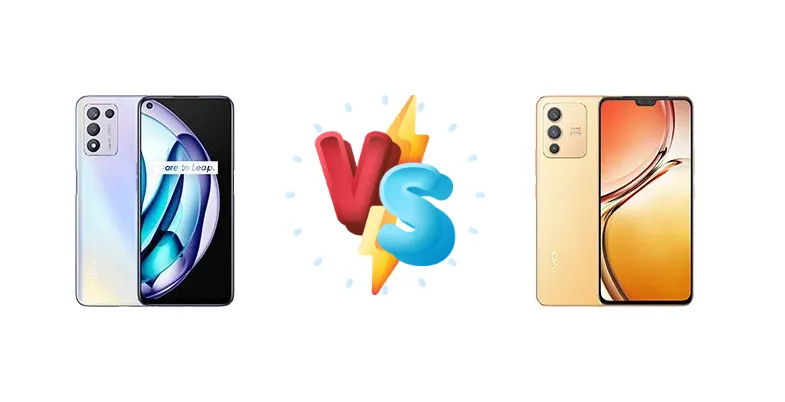
The Realme Q3s and vivo V23 5G represent compelling options in the increasingly competitive mid-range 5G smartphone market. While both aim to deliver a smooth experience without breaking the bank, they take different approaches to achieving this, primarily through chipset choice and charging implementation. This comparison dissects those differences to determine which device best suits your needs.
🏆 Quick Verdict
For the average user prioritizing sustained performance and value, the Realme Q3s emerges as the stronger contender. Its Snapdragon 778G 5G chipset offers a more balanced combination of CPU and GPU power, while the 30W charging is sufficient for daily use. The vivo V23 5G’s 44W charging is faster, but doesn't fully compensate for the Dimensity 920's slightly less efficient architecture.
| Network |
|---|
| 2G bands | GSM 850 / 900 / 1800 / 1900 | GSM 850 / 900 / 1800 / 1900 |
| 3G bands | HSDPA 850 / 900 / 1700(AWS) / 1900 / 2100 | HSDPA 850 / 900 / 1700(AWS) / 1900 / 2100 |
| 4G bands | 1, 3, 4, 5, 7, 8, 19, 28, 34, 38, 39, 40, 41 | 1, 2, 3, 4, 5, 8, 18, 19, 26, 38, 39, 40, 41 |
| 5G bands | 1, 28, 41, 77, 78 SA/NSA | 1, 3, 38, 40, 41, 77, 78 SA/NSA |
| Speed | HSPA, LTE, 5G | HSPA, LTE, 5G |
| Technology | GSM / CDMA / HSPA / EVDO / LTE / 5G | GSM / HSPA / LTE / 5G |
| | CDMA2000 1xEV-DO | 1, 3, 5, 8, 7, 20, 28, 38, 40, 41, 77, 78 SA/NSA |
| Launch |
|---|
| Announced | 2021, October 19 | 2022, January 05 |
| Status | Available. Released 2021, November 01 | Available. Released 2022, January 19 |
| Body |
|---|
| Build | - | Glass front (Schott Xensation Up), glass back |
| Dimensions | 164.4 x 75.8 x 8.5 mm (6.47 x 2.98 x 0.33 in) | 157.2 x 72.4 x 7.4 or 7.6 mm |
| SIM | Nano-SIM + Nano-SIM | Nano-SIM + Nano-SIM |
| Weight | 199 g (7.02 oz) | 179 g or 181 g (6.31 oz) |
| Display |
|---|
| Protection | - | Schott Xensation Up |
| Resolution | 1080 x 2412 pixels, 20:9 ratio (~401 ppi density) | 1080 x 2400 pixels, 20:9 ratio (~409 ppi density) |
| Size | 6.6 inches, 104.3 cm2 (~83.7% screen-to-body ratio) | 6.44 inches, 100.1 cm2 (~88.0% screen-to-body ratio) |
| Type | IPS LCD, 144Hz, 600 nits | AMOLED, 90Hz, HDR10+ |
| Platform |
|---|
| CPU | Octa-core (1x2.4 GHz Cortex-A78 & 3x2.2 GHz Cortex-A78 & 4x1.9 GHz Cortex-A55) | Octa-core (2x2.5 GHz Cortex-A78 & 6x2.0 GHz Cortex-A55) |
| Chipset | Qualcomm SM7325 Snapdragon 778G 5G (6 nm) | Mediatek Dimensity 920 (6 nm) |
| GPU | Adreno 642L | Mali-G68 MC4 |
| OS | Android 11, Realme UI 2.0 | Android 12, upgradable to Android 14, Funtouch 14 |
| Memory |
|---|
| Card slot | microSDXC (dedicated slot) | No |
| Internal | 128GB 6GB RAM, 128GB 8GB RAM, 256GB 8GB RAM | 128GB 8GB RAM, 256GB 12GB RAM |
| Main Camera |
|---|
| Dual | - | 50 MP, f/2.0, (wide), AF
8 MP, f/2.3, 105˚ (ultrawide) |
| Features | LED flash, HDR, panorama | Dual-LED flash, HDR, panorama |
| Single | 16 MP, f/2.1, 26mm (wide) | - |
| Triple | 48 MP, f/1.8, 26mm (wide), PDAF
2 MP (macro)
Auxiliary lens | 64 MP, f/1.9, 26mm (wide), PDAF
8 MP, f/2.2, 120˚, 16mm (ultrawide), 1/4.0", 1.12µm
2 MP (macro) |
| Video | 4K@30fps, 1080p@30/60fps | 4K@30fps, 1080p@30fps, gyro-EIS |
| Selfie camera |
|---|
| Dual | - | 50 MP, f/2.0, (wide), AF
8 MP, f/2.3, 105˚ (ultrawide) |
| Features | HDR, panorama | Dual-LED dual-tone flash, HDR |
| Single | 16 MP, f/2.1, 26mm (wide) | - |
| Video | 1080p@30fps | 4K@30fps, 1080p@30fps |
| Sound |
|---|
| 3.5mm jack | Yes | No |
| 35mm jack | Yes | No |
| Loudspeaker | Yes | Yes |
| | 24-bit/192kHz audio | 24-bit/192kHz audio |
| Comms |
|---|
| Bluetooth | 5.2, A2DP, LE | 5.2, A2DP, LE, aptX HD |
| NFC | No | Yes (market/region dependent) |
| Positioning | GPS, GLONASS, BDS, GALILEO, QZSS | GPS, GLONASS, BDS, GALILEO, QZSS, NavIC |
| Radio | No | No |
| USB | USB Type-C 2.0, OTG | USB Type-C, OTG |
| WLAN | Wi-Fi 802.11 a/b/g/n/ac/6, dual-band, Wi-Fi Direct | Wi-Fi 802.11 a/b/g/n/ac, Wi-Fi 6 (market dependent), dual-band, Wi-Fi Direct |
| Features |
|---|
| Sensors | Fingerprint (side-mounted), accelerometer, gyro, proximity, compass | Fingerprint (under display, optical), accelerometer, gyro, proximity, compass |
| | - | Color changing back panel when exposed to sunlight |
| Battery |
|---|
| Charging | 30W wired, 50% in 25 min | 44W wired, 68% in 30 min |
| Type | 5000 mAh | 4200 mAh |
| Misc |
|---|
| Colors | Aurora, Dark Blue | Sunshine Gold, Stardust Black |
| Models | - | V2130, V2303 |
| Price | About 200 EUR | About 280 EUR |
| SAR | - | 1.08 W/kg (head) 0.72 W/kg (body) |
| Tests |
|---|
| Battery life | - |
Endurance rating 103h
|
| Camera | - |
Photo / Video |
| Display | - |
Contrast ratio: Infinite (nominal) |
| Loudspeaker | - |
-28.5 LUFS (Average)
|
| Performance | - |
AnTuTu: 406498 (v8), 476058 (v9)
GeekBench: 8421 (v4.4), 2140 (v5.1)
GFXBench: 22fps (ES 3.1 onscreen) |
Realme Q3s
- Stronger sustained performance with Snapdragon 778G
- Balanced CPU/GPU configuration for gaming
- Competitive price point
- Slower charging speed compared to vivo V23 5G
- Display brightness data unavailable
vivo V23 5G
- Faster 44W wired charging
- Brighter display (629 nits)
- Potentially higher peak CPU performance
- Dimensity 920 may throttle under sustained load
- Slightly less efficient chipset architecture
Display Comparison
The vivo V23 5G boasts a measured peak brightness of 629 nits, suggesting a more visible screen outdoors compared to the Realme Q3s (brightness data unavailable). While both displays have an 'infinite' contrast ratio (nominal), the real-world difference will depend on panel quality and calibration. Without specific details on the Q3s’ panel type or brightness, the V23 5G has a clear advantage for users who frequently consume content in bright environments.
Camera Comparison
Both devices are listed as having 'Photo / Video' capabilities, lacking specific details. Without sensor size or aperture information, a direct comparison is difficult. However, the market segment suggests both will rely on software processing to enhance image quality. The absence of details on OIS (Optical Image Stabilization) is a significant omission; its presence would be a major differentiator. We can assume both will include standard features like portrait mode and night mode, but image quality will ultimately depend on the underlying hardware and software tuning.
Performance
The core difference lies in the chipsets: the Realme Q3s utilizes the Qualcomm SM7325 Snapdragon 778G 5G (6nm) and the vivo V23 5G features the Mediatek Dimensity 920 (6nm). The Snapdragon 778G’s CPU configuration – 1x2.4 GHz Cortex-A78, 3x2.2 GHz Cortex-A78, and 4x1.9 GHz Cortex-A55 – is optimized for a balance of performance and efficiency. The Dimensity 920, with its 2x2.5 GHz Cortex-A78 and 6x2.0 GHz Cortex-A55, prioritizes peak CPU performance, but may exhibit more thermal throttling during extended demanding tasks. Both are 6nm chips, but Qualcomm’s architecture generally provides better sustained performance.
Battery Life
Both phones share an endurance rating of 103 hours, indicating similar overall battery life despite differing charging speeds. The vivo V23 5G’s 44W wired charging is significantly faster, achieving 68% charge in 30 minutes, while the Realme Q3s reaches 50% in 25 minutes. This faster charging is beneficial for users who frequently need to top up their battery quickly. However, the similar endurance rating suggests the Q3s’ battery optimization is effective, mitigating the slower charging speed.
Buying Guide
Buy the Realme Q3s if you need a phone that excels in gaming and multitasking, offering a consistently smooth experience thanks to the Snapdragon 778G. Buy the vivo V23 5G if you prioritize faster charging speeds and a potentially brighter display, and are willing to accept a slight trade-off in sustained performance under heavy load.
Frequently Asked Questions
❓ Does the Dimensity 920 in the vivo V23 5G get noticeably hot during extended gaming sessions?
The Dimensity 920, while powerful, is known to generate more heat than the Snapdragon 778G under sustained load. While the phone likely has thermal management systems, users should expect some throttling and potential discomfort during prolonged gaming, especially with demanding titles. The Snapdragon 778G in the Q3s is generally more efficient and maintains performance for longer.
❓ Is the 44W charging on the vivo V23 5G a significant advantage over the Realme Q3s' 30W charging in real-world use?
Yes, the 44W charging is noticeably faster. Achieving 68% charge in 30 minutes versus 50% on the Q3s represents a substantial time saving. This is particularly beneficial for users who frequently need to quickly top up their battery before leaving the house or during short breaks. However, both phones offer similar overall endurance, so the slower charging isn't a dealbreaker for everyone.
❓ How does the CPU core configuration of the Snapdragon 778G compare to the Dimensity 920 in terms of multitasking?
The Snapdragon 778G's CPU configuration (1x2.4 GHz Cortex-A78, 3x2.2 GHz Cortex-A78, 4x1.9 GHz Cortex-A55) features more high-performance cores (A78) than the Dimensity 920 (2x2.5 GHz Cortex-A78, 6x2.0 GHz Cortex-A55). This can translate to smoother multitasking and quicker app switching, especially when running multiple demanding applications simultaneously.