
Realme Q3s vs Motorola Edge 20 Fusion: A Deep Dive into Mid-Range 5G Contenders
| Phones Images | |||||
|---|---|---|---|---|---|
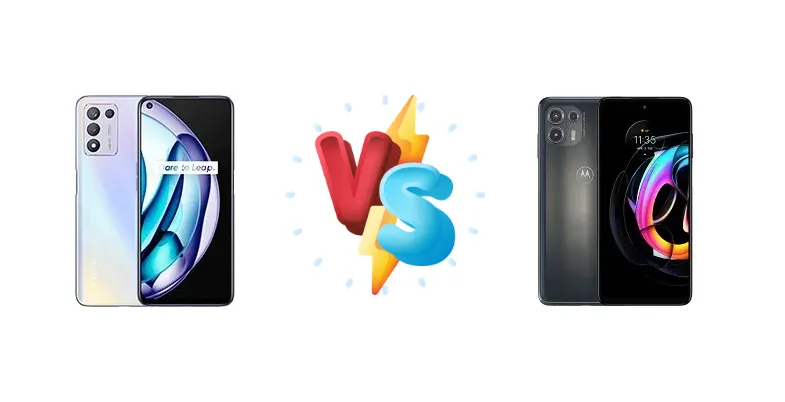
|
🏆 Quick Verdict
For most users, the Realme Q3s emerges as the stronger choice. Its Snapdragon 778G chipset, built on a more efficient 6nm process, provides a noticeable performance advantage and better long-term thermal management compared to the Motorola Edge 20 Fusion’s Dimensity 800U. While both offer 30W charging, the Q3s’ superior processing power makes it the better all-rounder.
| PHONES | ||
|---|---|---|
| Phone Names | Realme Q3s | Motorola Edge 20 Fusion |
| Network | ||
|---|---|---|
| 2G bands | GSM 850 / 900 / 1800 / 1900 | GSM 850 / 900 / 1800 / 1900 |
| 3G bands | HSDPA 850 / 900 / 1700(AWS) / 1900 / 2100 | HSDPA 850 / 900 / 1700(AWS) / 1900 / 2100 |
| 4G bands | 1, 3, 4, 5, 7, 8, 19, 28, 34, 38, 39, 40, 41 | 1, 2, 3, 4, 5, 7, 8, 12, 13, 17, 18, 19, 20, 26, 28, 32, 34, 38, 39, 40, 41, 42, 43, 66 |
| 5G bands | 1, 28, 41, 77, 78 SA/NSA | 1, 3, 5, 7, 8, 20, 28, 38, 40, 41, 77, 78, 66 SA/NSA/Sub6 |
| Speed | HSPA, LTE, 5G | HSPA 42.2/5.76 Mbps, LTE Cat18 1200/150 Mbps, 5G |
| Technology | GSM / CDMA / HSPA / EVDO / LTE / 5G | GSM / HSPA / LTE / 5G |
| CDMA2000 1xEV-DO | - | |
| Launch | ||
|---|---|---|
| Announced | 2021, October 19 | 2021, August 17 |
| Status | Available. Released 2021, November 01 | Available. Released 2021, August 27 |
| Body | ||
|---|---|---|
| Build | - | Glass front |
| Dimensions | 164.4 x 75.8 x 8.5 mm (6.47 x 2.98 x 0.33 in) | 166 x 76 x 8.3 mm (6.54 x 2.99 x 0.33 in) |
| SIM | Nano-SIM + Nano-SIM | Nano-SIM + Nano-SIM |
| Weight | 199 g (7.02 oz) | 185 g (6.53 oz) |
| - | Water-repellent design | |
| Display | ||
|---|---|---|
| Resolution | 1080 x 2412 pixels, 20:9 ratio (~401 ppi density) | 1080 x 2400 pixels, 20:9 ratio (~393 ppi density) |
| Size | 6.6 inches, 104.3 cm2 (~83.7% screen-to-body ratio) | 6.7 inches, 108.4 cm2 (~85.9% screen-to-body ratio) |
| Type | IPS LCD, 144Hz, 600 nits | OLED, 1B colors, 90Hz, HDR10+ |
| Platform | ||
|---|---|---|
| CPU | Octa-core (1x2.4 GHz Cortex-A78 & 3x2.2 GHz Cortex-A78 & 4x1.9 GHz Cortex-A55) | Octa-core (2x2.4 GHz Cortex-A76 & 6x2.0 GHz Cortex-A55) |
| Chipset | Qualcomm SM7325 Snapdragon 778G 5G (6 nm) | Mediatek Dimensity 800U (7 nm) |
| GPU | Adreno 642L | Mali-G57 MC3 |
| OS | Android 11, Realme UI 2.0 | Android 11 |
| Memory | ||
|---|---|---|
| Card slot | microSDXC (dedicated slot) | microSDXC |
| Internal | 128GB 6GB RAM, 128GB 8GB RAM, 256GB 8GB RAM | 128GB 6GB RAM, 128GB 8GB RAM |
| Main Camera | ||
|---|---|---|
| Features | LED flash, HDR, panorama | LED flash, HDR, panorama |
| Single | 16 MP, f/2.1, 26mm (wide) | - |
| Triple | 48 MP, f/1.8, 26mm (wide), PDAF 2 MP (macro) Auxiliary lens | 108 MP, f/1.9, (wide), 1/1.52", 0.7µm, PDAF 8 MP, f/2.2, 118˚ (ultrawide) Auxiliary lens |
| Video | 4K@30fps, 1080p@30/60fps | 4K@30fps, 1080p@30/60/120fps, gyro-EIS |
| Selfie camera | ||
|---|---|---|
| Features | HDR, panorama | HDR |
| Single | 16 MP, f/2.1, 26mm (wide) | 32 MP, f/2.3, (wide), 0.7µm |
| Video | 1080p@30fps | 1080p@30fps |
| Sound | ||
|---|---|---|
| 3.5mm jack | Yes | Yes |
| 35mm jack | Yes | Yes |
| Loudspeaker | Yes | Yes |
| 24-bit/192kHz audio | - | |
| Comms | ||
|---|---|---|
| Bluetooth | 5.2, A2DP, LE | 5.0, A2DP, LE |
| NFC | No | Yes |
| Positioning | GPS, GLONASS, BDS, GALILEO, QZSS | GPS, GLONASS, GALILEO |
| Radio | No | FM radio |
| USB | USB Type-C 2.0, OTG | USB Type-C 2.0 |
| WLAN | Wi-Fi 802.11 a/b/g/n/ac/6, dual-band, Wi-Fi Direct | Wi-Fi 802.11 a/b/g/n/ac, dual-band, Wi-Fi Direct |
| Features | ||
|---|---|---|
| Sensors | Fingerprint (side-mounted), accelerometer, gyro, proximity, compass | Fingerprint (side-mounted), accelerometer, gyro, proximity, compass |
| Battery | ||
|---|---|---|
| Charging | 30W wired, 50% in 25 min | 30W wired |
| Type | 5000 mAh | Li-Po 5000 mAh |
| Misc | ||
|---|---|---|
| Colors | Aurora, Dark Blue | Electric Graphite, Cyber Teal |
| Price | About 200 EUR | About 250 EUR |
Realme Q3s
- Superior chipset performance with Snapdragon 778G
- More efficient 6nm process for better battery life and thermal management
- Potentially better image processing due to advanced ISP
- Realme’s UI can be polarizing for some users
- Lack of detailed display specifications
Motorola Edge 20 Fusion
- Potentially refined software experience (Motorola’s near-stock Android)
- Competitive price point
- 30W fast charging
- Older Dimensity 800U chipset with less processing power
- Less efficient 7nm process
- Potentially inferior image processing
Display Comparison
Neither device’s display specifications are provided, so a direct comparison is limited. However, given the market positioning, both likely feature 120Hz AMOLED panels. The key difference will likely lie in peak brightness and color calibration. Motorola historically focuses on accurate color profiles, while Realme often prioritizes vibrant, punchy colors. The absence of LTPO technology on either suggests standard refresh rate scaling, impacting battery life during dynamic content.
Camera Comparison
Without detailed camera specs, analysis is limited. However, the chipset plays a role. The Snapdragon 778G’s ISP (Image Signal Processor) is generally more advanced than the Dimensity 800U’s, potentially leading to better image processing, especially in low-light conditions. The absence of information regarding sensor size and OIS makes a definitive camera comparison impossible, but the Q3s’ superior processing power gives it an edge in computational photography.
Performance
The core of the difference lies in the chipsets. The Realme Q3s boasts the Qualcomm SM7325 Snapdragon 778G 5G (6nm), featuring an octa-core CPU with a prime Cortex-A78 core clocked at 2.4GHz. This is a significant advantage over the Motorola Edge 20 Fusion’s MediaTek Dimensity 800U (7nm). While both are octa-core, the Dimensity 800U uses older Cortex-A76 cores at 2.4GHz, and a less efficient 7nm process. The Snapdragon 778G’s Adreno 642L GPU also provides a substantial graphical uplift. This translates to smoother gaming, faster app loading times, and improved multitasking on the Realme Q3s. The 6nm process also contributes to better thermal efficiency, reducing the likelihood of performance throttling during extended use.
Battery Life
Both devices feature 30W wired charging, offering a similar charging speed – both claim 50% charge in around 25 minutes. The actual battery capacity is unknown for both devices. However, the Snapdragon 778G’s 6nm process is more power-efficient than the Dimensity 800U’s 7nm process. This means the Realme Q3s is likely to achieve comparable or better battery life despite potentially having a similar or even smaller battery capacity. The efficiency gain is crucial for all-day usability.
Buying Guide
Buy the Realme Q3s if you prioritize gaming performance, sustained CPU/GPU loads, and future-proofing with a more modern chipset architecture. It’s ideal for users who frequently multitask, play demanding mobile games, or simply want a phone that feels responsive for years to come. Buy the Motorola Edge 20 Fusion if you prefer a potentially more refined software experience (depending on Motorola’s skin) and are less concerned with pushing the absolute limits of mobile gaming or intensive applications. It’s a solid choice for everyday tasks and media consumption.