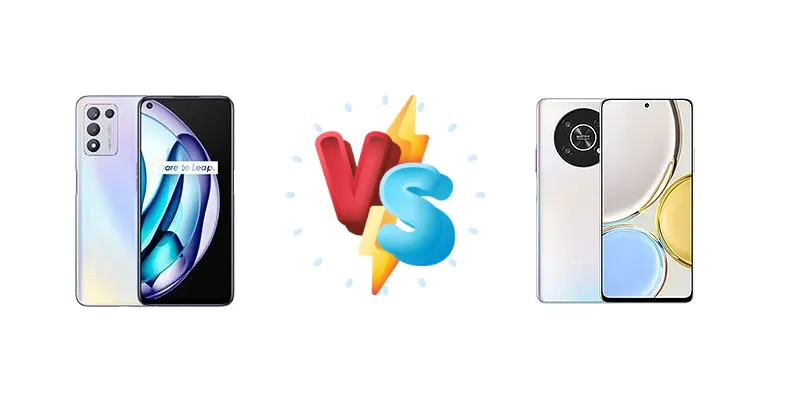
The Realme Q3s and Honor X9 5G represent compelling options in the increasingly competitive mid-range 5G smartphone market. While both aim to deliver 5G connectivity at accessible price points, they diverge significantly in their core processing power and charging capabilities. This comparison dissects these differences, helping you determine which device best suits your needs.
🏆 Quick Verdict
For users prioritizing raw performance and sustained gaming, the Realme Q3s, powered by the Snapdragon 778G 5G, is the clear winner. However, the Honor X9 5G’s significantly faster 66W charging offers a substantial convenience advantage for those who value quick top-ups over peak processing speed.
| Network |
|---|
| 2G bands | GSM 850 / 900 / 1800 / 1900 | GSM 850 / 900 / 1800 / 1900 |
| 3G bands | HSDPA 850 / 900 / 1700(AWS) / 1900 / 2100 | HSDPA 850 / 900 / 1700(AWS) / 1900 / 2100 |
| 4G bands | 1, 3, 4, 5, 7, 8, 19, 28, 34, 38, 39, 40, 41 | LTE |
| 5G bands | 1, 28, 41, 77, 78 SA/NSA | SA/NSA |
| Speed | HSPA, LTE, 5G | HSPA, LTE, 5G |
| Technology | GSM / CDMA / HSPA / EVDO / LTE / 5G | GSM / HSPA / LTE / 5G |
| | CDMA2000 1xEV-DO | Virtual proximity sensing |
| Launch |
|---|
| Announced | 2021, October 19 | 2022, March 29 |
| Status | Available. Released 2021, November 01 | Available. Released 2022, March 29 |
| Body |
|---|
| Build | - | Glass front, plastic frame, plastic back |
| Dimensions | 164.4 x 75.8 x 8.5 mm (6.47 x 2.98 x 0.33 in) | 166.1 x 75.8 x 8.1 mm (6.54 x 2.98 x 0.32 in) |
| SIM | Nano-SIM + Nano-SIM | Nano-SIM + Nano-SIM |
| Weight | 199 g (7.02 oz) | 189 g (6.67 oz) |
| Display |
|---|
| Resolution | 1080 x 2412 pixels, 20:9 ratio (~401 ppi density) | 1080 x 2388 pixels (~385 ppi density) |
| Size | 6.6 inches, 104.3 cm2 (~83.7% screen-to-body ratio) | 6.81 inches, 112.3 cm2 (~89.2% screen-to-body ratio) |
| Type | IPS LCD, 144Hz, 600 nits | IPS LCD, 120Hz |
| Platform |
|---|
| CPU | Octa-core (1x2.4 GHz Cortex-A78 & 3x2.2 GHz Cortex-A78 & 4x1.9 GHz Cortex-A55) | Octa-core (2x2.2 GHz Kryo 660 Gold & 6x1.8 GHz Kryo 660 Silver) |
| Chipset | Qualcomm SM7325 Snapdragon 778G 5G (6 nm) | Qualcomm SM6375 Snapdragon 695 5G (6 nm) |
| GPU | Adreno 642L | Adreno 619 |
| OS | Android 11, Realme UI 2.0 | Android 11, Magic UI 4.2 |
| Memory |
|---|
| Card slot | microSDXC (dedicated slot) | No |
| Internal | 128GB 6GB RAM, 128GB 8GB RAM, 256GB 8GB RAM | 128GB 8GB RAM, 256GB 8GB RAM |
| Main Camera |
|---|
| Features | LED flash, HDR, panorama | LED flash, panorama, HDR |
| Single | 16 MP, f/2.1, 26mm (wide) | 16 MP, f/2.5 |
| Triple | 48 MP, f/1.8, 26mm (wide), PDAF
2 MP (macro)
Auxiliary lens | 48 MP, f/1.8, 26mm (wide), PDAF
2 MP (macro)
Auxiliary lens |
| Video | 4K@30fps, 1080p@30/60fps | 1080p@30fps |
| Selfie camera |
|---|
| Features | HDR, panorama | - |
| Single | 16 MP, f/2.1, 26mm (wide) | 16 MP, f/2.5 |
| Video | 1080p@30fps | 1080p@30fps |
| Sound |
|---|
| 3.5mm jack | Yes | No |
| 35mm jack | Yes | No |
| Loudspeaker | Yes | Yes |
| | 24-bit/192kHz audio | - |
| Comms |
|---|
| Bluetooth | 5.2, A2DP, LE | 5.1, A2DP, LE |
| NFC | No | Yes |
| Positioning | GPS, GLONASS, BDS, GALILEO, QZSS | GPS, GLONASS, GALILEO, BDS |
| Radio | No | No |
| USB | USB Type-C 2.0, OTG | USB Type-C 2.0, OTG |
| WLAN | Wi-Fi 802.11 a/b/g/n/ac/6, dual-band, Wi-Fi Direct | Wi-Fi 802.11 a/b/g/n/ac, dual-band, Wi-Fi Direct |
| Features |
|---|
| Sensors | Fingerprint (side-mounted), accelerometer, gyro, proximity, compass | Fingerprint (side-mounted), accelerometer, gyro, compass |
| Battery |
|---|
| Charging | 30W wired, 50% in 25 min | 66W wired, 81% in 30 min |
| Type | 5000 mAh | Li-Po 4800 mAh |
| Misc |
|---|
| Colors | Aurora, Dark Blue | Titanium Silver, Ocean Blue, Midnight Black |
| Models | - | ANY-NX1 |
| Price | About 200 EUR | About 240 EUR |
Realme Q3s
- Superior processing power with Snapdragon 778G
- Better gaming performance
- Potentially improved image processing
- Slower charging speed (30W)
- Display specs unknown, potentially average
Honor X9 5G
- Significantly faster 66W charging
- Potentially better battery life with moderate use
- Likely more recent software updates
- Less powerful Snapdragon 695 chipset
- Lower gaming performance
- Image processing may be less refined
Display Comparison
Neither device's display specifications are provided, so a direct comparison is limited. However, given the market positioning, both likely feature LCD panels with 60Hz or 90Hz refresh rates. The Honor X9 5G, being a newer model, *may* benefit from slightly improved color calibration or peak brightness, but this is speculative. Bezels are likely comparable, focusing on maximizing screen real estate within their respective price brackets.
Camera Comparison
Without detailed camera specs, a precise comparison is difficult. However, the Snapdragon 778G’s ISP (Image Signal Processor) generally offers more advanced image processing capabilities than the 695’s. This means the Q3s is likely to produce images with better dynamic range and detail, particularly in challenging lighting conditions. The absence of information regarding sensor sizes and OIS makes a definitive statement impossible, but the chipset advantage leans towards the Realme Q3s.
Performance
The core difference lies in the chipsets. The Realme Q3s boasts the Qualcomm SM7325 Snapdragon 778G 5G (6 nm), featuring an octa-core CPU with a prime Cortex-A78 core clocked at 2.4 GHz. This architecture, built on a 6nm process, delivers significantly higher sustained performance than the Honor X9 5G’s Snapdragon 695 5G (6 nm). The 695 utilizes Kryo 660 Gold and Silver cores, maxing out at 2.2 GHz. While both are 6nm chips, the 778G’s more powerful core configuration and superior GPU translate to smoother multitasking, faster app loading times, and a more enjoyable gaming experience. The Q3s will handle graphically intensive titles at higher settings with less frame rate drop. The 778G also benefits from a more mature software optimization ecosystem.
Battery Life
The Realme Q3s supports 30W wired charging, achieving 50% charge in 25 minutes. The Honor X9 5G, however, shines with its 66W wired charging, reaching 81% in the same 30-minute timeframe. While battery capacity isn’t specified, the Honor X9 5G’s faster charging is a significant advantage for users who frequently need to quickly replenish their battery. The Q3s’s more efficient chipset *may* offset some of this difference in real-world usage, but the X9 5G’s charging speed is undeniably faster.
Buying Guide
Buy the Realme Q3s if you need a phone capable of handling demanding games and applications with relative ease, and you don't mind slightly slower charging. It's ideal for mobile gamers and power users. Buy the Honor X9 5G if you prioritize rapid charging and all-day battery life with moderate usage. It’s a better fit for users who primarily browse, stream content, and use social media.
Frequently Asked Questions
❓ Will the Snapdragon 695 in the Honor X9 5G struggle with demanding games like Genshin Impact?
Yes, the Snapdragon 695 is a mid-range chipset and will likely require significant graphics settings reductions to achieve playable frame rates in demanding titles like Genshin Impact. Expect noticeable frame drops and potentially longer loading times compared to the Realme Q3s with its Snapdragon 778G.
❓ How much faster is the 66W charging on the Honor X9 5G compared to the 30W charging on the Realme Q3s in a typical use case?
While the Honor X9 5G reaches 81% in 30 minutes, the Realme Q3s only reaches 50%. This means you'll gain approximately 31% more battery life in the same timeframe with the Honor X9 5G, making it ideal for users who need a quick boost before heading out.
❓ Does the Realme Q3s's Snapdragon 778G offer noticeable improvements in app loading times compared to the Honor X9 5G?
Yes, the Snapdragon 778G's more powerful CPU and faster storage access speeds will result in noticeably quicker app loading times, especially for larger applications like social media platforms and games. Multitasking will also feel smoother on the Q3s.