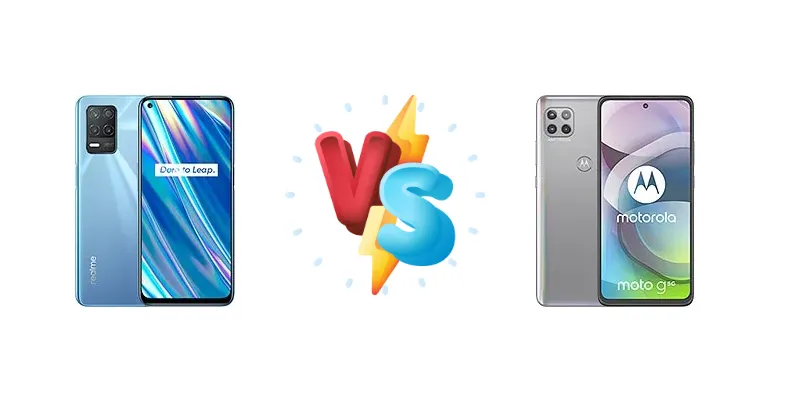
The Realme Q3i 5G and Motorola Moto G 5G represent compelling options in the increasingly competitive budget 5G smartphone market. Both aim to deliver 5G connectivity without breaking the bank, but they achieve this with different chipsets and feature sets. This comparison dives deep into the specifics to determine which device offers the best value for your money.
🏆 Quick Verdict
For most users, the Motorola Moto G 5G emerges as the slightly better choice. While both phones share an endurance rating of 131 hours, the Snapdragon 750G’s 8nm process offers a potential edge in sustained performance and efficiency, coupled with a slightly faster 20W charging solution.
| Network |
|---|
| 2G bands | GSM 850 / 900 / 1800 / 1900 | GSM 850 / 900 / 1800 / 1900 |
| 3G bands | HSDPA 800 / 850 / 900 / 1900 / 2100 | HSDPA 850 / 900 / 1700(AWS) / 1900 / 2100 |
| 4G bands | LTE | 1, 2, 3, 4, 5, 7, 8, 18, 19, 20, 26, 28, 38, 39, 40, 41, 42, 43 |
| 5G bands | SA/NSA | 1, 3, 5, 7, 8, 28, 38, 41, 77, 78 SA/NSA |
| Speed | HSPA, LTE, 5G | HSPA, LTE, 5G |
| Technology | GSM / CDMA / HSPA / CDMA2000 / LTE / 5G | GSM / HSPA / LTE / 5G |
| | CDMA2000 1x | - |
| Launch |
|---|
| Announced | 2021, April 22 | 2020, November 05. Released 2020, December 07 |
| Status | Available. Released 2021, April 22 | Discontinued |
| Body |
|---|
| Build | - | Glass front, plastic back, plastic frame |
| Dimensions | 162.5 x 74.8 x 8.5 mm (6.40 x 2.94 x 0.33 in) | 166.1 x 76.1 x 9.9 mm (6.54 x 3.00 x 0.39 in) |
| SIM | Nano-SIM + Nano-SIM | Nano-SIM + Nano-SIM |
| Weight | 185 g (6.53 oz) | 212 g (7.48 oz) |
| Display |
|---|
| Resolution | 1080 x 2400 pixels, 20:9 ratio (~405 ppi density) | 1080 x 2400 pixels, 20:9 ratio (~393 ppi density) |
| Size | 6.5 inches, 102.0 cm2 (~83.9% screen-to-body ratio) | 6.7 inches, 108.4 cm2 (~85.7% screen-to-body ratio) |
| Type | IPS LCD, 90Hz, 480 nits (typ), 600 nits | IPS LCD, HDR10 |
| Platform |
|---|
| CPU | Octa-core (2x2.2 GHz Cortex-A76 & 6x2.0 GHz Cortex-A55) | Octa-core (2x2.2 GHz Kryo 570 & 6x1.8 GHz Kryo 570) |
| Chipset | Mediatek Dimensity 700 (7 nm) | Qualcomm SM7225 Snapdragon 750G 5G (8 nm) |
| GPU | Mali-G57 MC2 | Adreno 619 |
| OS | Android 11, Realme UI 2.0 | Android 10 |
| Memory |
|---|
| Card slot | microSDXC (dedicated slot) | microSDXC (uses shared SIM slot) |
| Internal | 128GB 4GB RAM, 128GB 6GB RAM | 64GB 4GB RAM, 128GB 2GB RAM, 128GB 6GB RAM |
| | UFS 2.1 | - |
| Main Camera |
|---|
| Features | LED flash, HDR, panorama | LED flash, HDR, panorama |
| Single | 16 MP, f/2.1, 26mm (wide) | - |
| Triple | 48 MP, f/1.8, 26mm (wide), PDAF
2 MP (macro)
Auxiliary lens | 48 MP, f/1.7, 26mm (wide), 1/2.0", 0.8µm, PDAF
8 MP, f/2.2, 118˚ (ultrawide), 1.12µm
2 MP (macro), AF |
| Video | 1080p@30fps | 4K@30fps, 1080p@30/60fps, gyro-EIS |
| Selfie camera |
|---|
| Features | HDR | HDR |
| Single | 16 MP, f/2.1, 26mm (wide) | 16 MP, f/2.2, (wide), 1.0µm |
| Video | 1080p@30fps | 1080p@30fps |
| Sound |
|---|
| 3.5mm jack | Yes | Yes |
| 35mm jack | Yes | Yes |
| Loudspeaker | Yes | Yes |
| | 24-bit/192kHz audio | - |
| Comms |
|---|
| Bluetooth | 5.1, A2DP, LE | 5.1, A2DP, LE |
| NFC | No | Yes |
| Positioning | GPS, GLONASS, BDS, GALILEO, QZSS | GPS (L1+L5), GLONASS, GALILEO |
| Radio | Unspecified | FM radio, RDS |
| USB | USB Type-C 2.0 | USB Type-C 2.0 |
| WLAN | Wi-Fi 802.11 a/b/g/n/ac, dual-band, Wi-Fi Direct | Wi-Fi 802.11 a/b/g/n/ac, dual-band, Wi-Fi Direct |
| Features |
|---|
| Sensors | Fingerprint (side-mounted), accelerometer, gyro, proximity, compass | Fingerprint (rear-mounted), accelerometer, gyro, proximity, compass |
| Battery |
|---|
| Charging | 18W wired | 20W wired |
| Type | 5000 mAh | Li-Po 5000 mAh |
| Misc |
|---|
| Colors | Supersonic Blue, Supersonic Black | Volcanic Gray, Frosted Silver |
| Models | RMX3042 | - |
| Price | About 130 EUR | About 90 EUR |
| Tests |
|---|
| Battery life | - | Endurance rating 131h |
| Camera | - |
Photo / Video |
| Display | - |
Contrast ratio: 1419:1 |
| Loudspeaker | - |
-28.1 LUFS (Average) |
| Performance | - |
AnTuTu: 312461 (v8)
GeekBench: 1980 (v5.1)
GFXBench: 17fps (ES 3.1 onscreen) |
Realme Q3i 5G
- Potentially lower price point
- 5G connectivity
- Decent battery endurance
- Less efficient chipset (7nm vs 8nm)
- Slower charging (18W)
- Lack of detailed display specifications
Motorola Moto G 5G
- More efficient chipset (8nm)
- Faster charging (20W)
- Measured display brightness and contrast
- Potentially higher price
- Similar battery endurance to Q3i 5G
- Camera details are vague
Display Comparison
The Motorola Moto G 5G boasts a measured peak brightness of 484 nits and a 1419:1 contrast ratio, providing a more quantifiable understanding of its display quality. The Realme Q3i 5G lacks this specific data, making it difficult to assess its visual performance objectively. While both likely utilize LCD panels given their price points, the Moto G 5G’s measured specs suggest a more vibrant and visible display, particularly outdoors. Bezels are expected to be similar on both devices, reflecting their budget positioning.
Camera Comparison
Both phones are listed as having 'Photo / Video' capabilities, lacking specific details. This suggests a similar approach to camera systems – likely a main sensor paired with depth or macro lenses. Without sensor size or aperture information, it’s difficult to assess image quality. The prevalence of 2MP macro lenses in this segment suggests they are unlikely to be a significant selling point for either device. Image processing will likely differ, with Motorola often favoring a more natural look and Realme tending towards more saturated colors.
Performance
The core difference lies in the chipsets: the Realme Q3i 5G utilizes the Mediatek Dimensity 700 (7nm), while the Motorola Moto G 5G features the Qualcomm Snapdragon 750G (8nm). The Snapdragon 750G’s 8nm process generally translates to better thermal efficiency compared to the Dimensity 700’s 7nm node, potentially reducing throttling during extended gaming or demanding tasks. Both CPUs feature a similar core configuration (2x2.2 GHz + 6x lower clock speed), but the Kryo 570 cores in the Snapdragon 750G are architecturally different from the Cortex-A76/A55 in the Dimensity 700, potentially offering a slight performance advantage in certain workloads. RAM configurations are not specified, but LPDDR4X is likely on both.
Battery Life
Both the Realme Q3i 5G and Motorola Moto G 5G achieve an endurance rating of 131 hours, indicating comparable battery life under similar usage conditions. However, the Motorola Moto G 5G supports 20W wired charging, while the Realme Q3i 5G is limited to 18W. This 2W difference, while seemingly small, can translate to a faster 0-100% charge time for the Moto G 5G, offering a convenience advantage.
Buying Guide
Buy the Realme Q3i 5G if you prioritize a potentially lower price point and are primarily focused on basic 5G connectivity for everyday tasks. Buy the Motorola Moto G 5G if you value a more refined chipset with a potential for better long-term performance, slightly faster charging, and a display with measured brightness and contrast data available for informed decision-making.
Frequently Asked Questions
❓ Will the Snapdragon 750G in the Moto G 5G handle demanding games like PUBG or Call of Duty?
The Snapdragon 750G is capable of running PUBG and Call of Duty at medium settings. While it won't deliver flagship-level performance, the 8nm process and Adreno 619 GPU provide a reasonable gaming experience. Expect some frame drops during intense scenes, but it's generally playable.
❓ How long will it take to fully charge the Motorola Moto G 5G with the 20W charger?
While Motorola doesn't provide an exact figure, a 20W charger should fully charge the Moto G 5G in approximately 1 hour and 45 minutes to 2 hours, depending on usage during charging. This is faster than the Realme Q3i 5G's 18W charging.
❓ Is the camera on either phone good enough for casual social media photos?
Both phones should be adequate for casual social media photography in good lighting conditions. However, don't expect exceptional image quality, especially in low light. The lack of OIS and detailed sensor information suggests they will struggle in challenging scenarios.
❓ Does the Realme Q3i 5G support VoWiFi (WiFi Calling)?
Support for VoWiFi varies by carrier and region. Realme's documentation doesn't explicitly state VoWiFi support for the Q3i 5G, so it's best to check with your mobile carrier to confirm compatibility.