
OnePlus Nord 2 5G vs Realme Q3 Pro 5G: Which Dimensity Powerhouse Reigns Supreme?
| Phones Images | |||||
|---|---|---|---|---|---|
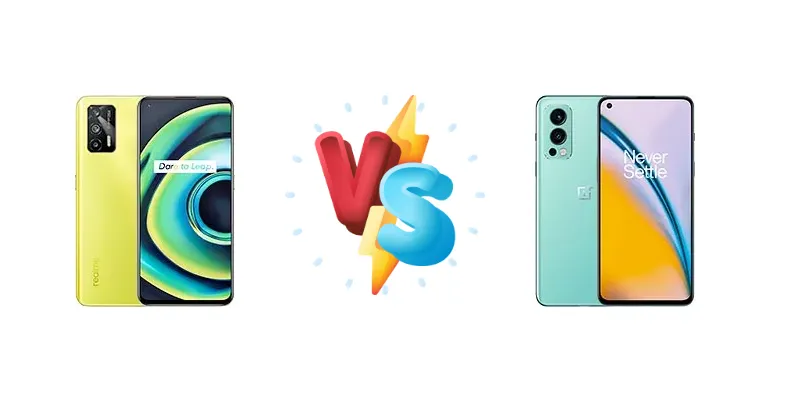
|
🏆 Quick Verdict
For most users, the OnePlus Nord 2 5G emerges as the superior choice. Its faster 65W charging, coupled with a comparable battery endurance rating of 102 hours, significantly reduces downtime. While the Q3 Pro offers a competitive price, the Nord 2’s refined experience justifies the price premium.
| PHONES | ||
|---|---|---|
| Phone Names | Realme Q3 Pro 5G | OnePlus Nord 2 5G |
| Network | ||
|---|---|---|
| 2G bands | GSM 850 / 900 / 1800 / 1900 | GSM 850 / 900 / 1800 / 1900 |
| 3G bands | HSDPA 800 / 850 / 900 / 1700(AWS) / 1900 / 2100 | HSDPA 800 / 850 / 900 / 1700(AWS) / 1800 / 1900 / 2100 |
| 4G bands | 1, 2, 3, 4, 5, 7, 8, 28, 34, 38, 39, 40, 41 | 1, 2, 3, 4, 5, 7, 8, 12, 17, 18, 19, 20, 26, 28, 32, 34, 38, 39, 40, 41, 66 - EU |
| 5G bands | 1, 28, 40, 41, 77, 78, 79 SA/NSA | 1, 3, 7, 8, 20, 28, 38, 41, 66, 78 SA/NSA - EU |
| Speed | HSPA, LTE, 5G | HSPA 42.2/5.76 Mbps, LTE Cat18 1200/150 Mbps, 5G |
| Technology | GSM / CDMA / HSPA / CDMA2000 / LTE / 5G | GSM / HSPA / LTE / 5G |
| CDMA2000 1x | - | |
| Launch | ||
|---|---|---|
| Announced | 2021, April 22 | 2021, July 22 |
| Status | Available. Released 2021, April 29 | Available. Released 2021, July 28 |
| Body | ||
|---|---|---|
| Build | - | Glass front (Gorilla Glass 5), glass back (Gorilla Glass 5), plastic frame |
| Dimensions | 158.5 x 73.3 x 8.4 mm (6.24 x 2.89 x 0.33 in) | 159.1 x 73.3 x 8.3 mm (6.26 x 2.89 x 0.33 in) |
| SIM | Nano-SIM + Nano-SIM | Nano-SIM + Nano-SIM |
| Weight | 179 g (6.31 oz) | 189 g (6.67 oz) |
| Display | ||
|---|---|---|
| Protection | - | Corning Gorilla Glass 5 |
| Resolution | 1080 x 2400 pixels, 20:9 ratio (~409 ppi density) | 1080 x 2400 pixels, 20:9 ratio (~409 ppi density) |
| Size | 6.43 inches, 99.8 cm2 (~85.9% screen-to-body ratio) | 6.43 inches, 99.8 cm2 (~85.6% screen-to-body ratio) |
| Type | Super AMOLED, 120Hz | Fluid AMOLED, 90Hz, HDR10+ |
| Platform | ||
|---|---|---|
| CPU | Octa-core (4x2.6 GHz Cortex-A78 & 4x2.0 GHz Cortex-A55) | Octa-core (1x3.0 GHz Cortex-A78 & 3x2.6 GHz Cortex-A78 & 4x2.0 GHz Cortex-A55) |
| Chipset | Mediatek Dimensity 1100 (6 nm) | Mediatek Dimensity 1200 (6 nm) |
| GPU | Mali-G77 MC9 | Mali-G77 MC9 |
| OS | Android 11, Realme UI 2.0 | Android 11, upgradable to Android 13, OxygenOS 13 |
| Memory | ||
|---|---|---|
| Card slot | No | No |
| Internal | 128GB 6GB RAM, 128GB 8GB RAM, 256GB 8GB RAM | 128GB 6GB RAM, 128GB 8GB RAM, 256GB 8GB RAM, 256GB 12GB RAM |
| UFS 3.1 | - | |
| Main Camera | ||
|---|---|---|
| Features | Dual-LED dual-tone flash, HDR, panorama | Dual-LED flash, HDR, panorama |
| Single | 16 MP, f/2.5, 26mm (wide) | - |
| Triple | 64 MP, f/1.8, 26mm (wide), 1/1.73", 0.8µm, PDAF 8 MP, f/2.3, 16mm, 119˚ (ultrawide), 1/4.0", 1.12µm 2 MP (macro) | 50 MP, f/1.9, 24mm (wide), 1/1.56", 1.0µm, PDAF, OIS 8 MP, f/2.3, 120˚ (ultrawide) Auxiliary lens |
| Video | 4K@30/60fps, 1080p@30/60fps, gyro-EIS | 4K@30fps, 1080p@30/60/120fps, gyro-EIS |
| Selfie camera | ||
|---|---|---|
| Features | HDR, panorama | Auto HDR |
| Single | 16 MP, f/2.5, 26mm (wide) | 32 MP, f/2.5, (wide), 1/2.8", 0.8µm |
| Video | 1080p@30fps | 1080p@30fps, gyro-EIS |
| Sound | ||
|---|---|---|
| 3.5mm jack | Yes | No |
| 35mm jack | Yes | No |
| Loudspeaker | Yes, with stereo speakers (Dolby Atmos) | Yes, with stereo speakers |
| 24-bit/192kHz audio | - | |
| Comms | ||
|---|---|---|
| Bluetooth | 5.1, A2DP, LE | 5.2, A2DP, LE, aptX HD |
| NFC | No | Yes |
| Positioning | GPS, GLONASS, GALILEO, BDS, QZSS | GPS, GLONASS, GALILEO, BDS, SBAS, NavIC |
| Radio | No | No |
| USB | USB Type-C 2.0 | USB Type-C 2.0, OTG |
| WLAN | Wi-Fi 802.11 a/b/g/n/ac/6, dual-band, Wi-Fi Direct | Wi-Fi 802.11 a/b/g/n/ac/6, dual-band, Wi-Fi Direct |
| Features | ||
|---|---|---|
| Sensors | Fingerprint (under display, optical), accelerometer, gyro, proximity, compass | Fingerprint (under display, optical), accelerometer, gyro, proximity, compass |
| Battery | ||
|---|---|---|
| Charging | 30W wired, 100% in 59 min | 65W wired, PD, 100% in 30 min |
| Type | 4500 mAh | Li-Po 4500 mAh |
| Misc | ||
|---|---|---|
| Colors | Black, Blue, Electric Yellow | Gray Sierra, Blue Haze, Green Wood, Pac-Man Edition |
| Models | RMX2205 | DN2101, DN2103 |
| Price | About 210 EUR | € 189.00 / $ 219.99 / £ 148.00 |
| Tests | ||
|---|---|---|
| Battery life | - | Endurance rating 102h |
| Camera | - | Photo / Video |
| Display | - | Contrast ratio: Infinite (nominal) |
| Loudspeaker | - | -24.3 LUFS (Very good) |
| Performance | - | AnTuTu: 512164 (v8) | 598022 (v9) GeekBench: 2792 (v5.1) GFXBench: 38fps (ES 3.1 onscreen) |
Realme Q3 Pro 5G
- Potentially lower price point
- Competent Dimensity 1100 performance
- Decent battery endurance (102h)
- Slower 30W charging
- Less detailed display specifications
- Potentially less refined software experience
OnePlus Nord 2 5G
- Faster 65W charging with PD
- Brighter display (633 nits)
- More powerful Dimensity 1200 chipset
- Higher price compared to Q3 Pro
- Camera specs lack detail
- May not offer significant camera improvements over Q3 Pro
Display Comparison
The OnePlus Nord 2 5G boasts a brighter display, reaching a measured peak of 633 nits, compared to an unspecified brightness for the Q3 Pro. While both likely utilize AMOLED panels, the Nord 2’s higher peak brightness translates to better visibility under direct sunlight. The Nord 2 also features an infinite (nominal) contrast ratio, typical of AMOLED displays, ensuring deep blacks and vibrant colors. The Q3 Pro’s display specifications are less detailed, leaving questions about color accuracy and outdoor performance unanswered.
Camera Comparison
Both devices feature photo and video capabilities, but detailed camera specifications are limited. Without sensor size or aperture information for either phone, a direct comparison is difficult. However, OnePlus generally prioritizes image processing for natural-looking photos, while Realme often leans towards more saturated and vibrant results. The absence of detailed camera specs suggests neither phone is positioned as a photography powerhouse, focusing instead on all-around capabilities. The usefulness of any included 2MP macro lenses on either device is questionable, offering limited image quality improvements.
Performance
Both phones are powered by MediaTek Dimensity chips fabricated on a 6nm process, but the Nord 2 5G’s Dimensity 1200 holds a clear advantage. Its CPU configuration – 1x3.0 GHz Cortex-A78, 3x2.6 GHz Cortex-A78, and 4x2.0 GHz Cortex-A55 – is more potent than the Q3 Pro’s 4x2.6 GHz Cortex-A78 & 4x2.0 GHz Cortex-A55. This translates to faster application loading times and smoother multitasking. While both chips support 5G connectivity, the 1200’s enhanced processing power will be more noticeable in graphically intensive tasks like gaming. The Nord 2’s likely superior thermal management, a common strength of OnePlus devices, will further sustain peak performance during extended gaming sessions.
Battery Life
Both the Realme Q3 Pro 5G and OnePlus Nord 2 5G achieve an endurance rating of 102 hours, suggesting similar real-world battery life despite potential differences in battery capacity (not specified for either device). However, the Nord 2 5G’s 65W wired charging with PD support is a game-changer, achieving a full charge in just 30 minutes. The Q3 Pro’s 30W charging, while respectable, takes nearly double the time (59 minutes) to reach 100%. This charging speed disparity significantly impacts user convenience, especially for those who frequently need to top up their battery.
Buying Guide
Buy the Realme Q3 Pro 5G if you prioritize maximizing value and are comfortable with slightly slower charging speeds. It’s ideal for users who primarily need a reliable daily driver and aren’t heavily invested in demanding mobile gaming. Buy the OnePlus Nord 2 5G if you value faster charging, a brighter display, and a more polished software experience, even if it means spending a bit more. This phone caters to users who frequently use their phone throughout the day and appreciate quick top-ups.