
Realme Q3 Pro 5G vs Motorola Edge 20 Fusion: A Deep Dive into Mid-Range 5G Performance
| Phones Images | |||||
|---|---|---|---|---|---|
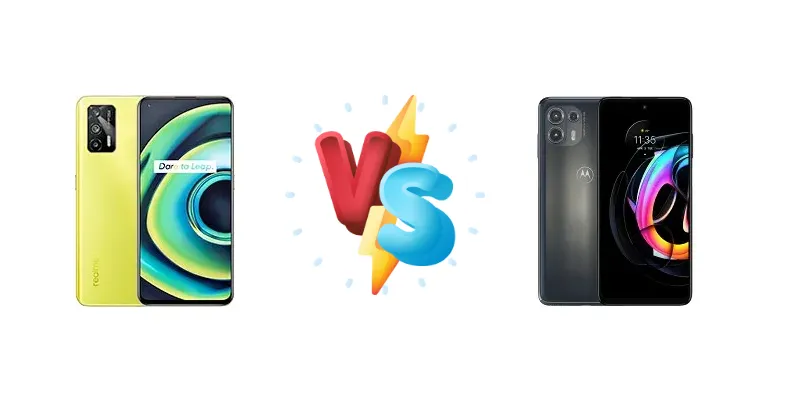
|
🏆 Quick Verdict
For users prioritizing raw performance and responsiveness, the Realme Q3 Pro 5G is the clear winner. Its Dimensity 1100 chipset offers a significant uplift over the Motorola Edge 20 Fusion’s Dimensity 800U. However, the Edge 20 Fusion remains a solid contender for those seeking a balanced experience with a focus on efficiency.
| PHONES | ||
|---|---|---|
| Phone Names | Realme Q3 Pro 5G | Motorola Edge 20 Fusion |
| Network | ||
|---|---|---|
| 2G bands | GSM 850 / 900 / 1800 / 1900 | GSM 850 / 900 / 1800 / 1900 |
| 3G bands | HSDPA 800 / 850 / 900 / 1700(AWS) / 1900 / 2100 | HSDPA 850 / 900 / 1700(AWS) / 1900 / 2100 |
| 4G bands | 1, 2, 3, 4, 5, 7, 8, 28, 34, 38, 39, 40, 41 | 1, 2, 3, 4, 5, 7, 8, 12, 13, 17, 18, 19, 20, 26, 28, 32, 34, 38, 39, 40, 41, 42, 43, 66 |
| 5G bands | 1, 28, 40, 41, 77, 78, 79 SA/NSA | 1, 3, 5, 7, 8, 20, 28, 38, 40, 41, 77, 78, 66 SA/NSA/Sub6 |
| Speed | HSPA, LTE, 5G | HSPA 42.2/5.76 Mbps, LTE Cat18 1200/150 Mbps, 5G |
| Technology | GSM / CDMA / HSPA / CDMA2000 / LTE / 5G | GSM / HSPA / LTE / 5G |
| CDMA2000 1x | - | |
| Launch | ||
|---|---|---|
| Announced | 2021, April 22 | 2021, August 17 |
| Status | Available. Released 2021, April 29 | Available. Released 2021, August 27 |
| Body | ||
|---|---|---|
| Build | - | Glass front |
| Dimensions | 158.5 x 73.3 x 8.4 mm (6.24 x 2.89 x 0.33 in) | 166 x 76 x 8.3 mm (6.54 x 2.99 x 0.33 in) |
| SIM | Nano-SIM + Nano-SIM | Nano-SIM + Nano-SIM |
| Weight | 179 g (6.31 oz) | 185 g (6.53 oz) |
| - | Water-repellent design | |
| Display | ||
|---|---|---|
| Resolution | 1080 x 2400 pixels, 20:9 ratio (~409 ppi density) | 1080 x 2400 pixels, 20:9 ratio (~393 ppi density) |
| Size | 6.43 inches, 99.8 cm2 (~85.9% screen-to-body ratio) | 6.7 inches, 108.4 cm2 (~85.9% screen-to-body ratio) |
| Type | Super AMOLED, 120Hz | OLED, 1B colors, 90Hz, HDR10+ |
| Platform | ||
|---|---|---|
| CPU | Octa-core (4x2.6 GHz Cortex-A78 & 4x2.0 GHz Cortex-A55) | Octa-core (2x2.4 GHz Cortex-A76 & 6x2.0 GHz Cortex-A55) |
| Chipset | Mediatek Dimensity 1100 (6 nm) | Mediatek Dimensity 800U (7 nm) |
| GPU | Mali-G77 MC9 | Mali-G57 MC3 |
| OS | Android 11, Realme UI 2.0 | Android 11 |
| Memory | ||
|---|---|---|
| Card slot | No | microSDXC |
| Internal | 128GB 6GB RAM, 128GB 8GB RAM, 256GB 8GB RAM | 128GB 6GB RAM, 128GB 8GB RAM |
| UFS 3.1 | - | |
| Main Camera | ||
|---|---|---|
| Features | Dual-LED dual-tone flash, HDR, panorama | LED flash, HDR, panorama |
| Single | 16 MP, f/2.5, 26mm (wide) | - |
| Triple | 64 MP, f/1.8, 26mm (wide), 1/1.73", 0.8µm, PDAF 8 MP, f/2.3, 16mm, 119˚ (ultrawide), 1/4.0", 1.12µm 2 MP (macro) | 108 MP, f/1.9, (wide), 1/1.52", 0.7µm, PDAF 8 MP, f/2.2, 118˚ (ultrawide) Auxiliary lens |
| Video | 4K@30/60fps, 1080p@30/60fps, gyro-EIS | 4K@30fps, 1080p@30/60/120fps, gyro-EIS |
| Selfie camera | ||
|---|---|---|
| Features | HDR, panorama | HDR |
| Single | 16 MP, f/2.5, 26mm (wide) | 32 MP, f/2.3, (wide), 0.7µm |
| Video | 1080p@30fps | 1080p@30fps |
| Sound | ||
|---|---|---|
| 3.5mm jack | Yes | Yes |
| 35mm jack | Yes | Yes |
| Loudspeaker | Yes, with stereo speakers (Dolby Atmos) | Yes |
| 24-bit/192kHz audio | - | |
| Comms | ||
|---|---|---|
| Bluetooth | 5.1, A2DP, LE | 5.0, A2DP, LE |
| NFC | No | Yes |
| Positioning | GPS, GLONASS, GALILEO, BDS, QZSS | GPS, GLONASS, GALILEO |
| Radio | No | FM radio |
| USB | USB Type-C 2.0 | USB Type-C 2.0 |
| WLAN | Wi-Fi 802.11 a/b/g/n/ac/6, dual-band, Wi-Fi Direct | Wi-Fi 802.11 a/b/g/n/ac, dual-band, Wi-Fi Direct |
| Features | ||
|---|---|---|
| Sensors | Fingerprint (under display, optical), accelerometer, gyro, proximity, compass | Fingerprint (side-mounted), accelerometer, gyro, proximity, compass |
| Battery | ||
|---|---|---|
| Charging | 30W wired, 100% in 59 min | 30W wired |
| Type | 4500 mAh | Li-Po 5000 mAh |
| Misc | ||
|---|---|---|
| Colors | Black, Blue, Electric Yellow | Electric Graphite, Cyber Teal |
| Models | RMX2205 | - |
| Price | About 210 EUR | About 250 EUR |
Realme Q3 Pro 5G
- Significantly faster processor for gaming and multitasking
- More efficient 6nm process node (potentially)
- Faster image processing capabilities
- Potentially higher thermal throttling under sustained load
- May consume more battery during intensive tasks
Motorola Edge 20 Fusion
- Potentially better thermal management
- Efficient processor for everyday tasks
- Balanced performance and battery life
- Noticeably slower processor compared to the Q3 Pro
- Less capable GPU for demanding games
Display Comparison
While specific display details (resolution, refresh rate) are missing, the core difference lies in the processing power driving the visuals. Both phones likely feature LCD panels given their price points. However, the Q3 Pro’s more powerful GPU, stemming from the Dimensity 1100, will translate to smoother frame rates in graphically intensive games. The impact of the chipset extends beyond gaming, influencing the responsiveness of the UI and the speed of image processing for display.
Camera Comparison
Without detailed camera specifications, it’s difficult to make a definitive judgment. However, the processing capabilities of the Dimensity 1100 in the Q3 Pro 5G will likely result in faster image processing and potentially better low-light performance. Motorola’s image processing tends to lean towards more natural colors, while Realme often boosts saturation. The chipset’s ISP (Image Signal Processor) plays a crucial role in noise reduction and dynamic range, giving the Q3 Pro an edge in challenging lighting conditions. We can assume both phones will feature a standard array of lenses, but the Q3 Pro’s chipset will be better equipped to handle complex computational photography tasks.
Performance
The Realme Q3 Pro 5G’s Mediatek Dimensity 1100 (6nm) is a substantial upgrade over the Motorola Edge 20 Fusion’s Dimensity 800U (7nm). The Dimensity 1100 boasts a more modern CPU architecture – four Cortex-A78 cores clocked at 2.6 GHz versus the Edge 20 Fusion’s two Cortex-A76 cores at 2.4 GHz. This translates to a noticeable performance advantage in CPU-bound tasks like video editing and app loading. The 6nm process node also contributes to improved power efficiency, though the larger core count may offset some of this benefit. The GPU within the Dimensity 1100 is also significantly more powerful, offering a better gaming experience.
Battery Life
Both devices feature 30W wired charging, achieving a full charge in approximately 59 minutes for the Q3 Pro. While battery capacity isn’t specified, the Dimensity 1100’s 6nm process *should* offer better power efficiency than the 7nm Dimensity 800U. However, the more powerful CPU and GPU in the Q3 Pro will likely consume more power under heavy load. Real-world battery life will depend heavily on usage patterns, but the Q3 Pro’s faster processing could lead to quicker battery drain during gaming or video editing.
Buying Guide
Buy the Realme Q3 Pro 5G if you need a phone capable of handling demanding games and multitasking with ease, and you value the fastest possible performance within this price bracket. Buy the Motorola Edge 20 Fusion if you prioritize a slightly more refined software experience, potentially better thermal management under sustained loads, and a generally efficient all-around performer for everyday tasks.