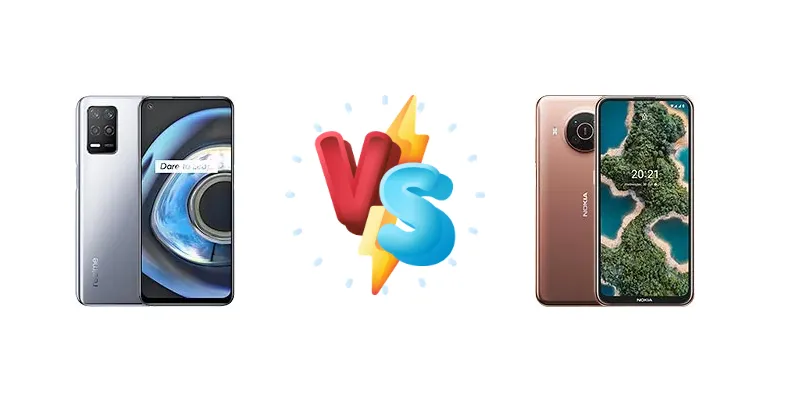
The Realme Q3 5G and Nokia X20 both aim to deliver affordable 5G connectivity, but they take different approaches. The Q3 5G prioritizes raw performance with a more powerful chipset, while the X20 emphasizes a cleaner software experience and Nokia’s commitment to longevity. This comparison breaks down the key differences to help you decide which phone best suits your needs.
🏆 Quick Verdict
For most users, the Realme Q3 5G emerges as the stronger choice. Its Snapdragon 750G chipset provides a noticeable performance advantage over the Snapdragon 480 in the Nokia X20, making it better suited for gaming and demanding applications. While the Nokia X20 offers a more refined software experience, the Q3 5G’s faster charging and superior processing power offer greater overall value.
| Network |
|---|
| 2G bands | GSM 850 / 900 / 1800 / 1900 | GSM 850 / 900 / 1800 / 1900 |
| 3G bands | HSDPA 800 / 850 / 900 / 1900 / 2100 | HSDPA 850 / 900 / 1700(AWS) / 1900 / 2100 |
| 4G bands | 1, 3, 5, 7, 8, 34, 38, 39, 40, 41 | 1, 2, 3, 4, 5, 7, 8, 12, 20, 28, 66, 38, 39, 40, 41 |
| 5G bands | 1, 28, 41, 78 SA/NSA | 1, 2, 3, 5, 7, 28, 38, 41, 66, 78 SA/NSA/Sub6 |
| Speed | HSPA, LTE, 5G | HSPA, LTE, 5G |
| Technology | GSM / CDMA / HSPA / CDMA2000 / LTE / 5G | GSM / HSPA / LTE / 5G |
| | CDMA2000 1x | - |
| Launch |
|---|
| Announced | 2021, April 22 | 2021, April 08 |
| Status | Available. Released 2021, April 29 | Available. Released 2021, May 12 |
| Body |
|---|
| Dimensions | 162.5 x 74.8 x 8.8 mm (6.40 x 2.94 x 0.35 in) | 168.9 x 79.7 x 9.1 mm (6.65 x 3.14 x 0.36 in) |
| SIM | Nano-SIM + Nano-SIM | · Nano-SIM· Nano-SIM + Nano-SIM |
| Weight | 189 g (6.67 oz) | 220 g (7.76 oz) |
| Display |
|---|
| Protection | - | Corning Gorilla Glass 5 |
| Resolution | 1080 x 2400 pixels, 20:9 ratio (~405 ppi density) | 1080 x 2400 pixels, 20:9 ratio (~395 ppi density) |
| Size | 6.5 inches, 102.0 cm2 (~83.9% screen-to-body ratio) | 6.67 inches, 107.4 cm2 (~79.8% screen-to-body ratio) |
| Type | IPS LCD, 120Hz, 480 nits (typ), 600 nits (peak) | IPS LCD, 450 nits (typ) |
| Platform |
|---|
| CPU | Octa-core (2x2.2 GHz Kryo 570 & 6x1.8 GHz Kryo 570) | Octa-core (2x2.0 GHz Kryo 460 & 6x1.8 GHz Kryo 460) |
| Chipset | Qualcomm SM7225 Snapdragon 750G 5G (8 nm) | Qualcomm SM4350 Snapdragon 480 5G (8 nm) |
| GPU | Adreno 619 | Adreno 619 |
| OS | Android 11, Realme UI 2.0 | Android 11, upgradable to Android 14 |
| Memory |
|---|
| Card slot | microSDXC (dedicated slot) | microSDXC (uses shared SIM slot) |
| Internal | 128GB 6GB RAM, 128GB 8GB RAM | 128GB 6GB RAM, 128GB 8GB RAM |
| Main Camera |
|---|
| Features | LED flash, HDR, panorama | Zeiss optics, LED flash, HDR, panorama |
| Quad | - | 64 MP, (wide), PDAF
5 MP, (ultrawide)
2 MP (macro)
Auxiliary lens |
| Single | 16 MP, f/2.1, 26mm (wide) | 32 MP, (wide) |
| Triple | 48 MP, f/1.8, 26mm (wide), PDAF
8 MP, f/2.3, 16mm, 119˚ (ultrawide), 1/4.0", 1.12µm
2 MP (macro) | - |
| Video | 4K@30fps, 1080p@30/60fps; gyro-EIS | 1080p@30/60fps |
| Selfie camera |
|---|
| Features | HDR, panorama | - |
| Single | 16 MP, f/2.1, 26mm (wide) | 32 MP, (wide) |
| Video | 1080p@30fps | 1080p@30fps |
| Sound |
|---|
| 3.5mm jack | Yes | Yes |
| 35mm jack | Yes | Yes |
| Loudspeaker | Yes | Yes |
| | 24-bit/192kHz audio | - |
| Comms |
|---|
| Bluetooth | 5.1, A2DP, LE | 5.0, A2DP, LE, aptX HD |
| NFC | No | Yes |
| Positioning | GPS, GLONASS, BDS, GALILEO, QZSS | GPS, GLONASS, GALILEO |
| Radio | Unspecified | FM radio |
| USB | USB Type-C 2.0 | USB Type-C 2.0, OTG |
| WLAN | - | Wi-Fi 802.11 a/b/g/n/ac, dual-band, Wi-Fi Direct |
| Features |
|---|
| Sensors | Fingerprint (side-mounted), accelerometer, gyro, proximity, compass | Fingerprint (side-mounted), accelerometer, gyro, proximity |
| Battery |
|---|
| Charging | 30W wired, 100% in 63 min | 18W wired |
| Type | 5000 mAh | Li-Po 4470 mAh |
| Misc |
|---|
| Colors | Black, Silver | Midnight Sun, Nordic Blue |
| Models | RMX3161 | TA-1341, TA-1344 |
| Price | About 170 EUR | About 130 EUR |
| SAR | - | 1.04 W/kg (head) 0.62 W/kg (body) |
| SAR EU | - | 0.51 W/kg (head) 1.29 W/kg (body) |
Realme Q3 5G
- Faster Snapdragon 750G processor
- 30W fast charging (63 min to 100%)
- Better performance for gaming and multitasking
- Software experience may be less refined than Nokia
- Long-term software support potentially shorter
Nokia X20
- Clean Android experience with guaranteed updates
- Nokia’s commitment to sustainability
- Potentially more natural color reproduction
- Slower Snapdragon 480 processor
- 18W slow charging
- Less capable for demanding tasks
Display Comparison
Neither device boasts a standout display. While specific display specs (resolution, panel type) are missing, the focus here is on performance. The absence of high refresh rates on either device suggests a cost-saving measure. The real differentiator will be color accuracy and brightness, which are not specified, but Realme generally targets vibrant displays while Nokia aims for more natural color reproduction.
Camera Comparison
Without detailed camera specs beyond the chipsets, a direct comparison is limited. However, the Snapdragon 750G generally supports more advanced image signal processors (ISPs) than the Snapdragon 480, potentially leading to better image quality in the Realme Q3 5G, especially in low-light conditions. Nokia’s image processing tends to be more realistic, while Realme often boosts saturation. The absence of OIS information suggests neither phone prioritizes advanced stabilization.
Performance
The Realme Q3 5G’s Qualcomm SM7225 Snapdragon 750G 5G (8nm) significantly outperforms the Nokia X20’s Snapdragon 480 5G (8nm). The 750G features a more capable CPU configuration – octa-core (2x2.2 GHz Kryo 570 & 6x1.8 GHz Kryo 570) versus the X20’s octa-core (2x2.0 GHz Kryo 460 & 6x1.8 GHz Kryo 460). The higher clock speeds on the 750G’s prime cores translate to faster app loading times and smoother multitasking. While both are 8nm chips, the architectural improvements in the 750G provide a clear advantage. Gamers will particularly benefit from the Q3 5G’s superior GPU.
Battery Life
The Realme Q3 5G’s 30W wired charging is a significant advantage over the Nokia X20’s 18W charging. The Q3 5G can reach 100% charge in just 63 minutes, while the X20 will take considerably longer. While battery capacity isn’t specified, the faster charging speed of the Q3 5G mitigates any potential disadvantage from a slightly smaller battery. This is crucial for users who need to quickly top up their phone throughout the day.
Buying Guide
Buy the Realme Q3 5G if you need a phone that can handle mobile gaming, multitasking, and future-proof 5G connectivity without breaking the bank. Its faster processor and charging are ideal for power users. Buy the Nokia X20 if you prioritize a clean Android experience, guaranteed software updates, and a more sustainable approach to smartphone ownership, even if it means sacrificing some raw performance.
Frequently Asked Questions
❓ Will the Snapdragon 480 in the Nokia X20 struggle with graphically intensive games like PUBG Mobile?
Yes, the Snapdragon 480 is an entry-level 5G chipset. While it can run PUBG Mobile, you’ll likely need to lower the graphics settings to achieve a smooth frame rate. The Realme Q3 5G’s Snapdragon 750G offers a much more comfortable gaming experience with higher settings and more consistent performance.
❓ How does Realme’s software compare to Nokia’s clean Android experience?
Realme UI, based on Android, includes several customizations and pre-installed apps. While it offers features like gesture navigation and theming options, it’s not as minimalist as the stock Android experience on the Nokia X20. Nokia prioritizes a bloatware-free experience and faster software updates.
❓ Is the difference in charging speed between 18W and 30W really that noticeable in everyday use?
Absolutely. The 30W charging on the Realme Q3 5G can add a significant amount of battery life in just a short period. Going from 0% to 100% in 63 minutes is much faster than the Nokia X20, making it ideal for users who are often on the go and need a quick power boost.