
Realme Q3 5G vs Motorola Moto G 5G Plus: A Detailed 5G Smartphone Comparison
| Phones Images | |||||
|---|---|---|---|---|---|
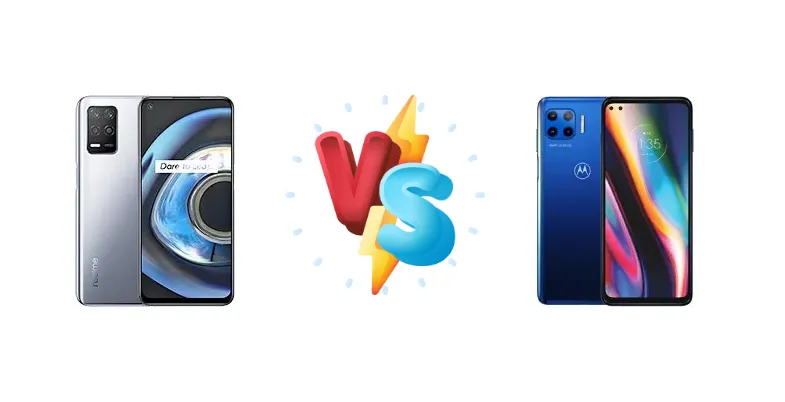
|
🏆 Quick Verdict
For the average user prioritizing a modern chipset and faster charging, the Realme Q3 5G emerges as the winner. Its Snapdragon 750G offers a slight performance edge and charges significantly faster. However, the Motorola Moto G 5G Plus remains a strong contender, particularly for those valuing a brighter display and potentially longer sustained performance due to its thermal headroom.
| PHONES | ||
|---|---|---|
| Phone Names | Realme Q3 5G | Motorola Moto G 5G Plus |
| Network | ||
|---|---|---|
| 2G bands | GSM 850 / 900 / 1800 / 1900 | GSM 850 / 900 / 1800 / 1900 |
| 3G bands | HSDPA 800 / 850 / 900 / 1900 / 2100 | HSDPA 850 / 900 / 1700(AWS) / 1900 / 2100 |
| 4G bands | 1, 3, 5, 7, 8, 34, 38, 39, 40, 41 | 1, 2, 3, 4, 5, 7, 8, 12, 17, 20, 26, 28, 32, 38, 39, 40, 41, 42, 43, 66 |
| 5G bands | 1, 28, 41, 78 SA/NSA | 1, 3, 7, 8, 28, 38, 41, 77, 78 SA/NSA |
| Speed | HSPA, LTE, 5G | HSPA, LTE, 5G |
| Technology | GSM / CDMA / HSPA / CDMA2000 / LTE / 5G | GSM / HSPA / LTE / 5G |
| CDMA2000 1x | 1, 2, 3, 4, 5, 7, 8, 12, 17, 20, 26, 28, 32, 38, 39, 40, 41, 42, 43, 66 | |
| Launch | ||
|---|---|---|
| Announced | 2021, April 22 | 2020, July 07. Released 2020, July 08 |
| Status | Available. Released 2021, April 29 | Discontinued |
| Body | ||
|---|---|---|
| Build | - | Glass front, plastic back, plastic frame |
| Dimensions | 162.5 x 74.8 x 8.8 mm (6.40 x 2.94 x 0.35 in) | 168.3 x 74 x 9.7 mm (6.63 x 2.91 x 0.38 in) |
| SIM | Nano-SIM + Nano-SIM | · Nano-SIM· Nano-SIM + Nano-SIM |
| Weight | 189 g (6.67 oz) | 207 g (7.30 oz) |
| - | Water-repellent coating | |
| Display | ||
|---|---|---|
| Resolution | 1080 x 2400 pixels, 20:9 ratio (~405 ppi density) | 1080 x 2520 pixels, 21:9 ratio (~409 ppi density) |
| Size | 6.5 inches, 102.0 cm2 (~83.9% screen-to-body ratio) | 6.7 inches, 104.9 cm2 (~84.2% screen-to-body ratio) |
| Type | IPS LCD, 120Hz, 480 nits (typ), 600 nits (peak) | IPS LCD, 90Hz, HDR10 |
| Platform | ||
|---|---|---|
| CPU | Octa-core (2x2.2 GHz Kryo 570 & 6x1.8 GHz Kryo 570) | Octa-core (1x2.3 GHz Kryo 475 Prime & 1x2.2 GHz Kryo 475 Gold & 6x1.8 GHz Kryo 475 Silver) |
| Chipset | Qualcomm SM7225 Snapdragon 750G 5G (8 nm) | Qualcomm SM7250 Snapdragon 765 5G (7 nm) |
| GPU | Adreno 619 | Adreno 620 |
| OS | Android 11, Realme UI 2.0 | Android 10 |
| Memory | ||
|---|---|---|
| Card slot | microSDXC (dedicated slot) | microSDXC (uses shared SIM slot) |
| Internal | 128GB 6GB RAM, 128GB 8GB RAM | 64GB 4GB RAM, 128GB 6GB RAM, 128GB 8GB RAM |
| - | UFS 2.1 | |
| Main Camera | ||
|---|---|---|
| Features | LED flash, HDR, panorama | Dual-LED flash, panorama, HDR |
| Quad | - | 48 MP, f/1.7, 26mm (wide), 1/2.0", 0.8µm, PDAF 8 MP, f/2.2, 118˚ (ultrawide), 1.12µm 5 MP (macro), AF Auxiliary lens |
| Single | 16 MP, f/2.1, 26mm (wide) | - |
| Triple | 48 MP, f/1.8, 26mm (wide), PDAF 8 MP, f/2.3, 16mm, 119˚ (ultrawide), 1/4.0", 1.12µm 2 MP (macro) | - |
| Video | 4K@30fps, 1080p@30/60fps; gyro-EIS | 4K@30fps, 1080p@30/60fps, gyro-EIS |
| Selfie camera | ||
|---|---|---|
| Dual | - | 16 MP, f/2.0, 29mm (normal), 1.0µm 8 MP, f/2.2, 118˚ (ultrawide), 1.12µm |
| Features | HDR, panorama | HDR |
| Single | 16 MP, f/2.1, 26mm (wide) | - |
| Video | 1080p@30fps | 1080p@30fps |
| Sound | ||
|---|---|---|
| 3.5mm jack | Yes | Yes |
| 35mm jack | Yes | Yes |
| Loudspeaker | Yes | Yes |
| 24-bit/192kHz audio | - | |
| Comms | ||
|---|---|---|
| Bluetooth | 5.1, A2DP, LE | 5.1, A2DP, LE |
| NFC | No | Yes |
| Positioning | GPS, GLONASS, BDS, GALILEO, QZSS | GPS (L1+L5), GLONASS, GALILEO, BDS |
| Radio | Unspecified | FM radio |
| USB | USB Type-C 2.0 | USB Type-C 2.0 |
| WLAN | - | Wi-Fi 802.11 a/b/g/n/ac, dual-band, Wi-Fi Direct |
| Features | ||
|---|---|---|
| Sensors | Fingerprint (side-mounted), accelerometer, gyro, proximity, compass | Fingerprint (side-mounted), accelerometer, gyro, proximity, compass |
| Battery | ||
|---|---|---|
| Charging | 30W wired, 100% in 63 min | 20W wired |
| Type | 5000 mAh | Li-Po 5000 mAh |
| Misc | ||
|---|---|---|
| Colors | Black, Silver | Surfing Blue, Mystic Lilac |
| Models | RMX3161 | XT2075, XT2075-2, XT2075-3 |
| Price | About 170 EUR | About 260 EUR |
| Tests | ||
|---|---|---|
| Battery life | - | Endurance rating 114h |
| Camera | - | Photo / Video |
| Display | - | Contrast ratio: 1269:1 |
| Loudspeaker | - | -28.4 LUFS (Average) |
| Performance | - | AnTuTu: 299926 (v8) GeekBench: 1898 (v5.1) GFXBench: 16fps (ES 3.1 onscreen) |
Realme Q3 5G
- Faster 30W charging for quick top-ups
- More modern Snapdragon 750G chipset
- Potentially better thermal efficiency due to 8nm process
- Missing display brightness data suggests potentially lower outdoor visibility
- No endurance rating available
Motorola Moto G 5G Plus
- Brighter display (543 nits) for better outdoor visibility
- Proven 114-hour endurance rating
- Potentially better sustained performance due to thermal headroom
- Slower 20W charging
- Older Snapdragon 765 chipset
Display Comparison
Both devices feature similar contrast ratios at 1269:1, indicating comparable black levels and overall image quality. However, the Motorola Moto G 5G Plus boasts a measured peak brightness of 543 nits, a significant advantage over the Realme Q3 5G (brightness data unavailable). This translates to better visibility in direct sunlight. While panel technology isn't specified, the brighter display on the Motorola is a clear win for outdoor users. The lack of high refresh rate information on either device suggests standard 60Hz panels, which is typical for this price bracket.
Camera Comparison
Both phones are listed as having 'Photo / Video' capabilities, lacking specific details. Without sensor size or aperture information, a direct comparison is difficult. However, the market segment suggests both will rely on multi-camera setups with a primary sensor, ultrawide, and potentially macro/depth sensors. Given the lack of detail, it's safe to assume image quality will be comparable, relying heavily on software processing. The absence of OIS information suggests neither phone prioritizes optical image stabilization.
Performance
The Realme Q3 5G utilizes the Qualcomm SM7225 Snapdragon 750G 5G (8nm), while the Motorola Moto G 5G Plus features the older SM7250 Snapdragon 765 5G (7nm). Despite the 765 having a slightly higher clock speed on its prime core (2.3 GHz vs 2.2 GHz), the 750G’s newer architecture and 8nm process offer improved efficiency. This means the Q3 5G is likely to deliver comparable, if not slightly better, real-world performance with potentially better thermal management. The CPU configurations are similar, but the 750G’s Kryo 570 cores represent an architectural improvement over the 765’s Kryo 475 cores. This impacts sustained performance and power efficiency.
Battery Life
The Motorola Moto G 5G Plus has an endurance rating of 114 hours, indicating solid battery life. The Realme Q3 5G lacks this rating, but compensates with significantly faster 30W wired charging, achieving a full charge in 63 minutes. The Moto G 5G Plus is limited to 20W charging. This difference in charging speed is substantial; the Realme Q3 5G allows for quicker top-ups, mitigating any potential battery capacity disadvantage. The 114-hour endurance rating of the Motorola suggests a larger battery capacity, but the Realme’s faster charging could be more convenient for many users.
Buying Guide
Buy the Realme Q3 5G if you need a phone with a more recent processor for smoother multitasking and potentially better 5G performance, and if fast charging is a priority. You'll benefit from quicker top-ups and a more future-proofed chipset. Buy the Motorola Moto G 5G Plus if you prefer a display with higher peak brightness for outdoor visibility and potentially more consistent performance under sustained load, and if you value a proven endurance rating.