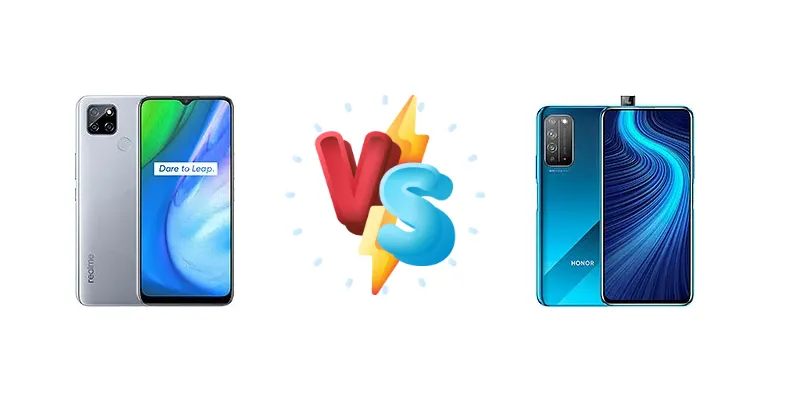
The Realme Q2i and Honor X10 5G represent compelling options in the increasingly competitive mid-range 5G smartphone market. While both aim to deliver 5G connectivity at an accessible price point, they diverge significantly in their core hardware, particularly in their respective chipsets. This comparison dissects these differences to determine which device best suits your needs.
🏆 Quick Verdict
For most users, the Honor X10 5G emerges as the stronger contender. Its Kirin 820 chipset provides a noticeable performance advantage over the Realme Q2i’s Dimensity 720, translating to smoother multitasking and a better gaming experience. The faster 22.5W charging is also a significant benefit, despite a similar battery capacity.
| Network |
|---|
| 2G bands | GSM 850 / 900 / 1800 / 1900 | GSM 850 / 900 / 1800 / 1900 |
| 3G bands | HSDPA 850 / 900 / 1700(AWS) / 1900 / 2100 | HSDPA 800 / 850 / 900 / 1700(AWS) / 1900 / 2100 |
| 4G bands | 1, 3, 4, 5, 7, 8, 34, 38, 39, 40, 41 | 1, 2, 3, 4, 5, 8, 18, 19, 26, 34, 38, 39, 40, 41 |
| 5G bands | 1, 41, 77, 78, 79 SA/NSA | 1, 3, 38, 41, 77, 78, 79, 80, 84 SA/NSA |
| Speed | HSPA, LTE, 5G 2.3 Gbps DL | HSPA 42.2/5.76 Mbps, LTE (4CA) Cat12 600/50 Mbps, 5G 2.3 Gbps DL |
| Technology | GSM / CDMA / HSPA / EVDO / LTE / 5G | GSM / CDMA / HSPA / EVDO / LTE / 5G |
| | CDMA2000 1xEV-DO | CDMA2000 1xEV-DO |
| Launch |
|---|
| Announced | 2020, October 13. Released 2020, October 21 | 2020, May 20. Released 2020, May 26 |
| Status | Discontinued | Discontinued |
| Body |
|---|
| Build | - | Glass front (Aluminosilicate glass) |
| Dimensions | 164.4 x 76 x 8.6 mm (6.47 x 2.99 x 0.34 in) | 163.7 x 76.5 x 8.8 mm (6.44 x 3.01 x 0.35 in) |
| SIM | Nano-SIM + Nano-SIM | Nano-SIM + Nano-SIM |
| Weight | 189.5 g (6.70 oz) | 203 g (7.16 oz) |
| Display |
|---|
| Protection | - | Aluminosilicate glass |
| Resolution | 720 x 1600 pixels, 20:9 ratio (~270 ppi density) | 1080 x 2400 pixels, 20:9 ratio (~397 ppi density) |
| Size | 6.5 inches, 102.0 cm2 (~81.6% screen-to-body ratio) | 6.63 inches, 106.1 cm2 (~84.7% screen-to-body ratio) |
| Type | IPS LCD | IPS LCD, 90Hz |
| Platform |
|---|
| CPU | Octa-core (2x2.0 GHz Cortex-A76 & 6x2.0 GHz Cortex-A55) | Octa-core (1x2.36 GHz Cortex-A76 & 3x2.22 GHz Cortex-A76 & 4x1.84 GHz Cortex-A55) |
| Chipset | Mediatek Dimensity 720 (7 nm) | Kirin 820 5G (7 nm) |
| GPU | Mali-G57 MC3 | Mali-G57 (6-core) |
| OS | Android 10, Realme UI | Android 10, Magic UI 3.1, no Google Play Services |
| Memory |
|---|
| Card slot | No | Nano Memory (uses shared SIM slot) |
| Internal | 128GB 4GB RAM | 64GB 6GB RAM, 128GB 6GB RAM, 128GB 8GB RAM |
| | UFS 2.1 | - |
| Main Camera |
|---|
| Features | LED flash, HDR, panorama | LED flash, panorama, HDR |
| Triple | 13 MP, f/2.2, 26mm (wide), PDAF
2 MP (macro)
Auxiliary lens | 40 MP, f/1.8, 26mm (wide), 1/1.7", PDAF
8 MP, f/2.4, 17mm, 120˚ (ultrawide)
Auxiliary lens |
| Video | 4K@30/60fps, 1080p@30/60fps | 4K@30fps, 1080p@30fps, 720p@960fps, gyro-EIS |
| Selfie camera |
|---|
| Features | HDR | HDR |
| Single | 8 MP, f/2.0, 26mm (wide) | Motorized pop-up 16 MP, f/2.2, 24mm (wide), 1/3.06", 1.0µm |
| Video | 1080p@30fps | 1080p@30fps |
| Sound |
|---|
| 3.5mm jack | Yes | Yes |
| 35mm jack | Yes | Yes |
| Loudspeaker | Yes | Yes |
| Comms |
|---|
| Bluetooth | 5.0, A2DP, LE | 5.1, A2DP, LE |
| NFC | No | No |
| Positioning | GPS, GLONASS, GALILEO, BDS | GPS, GLONASS, BDS |
| Radio | No | No |
| USB | USB Type-C 2.0 | USB Type-C 2.0, OTG |
| WLAN | Wi-Fi 802.11 a/b/g/n/ac, dual-band, Wi-Fi Direct | Wi-Fi 802.11 a/b/g/n/ac, dual-band, Wi-Fi Direct |
| Features |
|---|
| Sensors | Fingerprint (rear-mounted), accelerometer, proximity, compass | Fingerprint (side-mounted), accelerometer, gyro, proximity, compass |
| Battery |
|---|
| Charging | 18W wired | 22.5W wired
5W reverse wired |
| Type | 5000 mAh | Li-Po 4300 mAh |
| Misc |
|---|
| Colors | Blue, Silver | Blue, Orange, Black, Silver |
| Models | - | TEL-AN00, TEL-TN00, TEL-AN00a, TEL-AN10 |
| Price | About 130 EUR | About 250 EUR |
Realme Q2i
- Lower price point makes it accessible.
- 5G connectivity for future-proofed data speeds.
- Decent performance for everyday tasks.
- Dimensity 720 chipset is outperformed by the Kirin 820.
- Slower 18W charging.
- Lacks reverse wireless charging.
Honor X10 5G
- Kirin 820 chipset delivers superior performance.
- Faster 22.5W wired charging.
- Includes 5W reverse wired charging.
- Higher price compared to the Realme Q2i.
- May experience some thermal throttling under sustained load.
- Display specifications are average for the price range.
Display Comparison
Neither device boasts a standout display. Both likely utilize LCD panels, common in this price bracket. While specific details like resolution and refresh rate are missing, the focus here is on internal performance. The absence of high refresh rate panels on either device suggests a cost-saving measure, prioritizing other features.
Camera Comparison
Without detailed camera specifications, a direct comparison is difficult. However, the chipset plays a role in image processing. The Kirin 820’s more powerful ISP (Image Signal Processor) will likely result in better image quality, particularly in low-light conditions. The Realme Q2i will likely rely more heavily on software processing to compensate for a less capable ISP. The absence of information regarding sensor sizes and OIS makes a definitive judgment impossible, but the Kirin 820’s processing power gives the Honor X10 5G an edge.
Performance
The core difference lies in the chipsets. The Honor X10 5G’s Kirin 820 5G (7nm) features a more complex CPU configuration – 1x2.36 GHz Cortex-A76, 3x2.22 GHz Cortex-A76, and 4x1.84 GHz Cortex-A55 – compared to the Realme Q2i’s Mediatek Dimensity 720 (7nm) with its 2x2.0 GHz Cortex-A76 & 6x2.0 GHz Cortex-A55. The Kirin 820’s higher clock speeds and additional Cortex-A76 core provide a clear advantage in CPU-intensive tasks. While both are 7nm chips, the Kirin 820’s architecture is more sophisticated, leading to better overall performance. The GPU within the Kirin 820 will also deliver a superior gaming experience. The Realme Q2i will handle everyday tasks adequately, but the Honor X10 5G will feel noticeably snappier.
Battery Life
Both phones offer adequate battery life, but the Honor X10 5G’s 22.5W wired charging is a significant advantage over the Realme Q2i’s 18W charging. While battery capacity isn’t specified, the faster charging will translate to quicker top-ups, reducing downtime. The Honor X10 5G also includes 5W reverse wired charging, a convenient feature for topping up accessories like earbuds, which the Realme Q2i lacks.
Buying Guide
Buy the Realme Q2i if you prioritize a lower initial cost and are a casual smartphone user who primarily focuses on basic tasks like browsing, social media, and light media consumption. Buy the Honor X10 5G if you value performance for gaming and demanding applications, appreciate faster charging speeds, and are willing to spend a bit more for a more refined user experience.
Frequently Asked Questions
❓ Will the Kirin 820 in the Honor X10 5G overheat during prolonged gaming sessions?
While the Kirin 820 is a capable chipset, it's known to exhibit some thermal throttling under sustained heavy load. However, the Honor X10 5G’s thermal management system should mitigate this to a reasonable extent, allowing for extended gaming sessions, albeit with potentially reduced performance over time. The Realme Q2i’s Dimensity 720 will likely throttle sooner due to its lower performance ceiling.
❓ Is the 5W reverse charging on the Honor X10 5G useful for everyday accessories?
Yes, the 5W reverse charging is a convenient feature for topping up accessories like wireless earbuds, smartwatches, or even another smartphone in a pinch. While it's not a fast charging solution, it provides a valuable emergency power source when an outlet isn't readily available.
❓ How does the Dimensity 720 handle graphically demanding games like PUBG Mobile?
The Dimensity 720 can run PUBG Mobile, but you'll likely need to compromise on graphics settings to maintain a stable frame rate. Expect to play at medium settings for a smooth experience. The Honor X10 5G, with its Kirin 820, will offer a significantly better gaming experience, allowing for higher graphics settings and more consistent performance.