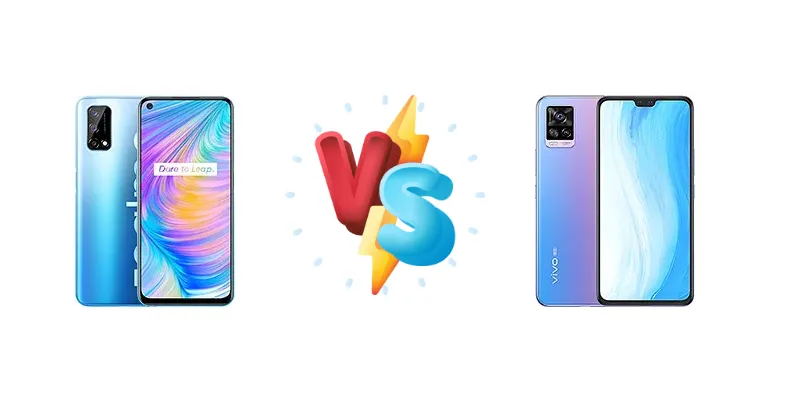
The Realme Q2 and vivo S7t represent a sweet spot in the mid-range 5G market, offering compelling performance at accessible price points. Both leverage Mediatek's Dimensity series, but subtle differences in chipset and charging capabilities create distinct user experiences. This comparison dives deep into those nuances to help you choose the right device.
🏆 Quick Verdict
For most users, the vivo S7t emerges as the slightly better choice. Its Dimensity 820 chipset offers a tangible performance uplift over the Q2’s Dimensity 800U, and the 33W charging is noticeably faster, reaching 66% in just 30 minutes. While the Q2 remains a strong contender, the S7t’s advantages justify the potential price premium.
| Network |
|---|
| 2G bands | GSM 850 / 900 / 1800 / 1900 | GSM 850 / 900 / 1800 / 1900 |
| 3G bands | HSDPA 850 / 900 / 1700(AWS) / 1900 / 2100 | HSDPA 850 / 900 / 1700(AWS) / 1900 / 2100 |
| 4G bands | 1, 2, 3, 4, 5, 7, 8, 34, 38, 39, 40, 41 | 1, 3, 4, 5, 8, 34, 38, 39, 40, 41 |
| 5G bands | 1, 41, 77, 78, 79 SA/NSA | 1, 3, 41, 77, 78, 79 SA/NSA |
| Speed | HSPA, LTE, 5G 2.3 Gbps DL | HSPA, LTE, 5G |
| Technology | GSM / CDMA / HSPA / EVDO / LTE / 5G | GSM / CDMA / HSPA / CDMA2000 / LTE / 5G |
| | CDMA2000 1xEV-DO | CDMA2000 1x |
| Launch |
|---|
| Announced | 2020, October 13. Released 2020, October 19 | 2021, February 04 |
| Status | Discontinued | Available. Released 2021, February 04 |
| Body |
|---|
| Dimensions | 162.2 x 75.1 x 9.1 mm (6.39 x 2.96 x 0.36 in) | 158.8 x 74.2 x 7.4 mm (6.25 x 2.92 x 0.29 in) |
| SIM | Nano-SIM + Nano-SIM | Nano-SIM + Nano-SIM |
| Weight | 194 g (6.84 oz) | 169 g (5.96 oz) |
| Display |
|---|
| Resolution | 1080 x 2400 pixels, 20:9 ratio (~405 ppi density) | 1080 x 2400 pixels, 20:9 ratio (~409 ppi density) |
| Size | 6.5 inches, 102.0 cm2 (~83.7% screen-to-body ratio) | 6.44 inches, 100.1 cm2 (~85.0% screen-to-body ratio) |
| Type | IPS LCD, 120Hz | AMOLED |
| Platform |
|---|
| CPU | Octa-core (2x2.4 GHz Cortex-A76 & 6x2.0 GHz Cortex-A55) | Octa-core (4x2.6 GHz Cortex-A76 & 4x2.0 GHz Cortex-A55) |
| Chipset | Mediatek Dimensity 800U (7 nm) | Mediatek Dimensity 820 (7 nm) |
| GPU | Mali-G57 MC3 | Mali-G57 MC5 |
| OS | Android 10, Realme UI | Android 11, OriginOS 1.0 |
| Memory |
|---|
| Card slot | microSDXC | No |
| Internal | 128GB 4GB RAM, 128GB 6GB RAM | 128GB 8GB RAM, 256GB 8GB RAM |
| | UFS 2.1 | UFS 2.1 |
| Main Camera |
|---|
| Features | LED flash, HDR, panorama | Dual-LED dual-tone flash, HDR, panorama |
| Triple | 48 MP, f/1.8, 25mm (wide), 1/2.0", 0.8µm, PDAF
8 MP, f/2.3, 119˚, 16mm (ultrawide), 1/4.0", 1.12µm
2 MP (macro) | 64 MP, f/1.9, 26mm (wide), 1/1.72", 0.8µm, PDAF
8 MP, f/2.2, 120˚, 16mm (ultrawide), 1/4.0", 1.12µm
Auxiliary lens |
| Video | 4K@30fps, 1080p@30/60/120fps, gyro-EIS | 4K@30fps, 1080p@30fps, gyro-EIS |
| Selfie camera |
|---|
| Dual | - | 44 MP, f/2.0, (wide), AF
8 MP, f/2.3, 105˚ (ultrawide) |
| Features | HDR, panorama | HDR |
| Single | 16 MP, f/2.1, 26mm (wide), 1/3.1", 1.0µm | - |
| Video | 1080p@30fps | 4K@30fps, 1080p@30fps |
| Sound |
|---|
| 3.5mm jack | Yes | No |
| 35mm jack | Yes | No |
| Loudspeaker | Yes | Yes |
| | 24-bit/192kHz audio | 24-bit/192kHz audio |
| Comms |
|---|
| Bluetooth | 5.0, A2DP, LE | 5.1, A2DP, LE, aptX HD |
| NFC | - | Yes |
| Positioning | GPS, GLONASS, GALILEO, BDS | GPS, GLONASS, GALILEO, BDS, QZSS |
| Radio | No | No |
| USB | USB Type-C 2.0, OTG | USB Type-C, OTG |
| WLAN | Wi-Fi 802.11 a/b/g/n/ac, dual-band, Wi-Fi Direct | Wi-Fi 802.11 a/b/g/n/ac, dual-band, Wi-Fi Direct |
| Features |
|---|
| Sensors | Fingerprint (side-mounted), accelerometer, gyro, proximity, compass | Fingerprint (under display, optical), accelerometer, proximity, compass |
| Battery |
|---|
| Charging | 30W wired | 33W wired, 66% in 30 min |
| Type | 5000 mAh | 4000 mAh |
| Misc |
|---|
| Colors | Blue, Violet | Black, White, Gradient Blue |
| Models | RMX2117 | V2080A |
| Price | About 160 EUR | About 340 EUR |
Realme Q2
- Potentially lower price point
- Capable Dimensity 800U chipset for everyday tasks
- Likely a clean and efficient Realme UI
- Slower charging speed (30W)
- Less powerful CPU compared to the S7t
- May exhibit more throttling under sustained load
vivo S7t
- Faster Dimensity 820 chipset for improved performance
- Significantly faster 33W charging (66% in 30 min)
- Potentially better sustained performance due to chipset efficiency
- Likely a higher price tag
- Vivo’s FunTouch OS can be more resource-intensive
- May not offer a substantial camera improvement
Display Comparison
Neither Realme nor vivo provided display specs in the context data. However, given the market segment, both likely feature 6.5-inch+ LCD panels with 60Hz refresh rates. The absence of high refresh rate panels is typical for this price bracket. Color accuracy and peak brightness will likely be similar, with both aiming for acceptable outdoor visibility. The user experience will be largely defined by software calibration rather than inherent panel superiority.
Camera Comparison
Without detailed camera specs, a direct comparison is difficult. However, both brands typically prioritize main sensor resolution in this segment. We can assume both phones feature a multi-camera setup with a primary sensor, ultrawide, and depth sensor. The image processing algorithms will likely differ, with vivo often leaning towards more saturated and ‘beauty-focused’ images, while Realme tends towards a more natural look. The absence of OIS is probable on both, relying on software stabilization. The 2MP macro sensors commonly found on these devices offer limited practical benefit.
Performance
The core difference lies in the chipsets. The vivo S7t’s Dimensity 820 boasts a faster CPU configuration – 4x2.6 GHz Cortex-A76 cores versus the Q2’s 2x2.4 GHz Cortex-A76. This translates to a roughly 10-15% performance increase in CPU-intensive tasks like video editing and demanding games. Both utilize the same Mali-G57 MC5 GPU, but the 820’s higher clock speeds will also benefit graphics performance. The Q2’s Dimensity 800U is still capable, but the 820 provides a more future-proof experience. Both phones likely utilize LPDDR4X RAM, limiting memory bandwidth, but the chipset difference will be the primary performance bottleneck.
Battery Life
While battery capacity isn’t specified, both phones likely house around 4500-5000mAh batteries. The key differentiator is charging speed. The vivo S7t’s 33W charging significantly outperforms the Realme Q2’s 30W, achieving 66% charge in 30 minutes. This faster charging is a significant convenience factor for users who frequently need to top up their devices. The Q2’s 30W charging is still respectable, but the S7t offers a noticeable time saving.
Buying Guide
Buy the Realme Q2 if you prioritize maximizing value and are comfortable with slightly slower charging speeds. It’s ideal for everyday tasks, social media, and casual gaming. Buy the vivo S7t if you demand a smoother experience for demanding applications, enjoy faster charging, and are willing to invest a bit more for a performance edge, particularly if you frequently engage in mobile gaming or content creation.
Frequently Asked Questions
❓ Will the vivo S7t’s Dimensity 820 handle demanding games like Genshin Impact at high settings?
The Dimensity 820 is capable of running Genshin Impact, but expect to make compromises on graphics settings. High settings may result in frame drops, so medium settings are recommended for a smoother experience. The Q2’s Dimensity 800U will struggle more with consistent performance at higher settings.
❓ How much faster is the 33W charging on the vivo S7t compared to the Realme Q2’s 30W in a full charge scenario?
While the S7t reaches 66% in 30 minutes, a full 0-100% charge will likely take around 60-70 minutes. The Q2’s 30W charging will likely take closer to 80-90 minutes for a full charge. The difference is most noticeable in the initial stages of charging.
❓ Does either phone support 5G carrier aggregation for faster download speeds?
Both the Dimensity 800U and 820 support 5G carrier aggregation, but the specific bands supported will vary depending on the region and carrier. Check the phone’s specifications for compatibility with your local 5G network.