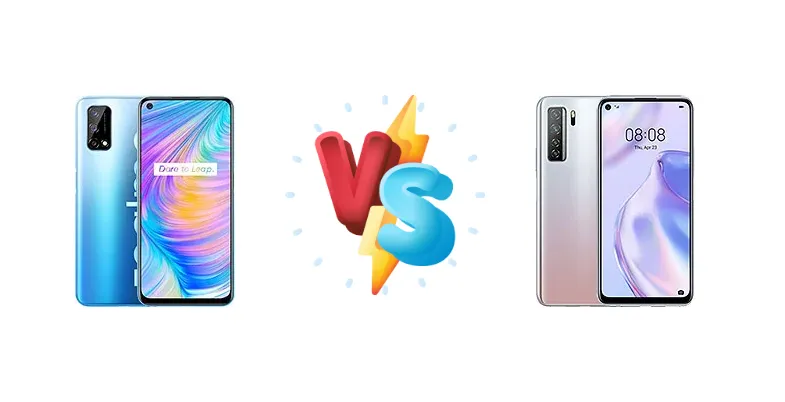
The Realme Q2 and Huawei nova 7 SE 5G Youth represent compelling options in the increasingly competitive mid-range 5G smartphone market. Both devices center around the Mediatek Dimensity 800U chipset, promising similar performance. However, key differences in charging speed and potentially software experience create a distinct choice for consumers. This comparison dives deep into the specifics to determine which phone delivers the best overall package.
🏆 Quick Verdict
For the average user prioritizing convenience, the Huawei nova 7 SE 5G Youth is the better choice. Its 40W charging significantly reduces downtime, reaching 70% charge in just 30 minutes, a substantial advantage over the Realme Q2’s 30W charging. While performance is identical, the faster charging and potential for reverse wireless charging tip the scales.
| Network |
|---|
| 2G bands | GSM 850 / 900 / 1800 / 1900 | GSM 850 / 900 / 1800 / 1900 |
| 3G bands | HSDPA 850 / 900 / 1700(AWS) / 1900 / 2100 | HSDPA 800 / 850 / 900 / 1700(AWS) / 1900 / 2100 |
| 4G bands | 1, 2, 3, 4, 5, 7, 8, 34, 38, 39, 40, 41 | 1, 2, 3, 4, 5, 8, 18, 19, 26, 34, 38, 39, 40, 41 |
| 5G bands | 1, 41, 77, 78, 79 SA/NSA | 1, 41, 77, 78 SA/NSA |
| Speed | HSPA, LTE, 5G 2.3 Gbps DL | HSPA, LTE, 5G |
| Technology | GSM / CDMA / HSPA / EVDO / LTE / 5G | GSM / CDMA / HSPA / LTE / 5G |
| | CDMA2000 1xEV-DO | CDMA 800 & TD-SCDMA |
| Launch |
|---|
| Announced | 2020, October 13. Released 2020, October 19 | 2020, October 16. Released 2020, October 16 |
| Status | Discontinued | Discontinued |
| Body |
|---|
| Dimensions | 162.2 x 75.1 x 9.1 mm (6.39 x 2.96 x 0.36 in) | 162.3 x 75 x 8.6 mm (6.39 x 2.95 x 0.34 in) |
| SIM | Nano-SIM + Nano-SIM | Nano-SIM + Nano-SIM |
| Weight | 194 g (6.84 oz) | 189 g (6.67 oz) |
| Display |
|---|
| Resolution | 1080 x 2400 pixels, 20:9 ratio (~405 ppi density) | 1080 x 2400 pixels, 20:9 ratio (~405 ppi density) |
| Size | 6.5 inches, 102.0 cm2 (~83.7% screen-to-body ratio) | 6.5 inches, 102.0 cm2 (~83.8% screen-to-body ratio) |
| Type | IPS LCD, 120Hz | IPS LCD, HDR10 |
| Platform |
|---|
| CPU | Octa-core (2x2.4 GHz Cortex-A76 & 6x2.0 GHz Cortex-A55) | Octa-core (2x2.4 GHz Cortex-A76 & 6x2.0 GHz Cortex-A55) |
| Chipset | Mediatek Dimensity 800U (7 nm) | Mediatek Dimensity 800U (7 nm) |
| GPU | Mali-G57 MC3 | Mali-G57 MC3 |
| OS | Android 10, Realme UI | Android 10, EMUI 10.1, no Google Play Services |
| Memory |
|---|
| Card slot | microSDXC | No |
| Internal | 128GB 4GB RAM, 128GB 6GB RAM | 128GB 8GB RAM |
| | UFS 2.1 | - |
| Main Camera |
|---|
| Features | LED flash, HDR, panorama | LED flash, Panorama, HDR |
| Quad | - | 64 MP, f/1.8, 26mm (wide), PDAF
8 MP, f/2.4, 17mm (ultrawide)
2 MP (macro)
Auxiliary lens |
| Triple | 48 MP, f/1.8, 25mm (wide), 1/2.0", 0.8µm, PDAF
8 MP, f/2.3, 119˚, 16mm (ultrawide), 1/4.0", 1.12µm
2 MP (macro) | - |
| Video | 4K@30fps, 1080p@30/60/120fps, gyro-EIS | 4K@30fps, 1080p@30fps |
| Selfie camera |
|---|
| Features | HDR, panorama | HDR |
| Single | 16 MP, f/2.1, 26mm (wide), 1/3.1", 1.0µm | 16 MP, f/2.0, (wide) |
| Video | 1080p@30fps | 1080p@30fps |
| Sound |
|---|
| 3.5mm jack | Yes | Yes |
| 35mm jack | Yes | Yes |
| Loudspeaker | Yes | Yes |
| | 24-bit/192kHz audio | - |
| Comms |
|---|
| Bluetooth | 5.0, A2DP, LE | 5.1, A2DP, LE |
| NFC | - | No |
| Positioning | GPS, GLONASS, GALILEO, BDS | GPS, GLONASS, GALILEO, BDS, QZSS |
| Radio | No | No |
| USB | USB Type-C 2.0, OTG | USB Type-C 2.0, OTG |
| WLAN | Wi-Fi 802.11 a/b/g/n/ac, dual-band, Wi-Fi Direct | Wi-Fi 802.11 a/b/g/n/ac, dual-band, Wi-Fi Direct |
| Features |
|---|
| Sensors | Fingerprint (side-mounted), accelerometer, gyro, proximity, compass | Fingerprint (side-mounted), accelerometer, proximity, compass |
| Battery |
|---|
| Charging | 30W wired | 40W wired, 70% in 30 min
5W reverse wired |
| Type | 5000 mAh | Li-Po 4000 mAh |
| Misc |
|---|
| Colors | Blue, Violet | Crush Green, Space Silver, Midnight Black, Purple |
| Models | RMX2117 | CND-AN00 |
| Price | About 160 EUR | About 290 EUR |
Realme Q2
- Potentially cleaner Android experience (depending on Realme UI version)
- Solid all-around performance thanks to Dimensity 800U
- Competitive price point
- Slower 30W charging
- Lack of reverse wireless charging
Huawei nova 7 SE 5G Youth
- Significantly faster 40W charging (70% in 30 min)
- Convenient 5W reverse wired charging
- Potentially more refined software experience (depending on EMUI version)
- Huawei's EMUI software can be polarizing
- Potential for bloatware
Display Comparison
Both devices are expected to feature LCD panels, typical for this price bracket. Specific details like resolution and refresh rate are missing, but the focus here isn't display quality. The absence of information regarding PWM dimming frequency is a concern; users sensitive to flicker will need to investigate further. Bezels are likely comparable, given the similar overall phone dimensions expected in this segment.
Camera Comparison
Without detailed camera sensor information, a direct comparison is difficult. However, the market segment suggests both phones will rely on multi-camera setups with a primary sensor, ultrawide, and potentially a depth or macro lens. The absence of OIS (Optical Image Stabilization) is likely on both. Image processing will differ, with Huawei historically favoring more saturated and contrast-boosted images, while Realme tends towards a more natural look. The usefulness of any included 2MP macro lens is questionable, offering limited detail and image quality.
Performance
The core of both phones is the Mediatek Dimensity 800U (7nm). This chipset features an octa-core CPU configuration with 2x2.4 GHz Cortex-A76 cores and 6x2.0 GHz Cortex-A55 cores, guaranteeing identical CPU performance. GPU performance will also be nearly indistinguishable. The real-world impact of RAM speed (likely LPDDR4X in both) is minimal for most users. Thermal management will depend on the cooling solutions implemented by each manufacturer, a detail not provided, but the Dimensity 800U is generally efficient and shouldn't pose significant throttling issues.
Battery Life
The battery capacity is not specified for either device. However, the key differentiator is charging speed. The Huawei nova 7 SE 5G Youth’s 40W wired charging is a significant advantage, promising a 70% charge in just 30 minutes. The Realme Q2’s 30W charging is respectable but noticeably slower. The inclusion of 5W reverse wired charging on the Huawei model adds versatility, allowing users to top up accessories like earbuds or smartwatches. The actual battery life will depend on the battery capacity and software optimization, but the faster charging of the Huawei device mitigates concerns about battery drain.
Buying Guide
Buy the Realme Q2 if you prioritize a potentially cleaner Android experience (depending on Realme UI version) and are comfortable with slightly slower charging speeds. It’s a solid all-rounder for users who don’t heavily rely on rapid top-ups. Buy the Huawei nova 7 SE 5G Youth if you value fast charging above all else, frequently find yourself needing to quickly replenish battery life, and appreciate the added convenience of 5W reverse wired charging for accessories.
Frequently Asked Questions
❓ Does the Huawei nova 7 SE 5G Youth support Google Mobile Services (GMS)?
Due to ongoing restrictions, Huawei phones released after May 2019 typically do not come with Google Mobile Services pre-installed. Instead, they utilize Huawei Mobile Services (HMS) and the AppGallery. While many popular apps are available through HMS and third-party sources, compatibility may vary.
❓ How does the Dimensity 800U perform in demanding games like PUBG Mobile or Call of Duty Mobile on these phones?
The Dimensity 800U is capable of running PUBG Mobile and Call of Duty Mobile at high settings with stable frame rates. However, sustained performance will depend on the phone’s thermal management. Expect to be able to play for extended periods without significant throttling, but prolonged gaming sessions may lead to some heat buildup.
❓ Is the 5W reverse charging on the Huawei nova 7 SE 5G Youth useful for everyday accessories?
Yes, the 5W reverse charging is quite practical for topping up smaller accessories like wireless earbuds, smartwatches, or even a friend's phone in an emergency. While it's not as fast as dedicated chargers, it provides a convenient way to share power on the go.