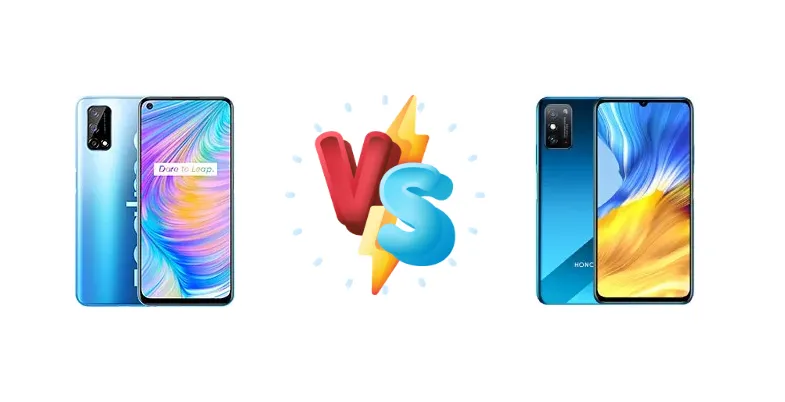
Both the Realme Q2 and Honor X10 Max 5G represent compelling options in the increasingly competitive mid-range 5G smartphone market. While both leverage Mediatek’s Dimensity 800 series, subtle yet significant differences in chipset implementation and charging capabilities dictate which device ultimately offers a superior user experience. This comparison dissects those differences to help you make an informed decision.
🏆 Quick Verdict
For the average user prioritizing sustained performance and faster charging, the Realme Q2 emerges as the winner. Its Dimensity 800U chipset, with a more modern CPU core configuration, provides a noticeable edge in multi-tasking and gaming, complemented by its 30W fast charging. The Honor X10 Max 5G remains a viable option, but falls slightly behind in raw processing power.
| Network |
|---|
| 2G bands | GSM 850 / 900 / 1800 / 1900 | GSM 850 / 900 / 1800 / 1900 |
| 3G bands | HSDPA 850 / 900 / 1700(AWS) / 1900 / 2100 | HSDPA 800 / 850 / 900 / 1700(AWS) / 1900 / 2100 |
| 4G bands | 1, 2, 3, 4, 5, 7, 8, 34, 38, 39, 40, 41 | 1, 2, 3, 4, 5, 8, 18, 19, 26, 34, 38, 39, 40, 41 |
| 5G bands | 1, 41, 77, 78, 79 SA/NSA | 1, 3, 38, 41, 77, 78, 79, 80, 84 SA/NSA |
| Speed | HSPA, LTE, 5G 2.3 Gbps DL | HSPA, LTE, 5G |
| Technology | GSM / CDMA / HSPA / EVDO / LTE / 5G | GSM / HSPA / LTE / 5G |
| | CDMA2000 1xEV-DO | - |
| Launch |
|---|
| Announced | 2020, October 13. Released 2020, October 19 | 2020, July 02. Released 2020, July 03 |
| Status | Discontinued | Discontinued |
| Body |
|---|
| Dimensions | 162.2 x 75.1 x 9.1 mm (6.39 x 2.96 x 0.36 in) | 174.4 x 84.9 x 8.3 mm (6.87 x 3.34 x 0.33 in) |
| SIM | Nano-SIM + Nano-SIM | Nano-SIM + Nano-SIM |
| Weight | 194 g (6.84 oz) | 232 g (8.18 oz) |
| Display |
|---|
| Resolution | 1080 x 2400 pixels, 20:9 ratio (~405 ppi density) | 1080 x 2280 pixels, 19:9 ratio (~356 ppi density) |
| Size | 6.5 inches, 102.0 cm2 (~83.7% screen-to-body ratio) | 7.09 inches, 125.5 cm2 (~84.7% screen-to-body ratio) |
| Type | IPS LCD, 120Hz | IPS LCD, HDR10 |
| Platform |
|---|
| CPU | Octa-core (2x2.4 GHz Cortex-A76 & 6x2.0 GHz Cortex-A55) | Octa-core (4x2.0 GHz Cortex-A76 & 4x2.0 GHz Cortex-A55) |
| Chipset | Mediatek Dimensity 800U (7 nm) | Mediatek Dimensity 800 (7 nm) |
| GPU | Mali-G57 MC3 | Mali-G57MP4 |
| OS | Android 10, Realme UI | Android 10, Magic UI 3.1, no Google Play Services |
| Memory |
|---|
| Card slot | microSDXC | Nano Memory (uses shared SIM slot) |
| Internal | 128GB 4GB RAM, 128GB 6GB RAM | 64GB 6GB RAM, 128GB 6GB RAM, 128GB 8GB RAM |
| | UFS 2.1 | - |
| Main Camera |
|---|
| Dual | - | 48 MP, f/1.8, 26mm (wide), 1/2.0", 0.8µm, PDAF
Auxiliary lens |
| Features | LED flash, HDR, panorama | LED flash, panorama, HDR |
| Triple | 48 MP, f/1.8, 25mm (wide), 1/2.0", 0.8µm, PDAF
8 MP, f/2.3, 119˚, 16mm (ultrawide), 1/4.0", 1.12µm
2 MP (macro) | - |
| Video | 4K@30fps, 1080p@30/60/120fps, gyro-EIS | 4K@30fps, 1080p@30fps, gyro-EIS |
| Selfie camera |
|---|
| Features | HDR, panorama | HDR |
| Single | 16 MP, f/2.1, 26mm (wide), 1/3.1", 1.0µm | 8 MP |
| Video | 1080p@30fps | 1080p@30fps |
| Sound |
|---|
| 3.5mm jack | Yes | Yes |
| 35mm jack | Yes | Yes |
| Loudspeaker | Yes | Yes, with dual speakers |
| | 24-bit/192kHz audio | - |
| Comms |
|---|
| Bluetooth | 5.0, A2DP, LE | 5.1, A2DP, LE |
| NFC | - | Yes |
| Positioning | GPS, GLONASS, GALILEO, BDS | GPS, GLONASS, BDS |
| Radio | No | No |
| USB | USB Type-C 2.0, OTG | USB Type-C 2.0, OTG |
| WLAN | Wi-Fi 802.11 a/b/g/n/ac, dual-band, Wi-Fi Direct | Wi-Fi 802.11 a/b/g/n/ac, dual-band, Wi-Fi Direct |
| Features |
|---|
| Sensors | Fingerprint (side-mounted), accelerometer, gyro, proximity, compass | Fingerprint (side-mounted), accelerometer, gyro, proximity, compass |
| Battery |
|---|
| Charging | 30W wired | 22.5W wired |
| Type | 5000 mAh | Li-Po 5000 mAh |
| Misc |
|---|
| Colors | Blue, Violet | Black, Blue, Silver |
| Models | RMX2117 | KKG-AN00 |
| Price | About 160 EUR | About 240 EUR |
Realme Q2
- Faster 30W charging for quicker top-ups.
- More powerful CPU with the Dimensity 800U.
- Potentially better multi-tasking performance.
- Display size potentially smaller than the Honor X10 Max 5G.
- Camera specs unknown, potential for average image quality.
Honor X10 Max 5G
- Potentially larger display for immersive media consumption.
- Likely more affordable price point.
- Honor's reputation for solid build quality.
- Slower 22.5W charging.
- Less powerful CPU with the Dimensity 800.
- Potentially lower multi-tasking performance.
Display Comparison
While specific display specs aren't provided, Honor historically favors larger displays, suggesting the X10 Max 5G likely boasts a larger screen size than the Realme Q2. However, display quality beyond size remains unknown. Both devices will likely utilize LCD panels given their price bracket. The absence of information regarding refresh rates (60Hz vs 90Hz/120Hz) is a key omission, impacting smoothness of scrolling and animations.
Camera Comparison
Without detailed camera specifications, a direct comparison is difficult. However, both phones likely employ a multi-camera setup geared towards general photography. The absence of information regarding sensor sizes and optical image stabilization (OIS) is notable. Given the price point, expect primary sensors in the 48MP-64MP range. Image processing algorithms will likely differentiate the final image quality, with Realme often leaning towards vibrant, saturated colors, while Honor typically aims for more natural tones.
Performance
The core difference lies in the chipsets: the Realme Q2 features the Mediatek Dimensity 800U, while the Honor X10 Max 5G uses the Dimensity 800. The 800U boasts a newer CPU configuration – 2x2.4 GHz Cortex-A76 and 6x2.0 GHz Cortex-A55 – compared to the 800’s 4x2.0 GHz Cortex-A76 and 4x2.0 GHz Cortex-A55. This means the Q2 has more of the higher-performance A76 cores, translating to better multi-core performance and responsiveness. While both are 7nm chips, the architectural refinement in the 800U provides a tangible advantage for demanding tasks. The GPU performance is likely similar, but the CPU difference is significant.
Battery Life
The Realme Q2’s 30W wired charging is a clear advantage over the Honor X10 Max 5G’s 22.5W charging. This translates to significantly faster charging times, reducing downtime. While battery capacity isn’t specified, the faster charging of the Q2 mitigates the impact of a potentially smaller battery. Expect the Q2 to reach 50% charge in approximately 25-30 minutes, while the X10 Max 5G will likely take closer to 45-60 minutes.
Buying Guide
Buy the Realme Q2 if you need a phone that can handle demanding applications and games without significant throttling, and if you value quicker top-ups thanks to its 30W charging. Buy the Honor X10 Max 5G if you prioritize a potentially larger display (based on brand history) and are willing to trade a small amount of processing power for a potentially lower price point. Both phones are geared towards users seeking 5G connectivity without breaking the bank.
Frequently Asked Questions
❓ Will the Realme Q2's Dimensity 800U handle demanding games like PUBG Mobile at high settings?
The Dimensity 800U is capable of running PUBG Mobile at high settings, but sustained performance may be limited by thermal throttling. Expect playable frame rates, but not necessarily a consistently smooth 60fps experience during extended gaming sessions. The 800U's improved CPU architecture over the 800 in the Honor X10 Max 5G should provide a slight edge in maintaining stable frame rates.
❓ How long will it take to fully charge the Realme Q2 with its 30W fast charging?
Based on typical 30W charging speeds, the Realme Q2 should fully charge from 0% to 100% in approximately 60-75 minutes. This is significantly faster than the Honor X10 Max 5G's 22.5W charging, which will likely take over 90 minutes for a full charge.
❓ Does the Honor X10 Max 5G support dual 5G SIMs?
While not explicitly stated, Honor phones in this price range often support dual 5G SIMs. However, it's crucial to verify this feature with the retailer or Honor's official specifications before purchasing, as support can vary by region and model.