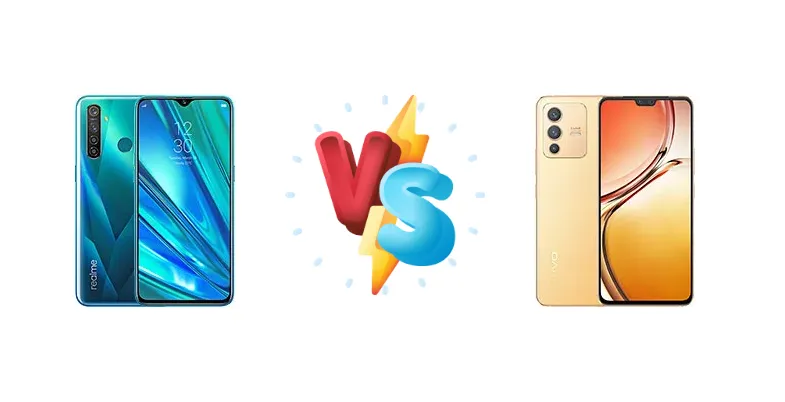
The Realme Q and vivo V23 5G represent compelling options in the competitive mid-range 5G smartphone market. The Realme Q, leveraging the Qualcomm Snapdragon 712, aims for efficient performance, while the vivo V23 5G, powered by the MediaTek Dimensity 920, targets a more powerful experience. This comparison dissects their key differences to determine which device best suits your needs.
🏆 Quick Verdict
For the average user prioritizing overall performance and faster charging, the vivo V23 5G emerges as the stronger contender. Its Dimensity 920 chipset offers a significant performance leap over the Snapdragon 712 in the Realme Q, and the 44W charging is noticeably quicker. However, the Realme Q remains a viable option for budget-conscious buyers.
| Network |
|---|
| 2G bands | GSM 850 / 900 / 1800 / 1900 | GSM 850 / 900 / 1800 / 1900 |
| 3G bands | HSDPA 850 / 900 / 2100 | HSDPA 850 / 900 / 1700(AWS) / 1900 / 2100 |
| 4G bands | 1, 3, 4, 5, 8, 38, 39, 40, 41 | 1, 2, 3, 4, 5, 8, 18, 19, 26, 38, 39, 40, 41 |
| 5G bands | - | 1, 3, 38, 40, 41, 77, 78 SA/NSA |
| Speed | HSPA, LTE | HSPA, LTE, 5G |
| Technology | GSM / CDMA / HSPA / LTE | GSM / HSPA / LTE / 5G |
| | CDMA 800 & TD-SCDMA | 1, 3, 5, 8, 7, 20, 28, 38, 40, 41, 77, 78 SA/NSA |
| Launch |
|---|
| Announced | 2019, September. Released 2019, September | 2022, January 05 |
| Status | Discontinued | Available. Released 2022, January 19 |
| Body |
|---|
| Build | Glass front (Gorilla Glass 3+), plastic back, plastic frame | Glass front (Schott Xensation Up), glass back |
| Dimensions | 157 x 74.2 x 8.9 mm (6.18 x 2.92 x 0.35 in) | 157.2 x 72.4 x 7.4 or 7.6 mm |
| SIM | Nano-SIM + Nano-SIM | Nano-SIM + Nano-SIM |
| Weight | 184 g (6.49 oz) | 179 g or 181 g (6.31 oz) |
| | Weather-sealed ports & loudspeaker | - |
| Display |
|---|
| Protection | Corning Gorilla Glass 3+ | Schott Xensation Up |
| Resolution | 1080 x 2340 pixels, 19.5:9 ratio (~409 ppi density) | 1080 x 2400 pixels, 20:9 ratio (~409 ppi density) |
| Size | 6.3 inches, 97.4 cm2 (~83.6% screen-to-body ratio) | 6.44 inches, 100.1 cm2 (~88.0% screen-to-body ratio) |
| Type | IPS LCD | AMOLED, 90Hz, HDR10+ |
| Platform |
|---|
| CPU | Octa-core (2x2.3 GHz Kryo 360 Gold & 6x1.7 GHz Kryo 360 Silver) | Octa-core (2x2.5 GHz Cortex-A78 & 6x2.0 GHz Cortex-A55) |
| Chipset | Qualcomm SDM712 Snapdragon 712 (10 nm) | Mediatek Dimensity 920 (6 nm) |
| GPU | Adreno 616 | Mali-G68 MC4 |
| OS | Android 9.0 (Pie), ColorOS 6 | Android 12, upgradable to Android 14, Funtouch 14 |
| Memory |
|---|
| Card slot | microSDXC (dedicated slot) | No |
| Internal | 64GB 4GB RAM, 64GB 6GB RAM, 128GB 8GB RAM | 128GB 8GB RAM, 256GB 12GB RAM |
| Main Camera |
|---|
| Dual | - | 50 MP, f/2.0, (wide), AF
8 MP, f/2.3, 105˚ (ultrawide) |
| Features | LED flash, HDR, panorama | Dual-LED flash, HDR, panorama |
| Quad | 48 MP, f/1.8, (wide), 1/2.0", 0.8µm, PDAF
8 MP, f/2.2, 13mm (ultrawide)
2 MP (macro)
Auxiliary lens | - |
| Single | 8 MP, AF | - |
| Triple | - | 64 MP, f/1.9, 26mm (wide), PDAF
8 MP, f/2.2, 120˚, 16mm (ultrawide), 1/4.0", 1.12µm
2 MP (macro) |
| Video | 4K@30fps, 1080p@30/60/120fps, 720p@960fps, gyro-EIS | 4K@30fps, 1080p@30fps, gyro-EIS |
| Selfie camera |
|---|
| Dual | - | 50 MP, f/2.0, (wide), AF
8 MP, f/2.3, 105˚ (ultrawide) |
| Features | HDR, panorama | Dual-LED dual-tone flash, HDR |
| Single | 16 MP, f/2.0, 25mm (wide), 1/3.06", 1.0µm | - |
| Video | 1080p@30fps | 4K@30fps, 1080p@30fps |
| Sound |
|---|
| 3.5mm jack | Yes | No |
| 35mm jack | Yes | No |
| Loudspeaker | Yes | Yes |
| | - | 24-bit/192kHz audio |
| Comms |
|---|
| Bluetooth | 5.0, A2DP, LE | 5.2, A2DP, LE, aptX HD |
| NFC | No | Yes (market/region dependent) |
| Positioning | GPS, GLONASS, GALILEO, BDS | GPS, GLONASS, BDS, GALILEO, QZSS, NavIC |
| Radio | FM radio | No |
| USB | USB Type-C 2.0, OTG | USB Type-C, OTG |
| WLAN | Wi-Fi 802.11 a/b/g/n/ac, dual-band, Wi-Fi Direct | Wi-Fi 802.11 a/b/g/n/ac, Wi-Fi 6 (market dependent), dual-band, Wi-Fi Direct |
| Features |
|---|
| Sensors | Fingerprint (rear-mounted), accelerometer, gyro, proximity, compass | Fingerprint (under display, optical), accelerometer, gyro, proximity, compass |
| | - | Color changing back panel when exposed to sunlight |
| Battery |
|---|
| Charging | 20W wired, 50% in 30 min | 44W wired, 68% in 30 min |
| Type | 4035 mAh, non-removable | 4200 mAh |
| Misc |
|---|
| Colors | Light Green, Light Blue | Sunshine Gold, Stardust Black |
| Models | CPN-AL00, CPN-W09, CPN-L09 | V2130, V2303 |
| Price | About 130 EUR | About 280 EUR |
| SAR | - | 1.08 W/kg (head) 0.72 W/kg (body) |
| Tests |
|---|
| Battery life | - |
Endurance rating 103h
|
| Camera | - |
Photo / Video |
| Display | - |
Contrast ratio: Infinite (nominal) |
| Loudspeaker | - |
-28.5 LUFS (Average)
|
| Performance | - |
AnTuTu: 406498 (v8), 476058 (v9)
GeekBench: 8421 (v4.4), 2140 (v5.1)
GFXBench: 22fps (ES 3.1 onscreen) |
Realme Q
- More affordable price point
- Reliable Qualcomm Snapdragon 712 chipset
- Decent battery endurance
- Slower charging speed (20W)
- Less powerful chipset compared to Dimensity 920
- Likely lower display brightness and quality
vivo V23 5G
- Faster and more efficient MediaTek Dimensity 920 chipset
- Significantly faster 44W charging
- Brighter and potentially higher-quality display
- Higher price compared to Realme Q
- Potential for software bloat (typical of vivo)
- Battery life is similar despite faster charging
Display Comparison
The vivo V23 5G boasts a measured peak brightness of 629 nits, providing a significantly more visible display in outdoor conditions compared to the Realme Q (brightness data unavailable, but likely lower given the chipset and price point). While both displays have an 'infinite' contrast ratio (nominal), the V23 5G’s higher brightness translates to a more vibrant and readable experience. The Realme Q’s display specifications are less detailed, suggesting a more standard LCD panel, while the V23 5G likely utilizes AMOLED technology for richer colors and deeper blacks.
Camera Comparison
Both devices feature photo and video capabilities, but detailed camera specifications are limited. The absence of sensor size or aperture information makes a direct comparison difficult. However, the Dimensity 920’s integrated image signal processor (ISP) in the V23 5G is more advanced than the Snapdragon 712’s, potentially leading to better image processing, noise reduction, and dynamic range. The Realme Q likely relies on software optimization to compensate for its less powerful ISP. Without further data, it's reasonable to assume the V23 5G offers a more capable camera system.
Performance
The core difference lies in the chipsets. The vivo V23 5G’s MediaTek Dimensity 920 (6nm) offers a substantial performance advantage over the Realme Q’s Qualcomm Snapdragon 712 (10nm). The Dimensity 920’s Cortex-A78 cores, clocked at 2.5 GHz, deliver faster processing speeds than the Snapdragon 712’s Kryo 360 Gold cores at 2.3 GHz. The 6nm process node of the Dimensity 920 also contributes to improved thermal efficiency, potentially reducing throttling during sustained workloads. This translates to smoother multitasking, faster app loading times, and a better gaming experience on the V23 5G.
Battery Life
Both phones achieve an endurance rating of 103 hours, suggesting similar overall battery life despite differing battery capacities (not specified). However, the vivo V23 5G’s 44W wired charging significantly outperforms the Realme Q’s 20W charging. The V23 5G can reach 68% charge in 30 minutes, while the Realme Q only manages 50%. This faster charging speed is a significant convenience factor for users who frequently need to top up their battery quickly.
Buying Guide
Buy the Realme Q if you need a reliable, affordable 5G smartphone for everyday tasks and light gaming, and aren't overly concerned with top-tier performance. Buy the vivo V23 5G if you prioritize a smoother, more responsive experience for demanding apps, gaming, and value faster charging speeds, even at a slightly higher price point.
Frequently Asked Questions
❓ Does the MediaTek Dimensity 920 in the vivo V23 5G get noticeably hot during extended gaming sessions?
While the Dimensity 920 is a powerful chip, its 6nm process node and vivo’s thermal management solutions generally prevent excessive overheating. Users report manageable temperatures during prolonged gaming, though some throttling may occur to maintain stability. The Realme Q’s Snapdragon 712, being less powerful, will likely run cooler but also deliver lower frame rates.
❓ Is the difference in charging speed between 20W (Realme Q) and 44W (vivo V23 5G) truly significant in everyday use?
Yes, the difference is substantial. The V23 5G’s 44W charging can add a significant amount of battery life in a short period – 68% in 30 minutes. The Realme Q’s 20W charging is considerably slower, making it less convenient for users who need a quick top-up. This is particularly beneficial for those with busy lifestyles.
❓ Given the similar endurance ratings, does the Realme Q's potentially larger battery capacity (unconfirmed) offset the V23 5G's faster charging?
While a larger battery capacity would theoretically offer longer runtimes, the convenience of the V23 5G’s 44W charging often outweighs the benefit of a slightly larger battery. Frequent, quick top-ups can effectively mitigate any potential difference in overall battery life, making the V23 5G a more practical choice for many users.