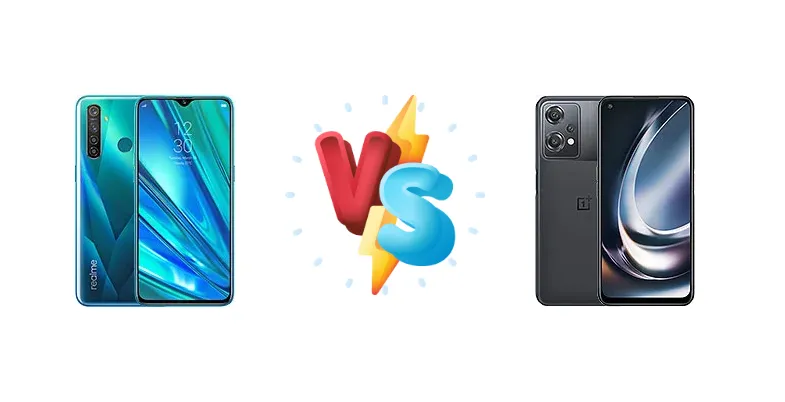
The Realme Q and OnePlus Nord CE 2 Lite 5G represent compelling options in the crowded budget and mid-range smartphone market. While both aim to deliver 5G connectivity at an accessible price, they take different approaches under the hood. The Realme Q relies on the older, but still capable, Snapdragon 712, while the Nord CE 2 Lite 5G opts for the newer, more efficient Snapdragon 695. This comparison dissects these key differences to determine which device offers the best overall value.
🏆 Quick Verdict
For the average user prioritizing future-proofing and faster charging, the OnePlus Nord CE 2 Lite 5G is the better choice. Its Snapdragon 695, built on a 6nm process, offers improved efficiency and 5G capabilities, complemented by significantly faster 33W charging. While the Realme Q remains a viable option, its older chipset and slower charging hold it back.
| Network |
|---|
| 2G bands | GSM 850 / 900 / 1800 / 1900 | GSM 850 / 900 / 1800 / 1900 |
| 3G bands | HSDPA 850 / 900 / 2100 | HSDPA 800 / 850 / 900 / 1700(AWS) / 1900 / 2100 |
| 4G bands | 1, 3, 4, 5, 8, 38, 39, 40, 41 | 1, 2, 3, 4, 5, 7, 8, 12, 13, 17, 18, 19, 20, 26, 28, 38, 39, 40, 41, 66 - Europe |
| 5G bands | - | 1, 3, 5, 7, 8, 20, 28, 38, 40, 41, 66, 77, 78 SA/NSA - Europe |
| Speed | HSPA, LTE | HSPA, LTE, 5G |
| Technology | GSM / CDMA / HSPA / LTE | GSM / HSPA / LTE / 5G |
| | CDMA 800 & TD-SCDMA | - |
| Launch |
|---|
| Announced | 2019, September. Released 2019, September | 2022, April 28 |
| Status | Discontinued | Available. Released 2022, April 30 |
| Body |
|---|
| Build | Glass front (Gorilla Glass 3+), plastic back, plastic frame | Glass front, plastic frame, plastic back |
| Dimensions | 157 x 74.2 x 8.9 mm (6.18 x 2.92 x 0.35 in) | 164.3 x 75.6 x 8.5 mm (6.47 x 2.98 x 0.33 in) |
| SIM | Nano-SIM + Nano-SIM | Nano-SIM + Nano-SIM |
| Weight | 184 g (6.49 oz) | 195 g (6.88 oz) |
| | Weather-sealed ports & loudspeaker | - |
| Display |
|---|
| Protection | Corning Gorilla Glass 3+ | - |
| Resolution | 1080 x 2340 pixels, 19.5:9 ratio (~409 ppi density) | 1080 x 2412 pixels, 20:9 ratio (~401 ppi density) |
| Size | 6.3 inches, 97.4 cm2 (~83.6% screen-to-body ratio) | 6.59 inches, 104.5 cm2 (~84.1% screen-to-body ratio) |
| Type | IPS LCD | IPS LCD, 120Hz |
| Platform |
|---|
| CPU | Octa-core (2x2.3 GHz Kryo 360 Gold & 6x1.7 GHz Kryo 360 Silver) | Octa-core (2x2.2 GHz Kryo 660 Gold & 6x1.7 GHz Kryo 660 Silver) |
| Chipset | Qualcomm SDM712 Snapdragon 712 (10 nm) | Qualcomm SM6375 Snapdragon 695 5G (6 nm) |
| GPU | Adreno 616 | Adreno 619 |
| OS | Android 9.0 (Pie), ColorOS 6 | Android 12, upgradable to Android 13, OxygenOS 13 |
| Memory |
|---|
| Card slot | microSDXC (dedicated slot) | microSDXC (uses shared SIM slot) |
| Internal | 64GB 4GB RAM, 64GB 6GB RAM, 128GB 8GB RAM | 128GB 6GB RAM, 128GB 8GB RAM |
| Main Camera |
|---|
| Features | LED flash, HDR, panorama | LED flash, HDR, panorama |
| Quad | 48 MP, f/1.8, (wide), 1/2.0", 0.8µm, PDAF
8 MP, f/2.2, 13mm (ultrawide)
2 MP (macro)
Auxiliary lens | - |
| Single | 8 MP, AF | - |
| Triple | - | 64 MP, f/1.7, 26mm (wide), 0.7µm, PDAF
2 MP (macro)
Auxiliary lens |
| Video | 4K@30fps, 1080p@30/60/120fps, 720p@960fps, gyro-EIS | 1080p@30fps |
| Selfie camera |
|---|
| Features | HDR, panorama | HDR |
| Single | 16 MP, f/2.0, 25mm (wide), 1/3.06", 1.0µm | 16 MP, f/2.0, (wide), 1/3.0", 1.0µm |
| Video | 1080p@30fps | 1080p@30fps |
| Sound |
|---|
| 3.5mm jack | Yes | Yes |
| 35mm jack | Yes | Yes |
| Loudspeaker | Yes | Yes |
| Comms |
|---|
| Bluetooth | 5.0, A2DP, LE | 5.2, A2DP, LE, aptX HD |
| NFC | No | Yes (market/region dependent) |
| Positioning | GPS, GLONASS, GALILEO, BDS | GPS, GLONASS, GALILEO, BDS, QZSS |
| Radio | FM radio | Unspecified |
| USB | USB Type-C 2.0, OTG | USB Type-C 2.0, OTG |
| WLAN | Wi-Fi 802.11 a/b/g/n/ac, dual-band, Wi-Fi Direct | Wi-Fi 802.11 a/b/g/n/ac, dual-band, Wi-Fi Direct |
| Features |
|---|
| Sensors | Fingerprint (rear-mounted), accelerometer, gyro, proximity, compass | Fingerprint (side-mounted), accelerometer, gyro, proximity, compass |
| Battery |
|---|
| Charging | 20W wired, 50% in 30 min | 33W wired |
| Type | 4035 mAh, non-removable | Li-Po 5000 mAh |
| Misc |
|---|
| Colors | Light Green, Light Blue | Black Dusk, Blue Tide |
| Models | CPN-AL00, CPN-W09, CPN-L09 | CPH2381, CPH2409 |
| Price | About 130 EUR | About 220 EUR |
| SAR | - | 1.19 W/kg (head) 0.71 W/kg (body) |
Realme Q
- Proven Snapdragon 712 performance
- Potentially lower price point
- Stable software experience (Realme UI)
- Slower 20W charging
- Older Snapdragon 712 chipset
- Less efficient 10nm process
OnePlus Nord CE 2 Lite 5G
- Faster 33W charging
- More efficient Snapdragon 695 chipset (6nm)
- Modern 5G modem
- Potentially slightly lower CPU performance in burst tasks
- OnePlus software updates can be inconsistent
Display Comparison
Neither device boasts a standout display. Given the context data focuses on processors, we can infer both likely utilize standard LCD panels common in this price bracket. The absence of information regarding refresh rates suggests both are likely 60Hz. The key difference will likely be color calibration and peak brightness, areas where OnePlus typically performs slightly better. Bezels are expected to be comparable, reflecting the budget nature of both devices.
Camera Comparison
Without specific camera sensor details, it’s difficult to make a definitive judgment. However, given the market positioning, both phones likely feature a primary sensor around the 48MP-64MP range. The Snapdragon 695’s ISP (Image Signal Processor) is newer and more advanced than the 712’s, potentially leading to better image processing, particularly in low-light conditions. The Realme Q may rely more on software processing to compensate for its older ISP. The presence of a 2MP macro lens on either device is largely inconsequential; these sensors typically offer limited detail and are more of a marketing feature than a practical benefit.
Performance
The core of this comparison lies in the chipsets. The OnePlus Nord CE 2 Lite 5G’s Snapdragon 695 (6nm) represents a significant architectural leap over the Realme Q’s Snapdragon 712 (10nm). While the CPU core configuration is similar – both feature 2x performance cores and 6x efficiency cores – the 6nm process node of the 695 translates to improved power efficiency and reduced thermal throttling. This means the Nord CE 2 Lite 5G is likely to sustain peak performance for longer periods, particularly in demanding tasks like gaming. The 695 also integrates a more modern 5G modem, offering potentially faster and more reliable 5G connectivity. The Realme Q’s SD712, while still capable, will show its age in sustained workloads.
Battery Life
The OnePlus Nord CE 2 Lite 5G’s 33W charging is a clear advantage over the Realme Q’s 20W charging. This translates to significantly faster top-up times – the Nord CE 2 Lite 5G can likely reach 50% charge in under 30 minutes, while the Realme Q will take considerably longer. While battery capacity isn’t specified, the Snapdragon 695’s improved efficiency should result in comparable, if not slightly better, real-world battery life on the Nord CE 2 Lite 5G, despite potentially having a smaller battery capacity.
Buying Guide
Buy the Realme Q if you prioritize a proven, if slightly older, chipset with a track record of stable performance and are less concerned with the latest 5G advancements or rapid charging. Buy the OnePlus Nord CE 2 Lite 5G if you value a more modern, efficient processor, faster charging speeds, and a potentially longer software support lifecycle, even if it means sacrificing some raw CPU power.
Frequently Asked Questions
❓ Will the Snapdragon 695 in the OnePlus Nord CE 2 Lite 5G struggle with demanding games like PUBG or Call of Duty?
While not a flagship chipset, the Snapdragon 695 is capable of running PUBG and Call of Duty at medium settings with stable frame rates. The 6nm process helps mitigate thermal throttling, allowing for sustained performance during gaming sessions. However, users seeking the highest possible graphics settings should consider a more powerful device.
❓ How much faster is the 33W charging on the OnePlus Nord CE 2 Lite 5G compared to the Realme Q's 20W charging in real-world use?
The 33W charging on the Nord CE 2 Lite 5G can realistically shave off 30-45 minutes from a full charge compared to the Realme Q. Expect to reach around 50% charge in approximately 25-30 minutes on the Nord CE 2 Lite 5G, while the Realme Q will likely take closer to 60 minutes to achieve the same level.
❓ Does the Snapdragon 695 support all 5G bands available in the US?
5G band support varies by carrier and region. The Snapdragon 695 supports a wide range of 5G bands, but it's crucial to verify compatibility with your specific carrier before purchasing. Check the OnePlus Nord CE 2 Lite 5G's official specifications for a detailed list of supported bands.