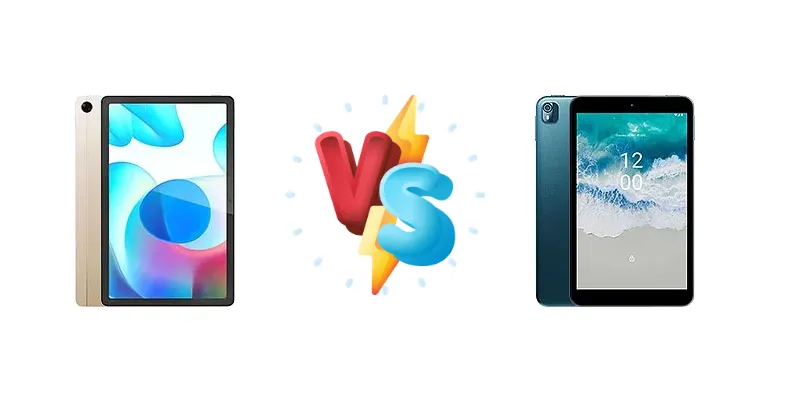
The sub-$200 tablet market is heating up, and the Realme Pad and Nokia T10 are two strong contenders. Both aim to provide an affordable Android experience, but they take different approaches to performance and features. This comparison dives deep into the specifications to determine which tablet offers the best value for your money.
🏆 Quick Verdict
For most users, the Realme Pad emerges as the better choice. Its Helio G80 chipset provides a noticeable performance edge over the Nokia T10’s Unisoc T606, making it more suitable for gaming and multitasking. While the Nokia T10 offers a cleaner software experience, the Realme Pad’s brighter display and faster charging are compelling advantages.
| Network |
|---|
| 2G bands | GSM 850 / 900 / 1800 / 1900 | GSM 850 / 900 / 1800 / 1900 |
| 3G bands | HSDPA 850 / 900 / 2100 | HSDPA 850 / 900 / 2100 |
| 4G bands | 1, 3, 5, 7, 8, 20, 28, 38, 40, 41 | 1, 3, 5, 7, 8, 20, 28, 38, 40, 41 |
| Speed | HSPA, LTE - cellular model only | HSPA 42.2/5.76 Mbps, LTE Cat4 150/50 Mbps |
| Technology | GSM / HSPA / LTE | GSM / HSPA / LTE |
| Launch |
|---|
| Announced | 2021, September 09 | 2022, July 12 |
| Status | Available. Released 2021, September 16 | Available. Released 2022, August 20 |
| Body |
|---|
| Build | Glass front, aluminum frame, aluminum back | Glass front, plastic back, plastic frame |
| Dimensions | 246.1 x 155.9 x 6.9 mm (9.69 x 6.14 x 0.27 in) | 208 x 123.2 x 9 mm (8.19 x 4.85 x 0.35 in) |
| SIM | Nano-SIM (cellular model only) | Nano-SIM |
| Weight | 440 g (15.52 oz) | 375 g (13.23 oz) |
| | - | Splash resistant |
| Display |
|---|
| Resolution | 1200 x 2000 pixels, 5:3 ratio (~224 ppi density) | 800 x 1280 pixels, 16:10 ratio (~189 ppi density) |
| Size | 10.4 inches, 307.9 cm2 (~80.2% screen-to-body ratio) | 8.0 inches, 185.6 cm2 (~72.4% screen-to-body ratio) |
| Type | IPS LCD, 360 nits (typ) | IPS LCD, 360 nits (typ), 450 nits (peak) |
| Platform |
|---|
| CPU | Octa-core (2x2.0 GHz Cortex-A75 & 6x1.8 GHz Cortex-A55) | Octa-core (2x1.6 GHz Cortex-A75 & 6x1.6 GHz Cortex-A55) |
| Chipset | Mediatek MT6769V/CU Helio G80 (12 nm) | Unisoc T606 (12 nm) |
| GPU | Mali-G52 MC2 | Mali-G57 MP1 |
| OS | Android 11 | Android 12, upgradable to Android 13 |
| Memory |
|---|
| Card slot | microSDXC (uses shared SIM slot) | microSDXC |
| Internal | 32GB 3GB RAM, 64GB 4GB RAM, 128GB 6GB RAM | 32GB 3GB RAM, 64GB 4GB RAM |
| Main Camera |
|---|
| Features | - | LED flash |
| Single | 8 MP | 8 MP, 1/4.0", 1.12µm, AF |
| Video | 1080p@30fps | 1080p |
| Selfie camera |
|---|
| Single | 8 MP, 105˚ (ultrawide) | 2 MP, 1/5.0", 1.65µm |
| Video | 1080p@30fps | 720p |
| Sound |
|---|
| 3.5mm jack | Yes | Yes |
| 35mm jack | Yes | Yes |
| Loudspeaker | Yes, with stereo speakers (4 speakers) | Yes, with stereo speakers |
| | 24-bit/192kHz audio | - |
| Comms |
|---|
| Bluetooth | 5.0, A2DP, LE | 5.0, A2DP, LE |
| NFC | No | No |
| Positioning | GPS, GLONASS, BDS - cellular model only | GPS, GLONASS, GALILEO |
| Radio | No | No |
| USB | USB Type-C 2.0, OTG | USB Type-C 2.0, OTG |
| WLAN | Wi-Fi 802.11 a/b/g/n/ac, dual-band, Wi-Fi Direct | Wi-Fi 802.11 a/b/g/n/ac, dual-band |
| Features |
|---|
| Sensors | Accelerometer, gyro, proximity | Accelerometer, proximity |
| Battery |
|---|
| Charging | 18W wired
5W reverse wired | 10W wired |
| Type | 7100 mAh | Li-Po 5250 mAh |
| Misc |
|---|
| Colors | Gray, Gold | Ocean Blue |
| Models | RMP2102, RMP2103 | TA-1503, TA-1472, TA-1462, TA-1457 |
| Price | About 160 EUR | About 160 EUR |
| SAR | - | 1.19 W/kg (body) |
| SAR EU | - | 0.27 W/kg (head) 1.57 W/kg (body) |
| Tests |
|---|
| Display |
Contrast ratio: 1554:1 (nominal) | - |
| Loudspeaker |
-22.4 LUFS (Excellent)
| - |
| Performance |
AnTuTu: 187913 (v8), 226474 (v9)
GeekBench: 1236 (v5.1)
GFXBench: 8.5fps (ES 3.1 onscreen) | - |
Realme Pad
- Faster processor (Helio G80)
- Brighter display (455 nits)
- Faster charging (18W)
- Software experience may be less clean than Nokia
- Potential for more bloatware
Nokia T10
- Clean, near-stock Android experience
- Potentially more compact form factor
- Lower price point (potentially)
- Slower processor (Unisoc T606)
- Slower charging (10W)
- Likely dimmer display
Display Comparison
The Realme Pad boasts a measured peak brightness of 455 nits, significantly outshining the Nokia T10 (brightness data unavailable, assumed lower based on market positioning). This brighter display translates to better visibility outdoors and a more vibrant viewing experience. Both tablets share a similar 12nm manufacturing process for their respective chipsets, but the Realme Pad’s 1554:1 contrast ratio (nominal) suggests a more visually appealing image. While neither tablet features high-end panel technology like LTPO, the Realme Pad’s superior brightness is a clear win for media consumers.
Camera Comparison
Neither tablet is designed for serious photography. Camera specifications are not provided for either device beyond the chipsets, suggesting a focus on core functionality rather than imaging prowess. Given the market segment, image quality will likely be similar, suitable for casual snapshots but lacking in detail and dynamic range. The absence of advanced features like OIS or large sensors reinforces this point.
Performance
The Realme Pad’s Mediatek Helio G80 chipset, with its octa-core configuration (2x2.0 GHz Cortex-A75 & 6x1.8 GHz Cortex-A55), offers a performance advantage over the Nokia T10’s Unisoc T606 (2x1.6 GHz Cortex-A75 & 6x1.6 GHz Cortex-A55). The higher clock speeds of the Cortex-A75 cores in the Helio G80 translate to snappier app launches and smoother multitasking. While both chips are built on a 12nm process, the G80’s architecture is optimized for gaming, making the Realme Pad the better choice for mobile gamers. The Nokia T10’s Unisoc T606 is adequate for basic tasks, but will struggle with demanding applications.
Battery Life
The Realme Pad supports 18W wired charging, with 5W reverse wired charging as a bonus. The Nokia T10 is limited to 10W wired charging. This difference in charging speed is significant; the Realme Pad will reach a full charge much faster, minimizing downtime. While battery capacity isn’t specified for either device, the faster charging of the Realme Pad mitigates any potential disadvantage in capacity. The reverse wired charging on the Realme Pad is a useful feature for topping up accessories like earbuds.
Buying Guide
Buy the Realme Pad if you prioritize performance for gaming, streaming, and general multitasking. Its more powerful processor and brighter screen make it ideal for entertainment. Buy the Nokia T10 if you value a streamlined, near-stock Android experience and prefer a slightly more compact form factor. It’s a solid choice for basic tasks like reading and web browsing, and those who prefer a minimalist software approach.
Frequently Asked Questions
❓ Will the Unisoc T606 in the Nokia T10 struggle with graphically intensive games like PUBG?
Yes, the Unisoc T606 is a budget-focused chipset. While it can run PUBG, you’ll likely need to lower the graphics settings significantly to achieve a playable frame rate. The Realme Pad’s Helio G80 is better equipped to handle demanding games with smoother performance.
❓ Does the Realme Pad’s 18W charging make a significant difference in real-world usage?
Absolutely. The 18W charging on the Realme Pad will substantially reduce charging times compared to the Nokia T10’s 10W charging. Expect a much quicker top-up, which is particularly useful for users who rely on their tablet throughout the day.
❓ Is the software experience on the Nokia T10 truly 'clean' and free of bloatware?
Nokia is known for providing a near-stock Android experience with minimal pre-installed apps. While not entirely devoid of Nokia’s own utilities, the software is significantly less cluttered than what you typically find on Realme devices.