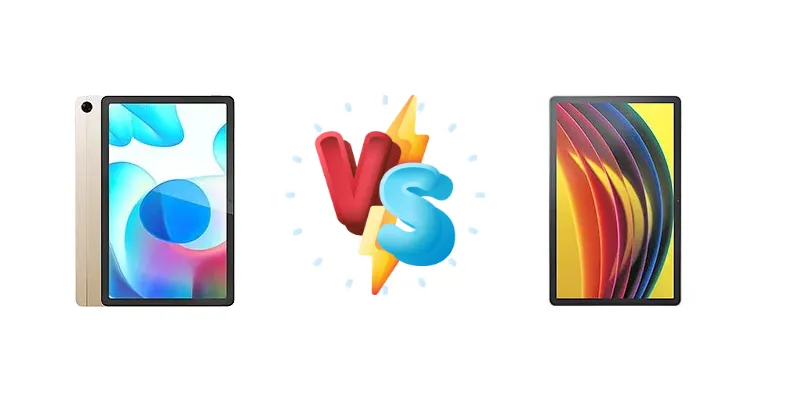
The sub-$200 tablet market is heating up, and the Realme Pad and Lenovo Tab P11 Plus are two strong contenders. Both aim to deliver a solid Android tablet experience without breaking the bank, but they take different approaches to achieving that goal. This comparison dives deep into their specifications and performance to determine which tablet offers the best value for your money.
🏆 Quick Verdict
For most users, the Lenovo Tab P11 Plus emerges as the better choice. Its Helio G90T chipset provides a noticeable performance boost over the Realme Pad’s Helio G80, making it more capable for gaming and multitasking. While both offer similar display quality, the faster charging of the P11 Plus is a welcome addition.
| Network |
|---|
| 2G bands | GSM 850 / 900 / 1800 / 1900 | GSM 850 / 900 / 1800 / 1900 |
| 3G bands | HSDPA 850 / 900 / 2100 | HSDPA 850 / 900 / 1900 / 2100 |
| 4G bands | 1, 3, 5, 7, 8, 20, 28, 38, 40, 41 | 1, 2, 3, 4, 5, 7, 8, 20, 28, 38, 40, 41 |
| Speed | HSPA, LTE - cellular model only | HSPA, LTE - cellular model only |
| Technology | GSM / HSPA / LTE | GSM / HSPA / LTE |
| Launch |
|---|
| Announced | 2021, September 09 | 2021, June 28 |
| Status | Available. Released 2021, September 16 | Available. Released 2021, July 29 |
| Body |
|---|
| Build | Glass front, aluminum frame, aluminum back | - |
| Dimensions | 246.1 x 155.9 x 6.9 mm (9.69 x 6.14 x 0.27 in) | 258.4 x 163 x 7.5 mm (10.17 x 6.42 x 0.30 in) |
| SIM | Nano-SIM (cellular model only) | Nano-SIM (cellular model only) |
| Weight | 440 g (15.52 oz) | 490 g (1.08 lb) |
| | - | Stylus support |
| Display |
|---|
| Resolution | 1200 x 2000 pixels, 5:3 ratio (~224 ppi density) | 1200 x 2000 pixels, 5:3 ratio (~212 ppi density) |
| Size | 10.4 inches, 307.9 cm2 (~80.2% screen-to-body ratio) | 11.0 inches, 344.4 cm2 (~81.8% screen-to-body ratio) |
| Type | IPS LCD, 360 nits (typ) | IPS LCD, 400 nits (typ) |
| Platform |
|---|
| CPU | Octa-core (2x2.0 GHz Cortex-A75 & 6x1.8 GHz Cortex-A55) | Octa-core (2x2.05 GHz Cortex-A76 & 6x2.0 GHz Cortex-A55) |
| Chipset | Mediatek MT6769V/CU Helio G80 (12 nm) | Mediatek MT6785 Helio G90T (12 nm) |
| GPU | Mali-G52 MC2 | Mali-G76 MC4 |
| OS | Android 11 | Android 11 |
| Memory |
|---|
| Card slot | microSDXC (uses shared SIM slot) | microSDXC (dedicated slot) |
| Internal | 32GB 3GB RAM, 64GB 4GB RAM, 128GB 6GB RAM | 64GB 4GB RAM, 128GB 4GB RAM, 128GB 6GB RAM |
| Main Camera |
|---|
| Features | - | LED flash |
| Single | 8 MP | 13 MP, (wide), AF |
| Video | 1080p@30fps | 1080p@30fps |
| Selfie camera |
|---|
| Single | 8 MP, 105˚ (ultrawide) | 8 MP, (wide) |
| Video | 1080p@30fps | 1080p@30fps |
| Sound |
|---|
| 3.5mm jack | Yes | No |
| 35mm jack | Yes | No |
| Loudspeaker | Yes, with stereo speakers (4 speakers) | Yes, with stereo speakers (4 speakers) |
| | 24-bit/192kHz audio | - |
| Comms |
|---|
| Bluetooth | 5.0, A2DP, LE | 5.1, A2DP, LE |
| NFC | No | No |
| Positioning | GPS, GLONASS, BDS - cellular model only | GPS, GLONASS, BDS - cellular model only |
| Radio | No | FM radio |
| USB | USB Type-C 2.0, OTG | USB Type-C 2.0 |
| WLAN | Wi-Fi 802.11 a/b/g/n/ac, dual-band, Wi-Fi Direct | Wi-Fi 802.11 a/b/g/n/ac, dual-band, Wi-Fi Direct |
| Features |
|---|
| Sensors | Accelerometer, gyro, proximity | Accelerometer, gyro, proximity |
| Battery |
|---|
| Charging | 18W wired
5W reverse wired | 20W wired |
| Type | 7100 mAh | Li-Po 7700 mAh |
| Misc |
|---|
| Colors | Gray, Gold | Slate Grey, Platinum Grey, Modernist teal |
| Models | RMP2102, RMP2103 | ZA940124SE |
| Price | About 160 EUR | About 300 EUR |
| Tests |
|---|
| Display |
Contrast ratio: 1554:1 (nominal) | - |
| Loudspeaker |
-22.4 LUFS (Excellent)
| - |
| Performance |
AnTuTu: 187913 (v8), 226474 (v9)
GeekBench: 1236 (v5.1)
GFXBench: 8.5fps (ES 3.1 onscreen) | - |
Realme Pad
- Simple and streamlined user experience
- Affordable price point
- Decent display brightness for indoor use
- Less powerful Helio G80 chipset
- Slower 18W charging
- Limited performance for demanding tasks
Lenovo Tab P11 Plus
- More powerful Helio G90T chipset
- Faster 20W charging
- Better performance for gaming and multitasking
- May be slightly more expensive than the Realme Pad
- Similar display quality to the Realme Pad
- Software experience may include more bloatware
Display Comparison
Both tablets feature similar display characteristics, focusing on affordability rather than cutting-edge technology. The Realme Pad boasts a measured peak brightness of 455 nits and a 1554:1 contrast ratio. While these numbers are respectable, they don’t position either tablet as a display champion. The lack of information regarding panel type (IPS, TFT) for either device suggests a focus on cost reduction. Bezels are likely to be substantial on both, typical for this price bracket. Color accuracy is also likely to be standard, suitable for everyday use but not ideal for color-critical work.
Camera Comparison
Camera performance is unlikely to be a deciding factor for most buyers in this segment. Neither tablet is positioned as a photography powerhouse. Without detailed sensor information, it’s safe to assume both feature basic camera setups adequate for video calls and casual snapshots. Focusing on megapixel counts alone would be misleading; image processing and sensor size are far more important. Given the price point, expect limited low-light performance and average image quality from both devices.
Performance
The core difference between these tablets lies in their chipsets. The Lenovo Tab P11 Plus utilizes the MediaTek Helio G90T, featuring a dual-core CPU configuration with 2x2.05 GHz Cortex-A76 cores and 6x2.0 GHz Cortex-A55 cores. This is a step up from the Realme Pad’s Helio G80, which has 2x2.0 GHz Cortex-A75 cores and 6x1.8 GHz Cortex-A55 cores. The Cortex-A76 cores in the G90T offer a significant architectural advantage, resulting in better single-core and multi-core performance. This translates to snappier app launches, smoother multitasking, and a more enjoyable gaming experience. While both use 12nm process technology, the G90T’s superior core design provides a clear performance edge.
Battery Life
The Realme Pad supports 18W wired charging with 5W reverse wired charging, while the Lenovo Tab P11 Plus offers 20W wired charging. While battery capacity isn’t specified, the faster charging speed of the P11 Plus is a tangible benefit. A 20W charger will significantly reduce the time it takes to reach a full charge compared to the 18W charger of the Realme Pad. This is particularly useful for users who rely on their tablets throughout the day and need quick top-ups.
Buying Guide
Buy the Realme Pad if you prioritize a simple, streamlined experience and are primarily focused on media consumption and light tasks. It’s a good option for casual users who don’t need demanding performance. Buy the Lenovo Tab P11 Plus if you want a more versatile tablet capable of handling gaming, multitasking, and more intensive applications. The improved chipset and faster charging make it a better long-term investment for power users.
Frequently Asked Questions
❓ Will the Lenovo Tab P11 Plus handle demanding games like PUBG Mobile smoothly?
The Helio G90T chipset in the Lenovo Tab P11 Plus is significantly more capable of handling demanding games like PUBG Mobile than the Helio G80 in the Realme Pad. While you may need to adjust graphics settings for optimal performance, the P11 Plus should provide a smoother and more enjoyable gaming experience.
❓ Does the Realme Pad support widevine L1 certification for HD streaming on Netflix and Amazon Prime Video?
While not explicitly stated in the provided specifications, Realme typically includes Widevine L1 certification in their tablets to enable HD streaming on popular platforms like Netflix and Amazon Prime Video. However, it's always best to verify this information through Realme's official documentation or user reports before purchasing if HD streaming is a priority.
❓ How much storage does each tablet offer, and is it expandable?
The provided context data does not specify storage options. However, based on market trends for tablets in this price range, both the Realme Pad and Lenovo Tab P11 Plus are likely to offer multiple storage configurations (e.g., 32GB, 64GB, 128GB) and support microSD card expansion for additional storage.