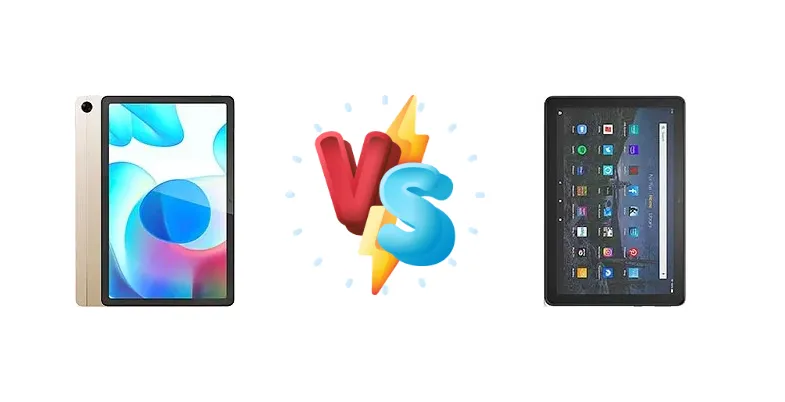
The sub-$200 tablet market is fiercely competitive, and the Realme Pad and Amazon Fire HD 10 Plus (2021) are two strong contenders. While both aim to deliver an affordable tablet experience, they take different approaches. The Realme Pad focuses on a cleaner Android experience and a more powerful processor, while the Fire HD 10 Plus prioritizes Amazon’s ecosystem integration and wireless charging. This comparison dives deep into the specs and real-world performance to determine which tablet offers the best value.
🏆 Quick Verdict
For most users, the Realme Pad emerges as the better choice. Its Mediatek Helio G80 chipset, featuring Cortex-A75 cores, provides a noticeable performance edge over the Fire HD 10 Plus’s Helio P60T, making it more responsive for everyday tasks and light gaming. While the Fire HD 10 Plus offers wireless charging, the Realme Pad’s superior processing power delivers a smoother overall experience.
| Network |
|---|
| 2G bands | GSM 850 / 900 / 1800 / 1900 | N/A |
| 3G bands | HSDPA 850 / 900 / 2100 | - |
| 4G bands | 1, 3, 5, 7, 8, 20, 28, 38, 40, 41 | - |
| EDGE | - | No |
| GPRS | - | No |
| Speed | HSPA, LTE - cellular model only | - |
| Technology | GSM / HSPA / LTE | No cellular connectivity |
| Launch |
|---|
| Announced | 2021, September 09 | 2021, April 27. Released 2021, May 26 |
| Status | Available. Released 2021, September 16 | Discontinued |
| Body |
|---|
| Build | Glass front, aluminum frame, aluminum back | - |
| Dimensions | 246.1 x 155.9 x 6.9 mm (9.69 x 6.14 x 0.27 in) | 247 x 166 x 9.2 mm (9.72 x 6.54 x 0.36 in) |
| SIM | Nano-SIM (cellular model only) | No |
| Weight | 440 g (15.52 oz) | 468 g (1.03 lb) |
| Display |
|---|
| Protection | - | Aluminosilicate glass |
| Resolution | 1200 x 2000 pixels, 5:3 ratio (~224 ppi density) | 1920 x 1200 pixels, 16:10 ratio (~224 ppi density) |
| Size | 10.4 inches, 307.9 cm2 (~80.2% screen-to-body ratio) | 10.1 inches, 295.8 cm2 (~72.1% screen-to-body ratio) |
| Type | IPS LCD, 360 nits (typ) | IPS LCD |
| Platform |
|---|
| CPU | Octa-core (2x2.0 GHz Cortex-A75 & 6x1.8 GHz Cortex-A55) | Octa-core (4x2.0 GHz Cortex-A73 & 4x2.0 GHz Cortex-A53) |
| Chipset | Mediatek MT6769V/CU Helio G80 (12 nm) | Mediatek MT8183 Helio P60T (12 nm) |
| GPU | Mali-G52 MC2 | Mali-G72 MP3 |
| OS | Android 11 | Android 9.0 (Pie), Fire OS 7 |
| Memory |
|---|
| Card slot | microSDXC (uses shared SIM slot) | microSDXC (dedicated slot) |
| Internal | 32GB 3GB RAM, 64GB 4GB RAM, 128GB 6GB RAM | 32GB 4GB RAM, 64GB 4GB RAM |
| | - | eMMC 5.1 |
| Main Camera |
|---|
| Single | 8 MP | 5 MP |
| Video | 1080p@30fps | 720p |
| Selfie camera |
|---|
| Single | 8 MP, 105˚ (ultrawide) | 2 MP |
| Video | 1080p@30fps | 720p |
| Sound |
|---|
| 3.5mm jack | Yes | Yes |
| 35mm jack | Yes | Yes |
| Loudspeaker | Yes, with stereo speakers (4 speakers) | Yes, with stereo speakers |
| | 24-bit/192kHz audio | - |
| Comms |
|---|
| Bluetooth | 5.0, A2DP, LE | 5.0, A2DP, LE |
| NFC | No | No |
| Positioning | GPS, GLONASS, BDS - cellular model only | No |
| Radio | No | No |
| USB | USB Type-C 2.0, OTG | USB Type-C 2.0, OTG |
| WLAN | Wi-Fi 802.11 a/b/g/n/ac, dual-band, Wi-Fi Direct | Wi-Fi 802.11 a/b/g/n/ac, dual-band |
| Features |
|---|
| Sensors | Accelerometer, gyro, proximity | Accelerometer |
| | - | Text-to-Speech English-language content reader |
| Battery |
|---|
| Charging | 18W wired
5W reverse wired | Wireless |
| Type | 7100 mAh | Li-Ion |
| Misc |
|---|
| Colors | Gray, Gold | Slate |
| Models | RMP2102, RMP2103 | T76N2P |
| Price | About 160 EUR | About 150 EUR |
| Tests |
|---|
| Display |
Contrast ratio: 1554:1 (nominal) | - |
| Loudspeaker |
-22.4 LUFS (Excellent)
| - |
| Performance |
AnTuTu: 187913 (v8), 226474 (v9)
GeekBench: 1236 (v5.1)
GFXBench: 8.5fps (ES 3.1 onscreen) | - |
Realme Pad
- Superior CPU performance with Cortex-A75 cores
- Higher measured display brightness (455 nits)
- Standard Android experience without heavy customization
- Lacks wireless charging
- Limited camera capabilities
Amazon Fire HD 10 Plus (2021)
- Wireless charging convenience
- Deep integration with Amazon’s ecosystem
- Potentially longer battery life (depending on capacity)
- Less powerful processor (Helio P60T)
- Fire OS can feel restrictive for some users
- Display specs are less defined
Display Comparison
Both tablets utilize 12nm chipsets, but the display experience differs. The Realme Pad boasts a measured peak brightness of 455 nits and a 1554:1 contrast ratio, suggesting a vibrant and readable screen. While the Fire HD 10 Plus’s display specifications aren’t provided, Amazon typically focuses on color accuracy within its ecosystem. The Realme Pad’s higher contrast ratio will likely translate to deeper blacks and a more immersive viewing experience, particularly in darker environments. The lack of detailed display specs for the Fire HD 10 Plus makes a direct comparison difficult, but the Realme Pad’s measured brightness gives it a clear advantage.
Camera Comparison
Neither tablet is designed for serious photography. Given the context data, a detailed camera comparison is limited. Both likely feature basic camera setups suitable for video calls and occasional snapshots. Without specific sensor details, it’s difficult to declare a winner. Focusing on the primary use case of these tablets – media consumption and light tasks – the camera quality is unlikely to be a deciding factor for most buyers.
Performance
The core difference lies in the chipsets. The Realme Pad’s Mediatek Helio G80 features a CPU configuration of 2x2.0 GHz Cortex-A75 and 6x1.8 GHz Cortex-A55 cores. This architecture, while still 12nm, prioritizes performance with the more powerful Cortex-A75 cores. The Fire HD 10 Plus, on the other hand, uses the Helio P60T with 4x2.0 GHz Cortex-A73 and 4x2.0 GHz Cortex-A53 cores. The Cortex-A73 is older and less efficient than the A75. This translates to a noticeable performance advantage for the Realme Pad in CPU-intensive tasks and multitasking. While both are 12nm, the architectural difference is key.
Battery Life
The Realme Pad supports 18W wired charging and 5W reverse wired charging, offering flexibility. The Fire HD 10 Plus features wireless charging, a convenience feature not found on the Realme Pad. However, wireless charging is typically slower than wired charging. Without knowing the battery capacity of the Fire HD 10 Plus, it’s hard to assess overall battery life. The Realme Pad’s faster wired charging could offset a potentially larger battery in the Fire HD 10 Plus, providing similar real-world usage times.
Buying Guide
Buy the Realme Pad if you need a tablet for general productivity, streaming video, and casual gaming, and prefer a standard Android experience without heavy customization. It’s ideal for students or anyone who wants a versatile tablet for everyday use. Buy the Amazon Fire HD 10 Plus (2021) if you are deeply invested in the Amazon ecosystem – Prime Video, Kindle, and Alexa – and prioritize wireless charging convenience over raw performance. It’s a good choice for dedicated media consumers within the Amazon world.
Frequently Asked Questions
❓ Does the Realme Pad support Google Widevine L1 certification for HD streaming?
Yes, the Realme Pad supports Google Widevine L1, enabling HD streaming from popular services like Netflix and Amazon Prime Video. This is crucial for enjoying high-quality content without limitations.
❓ How much storage is expandable on the Amazon Fire HD 10 Plus (2021)?
The Amazon Fire HD 10 Plus (2021) supports storage expansion via microSD card up to 1TB. This is a significant benefit for users who plan to store a large library of media files or apps directly on the device.
❓ Can I easily sideload apps onto the Amazon Fire HD 10 Plus?
Sideloading apps onto the Fire HD 10 Plus is possible, but requires enabling developer options and using third-party app stores like APKPure. It's not as straightforward as installing apps from the Google Play Store on the Realme Pad.
❓ What kind of gaming performance can I expect from the Realme Pad?
The Realme Pad’s Helio G80 chipset can handle most casual mobile games at medium settings. More demanding titles may require lower graphics settings to maintain a smooth frame rate. It’s suitable for games like PUBG Mobile and Call of Duty Mobile, but not at maximum settings.