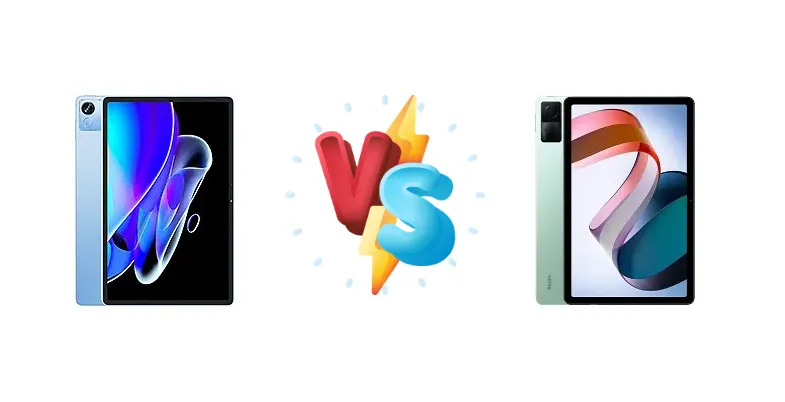
The budget tablet market is heating up! Both the Realme Pad X and Xiaomi Redmi Pad offer compelling features at attractive prices. But which one deserves your money? We're diving deep into a head-to-head comparison to help you decide.
🏆 Quick Verdict
The Realme Pad X edges out the Redmi Pad thanks to its brighter display, faster charging, and slightly more powerful chipset. However, the Redmi Pad offers excellent value and a more streamlined software experience, making it a strong contender for budget-conscious buyers.
| Network |
|---|
| 2G bands | GSM 850 / 900 / 1800 / 1900 | N/A |
| 3G bands | HSDPA 850 / 900 / 2100 | N/A |
| 4G bands | LTE | N/A |
| 5G bands | SA/NSA | - |
| EDGE | - | N/A |
| GPRS | - | N/A |
| Speed | HSPA, LTE, 5G - cellular model only | - |
| Technology | GSM / HSPA / LTE / 5G | No cellular connectivity |
| Launch |
|---|
| Announced | 2022, May 25 | 2022, October 04 |
| Status | Available. Released 2022, June 12 | Available. Released 2022, October 05 |
| Body |
|---|
| Build | Glass front, plastic frame, plastic back | Glass front, aluminum frame |
| Dimensions | 256.5 x 161.1 x 7.1 mm (10.10 x 6.34 x 0.28 in) | 250.5 x 158.1 x 7.1 mm (9.86 x 6.22 x 0.28 in) |
| SIM | Nano-SIM + Nano-SIM (cellular model only) | No |
| Weight | 499 g / 506 g (1.10 lb) | 465 g (1.03 lb) |
| | Stylus support (magnetic charging) | - |
| Display |
|---|
| Resolution | 1200 x 2000 pixels, 5:3 ratio (~213 ppi density) | 1200 x 2000 pixels, 5:3 ratio (~220 ppi density) |
| Size | 10.95 inches, 341.3 cm2 (~82.6% screen-to-body ratio) | 10.61 inches, 320.4 cm2 (~80.9% screen-to-body ratio) |
| Type | IPS LCD, 450 nits (peak) | IPS LCD, 1B colors, 90Hz, 400 nits (typ) |
| Platform |
|---|
| CPU | Octa-core (2x2.2 GHz Kryo 660 Gold & 6x1.7 GHz Kryo 660 Silver) | Octa-core (2x2.2 GHz Cortex-A76 & 6x2.0 GHz Cortex-A55) |
| Chipset | Qualcomm SM6375 Snapdragon 695 5G (6 nm) | Mediatek Helio G99 (6 nm) |
| GPU | Adreno 619 | Mali-G57 MC2 |
| OS | Android, Realme UI 3.0 | Android 12, upgradable to Android 13, MIUI 14 |
| Memory |
|---|
| Card slot | microSDXC | microSDXC |
| Internal | 64GB 4GB RAM, 128GB 6GB RAM | 64GB 3GB RAM, 128GB 4GB RAM, 128GB 6GB RAM |
| | - | UFS 2.2 |
| Main Camera |
|---|
| Single | 13 MP, f/2.2, (wide), AF | 8 MP, f/2.0, (wide), AF |
| Video | 1080p@30fps | 1080p@30fps |
| Selfie camera |
|---|
| Single | 8 MP, f/2.0, 105˚ (ultrawide) | 8 MP, f/2.3, 105° (ultrawide) |
| Video | 1080p@30fps | 1080p@30fps |
| Sound |
|---|
| 3.5mm jack | No | No |
| 35mm jack | No | No |
| Loudspeaker | Yes, with stereo speakers (4 speakers) | Yes, with stereo speakers (4 speakers) |
| | 24-bit/192kHz audio | 24-bit/192kHz audio |
| Comms |
|---|
| Bluetooth | 5.1, A2DP, LE | 5.2, A2DP, LE |
| NFC | No | No |
| Positioning | GPS, GLONASS, GALILEO, BDS - cellular model only | No |
| Radio | No | No |
| USB | USB Type-C 2.0, OTG | USB Type-C, OTG |
| WLAN | Wi-Fi 802.11 b/g/n/ac, hotspot | Wi-Fi 802.11 a/b/g/n/ac, dual-band, Wi-Fi Direct |
| Features |
|---|
| Sensors | Accelerometer, gyro, compass | Accelerometer |
| Battery |
|---|
| Charging | 33W wired, PD
5W reverse wired | 18W wired |
| Type | 8340 mAh | Li-Po 8000 mAh |
| Misc |
|---|
| Colors | Glowing Gray, Glacier Blue, Green | Graphite Gray, Moonlight Silver, Mint Green |
| Models | RMP2107, RMP2108 | 22081283G |
| Price | About 250 EUR | About 250 EUR |
| SAR EU | - | 0.36 W/kg (body) |
| Tests |
|---|
| Display |
Contrast ratio: 1664:1 |
Contrast ratio: 1529:1 (nominal) |
| Loudspeaker |
-22.5 LUFS (Excellent)
|
-23.9 LUFS (Very good)
|
| Performance |
AnTuTu: 395824 (v9)
GeekBench: 2026 (v5.1)
GFXBench: 18fps (ES 3.1 onscreen) |
AnTuTu: 319077 (v9)
GeekBench: 1852 (v5.1)
GFXBench: 13fps (ES 3.1 onscreen) |
Realme Pad X
- Brighter Display
- Faster Charging (33W)
- More Powerful Chipset (Snapdragon 695)
- 5G Connectivity
- Potentially more bloatware
- Slightly higher price
Xiaomi Redmi Pad
- Excellent Value for Money
- Clean Software Experience
- Long Battery Life
- Good Build Quality
- Lower Peak Brightness
- Slower Charging (18W)
- Less Powerful Chipset (Helio G99)
Display Comparison
The Realme Pad X boasts a slightly higher peak brightness of 496 nits compared to the Redmi Pad's 402 nits, resulting in better visibility in bright environments. Both offer good contrast ratios (1655:1 vs 1529:1), but the Realme Pad X's extra brightness gives it a slight advantage. Both tablets feature LCD panels.
Camera Comparison
Camera quality on budget tablets is rarely a highlight. Both devices likely feature modest rear cameras (around 8MP) and front-facing cameras (around 5-8MP). Expect decent image quality in good lighting conditions, but don't expect flagship-level performance. Detailed camera comparisons would require more in-depth testing.
Performance
The Realme Pad X utilizes the Qualcomm Snapdragon 695 5G, a generally more powerful chipset than the Redmi Pad's Mediatek Helio G99. While both are capable of handling everyday tasks, the Pad X should offer smoother performance in demanding games and multitasking scenarios. The Snapdragon 695 also supports 5G connectivity, a feature absent in the Redmi Pad.
Battery Life
Both tablets likely feature large batteries (around 8000mAh), providing all-day battery life for typical usage. However, the Realme Pad X's 33W fast charging significantly outperforms the Redmi Pad's 18W charging, allowing for quicker top-ups.
Buying Guide
The Realme Pad X is ideal for users who prioritize display quality, performance, and fast charging. The Xiaomi Redmi Pad is a great choice for those seeking a reliable, affordable tablet with a clean software experience and long battery life for media consumption and basic tasks.
Frequently Asked Questions
❓ Which tablet is better for gaming?
The Realme Pad X's more powerful Snapdragon 695 chipset makes it a slightly better choice for gaming, especially for more demanding titles.
❓ Is the Redmi Pad good for kids?
Yes, the Redmi Pad's clean software and long battery life make it a great option for kids, especially for watching videos and playing casual games.
❓ Does the Realme Pad X support expandable storage?
Yes, both tablets typically support microSD card expansion, allowing you to increase storage capacity.
❓ What resolution are the displays on these tablets?
Both tablets feature a resolution of 2000 x 1200 pixels, providing a sharp and detailed viewing experience.