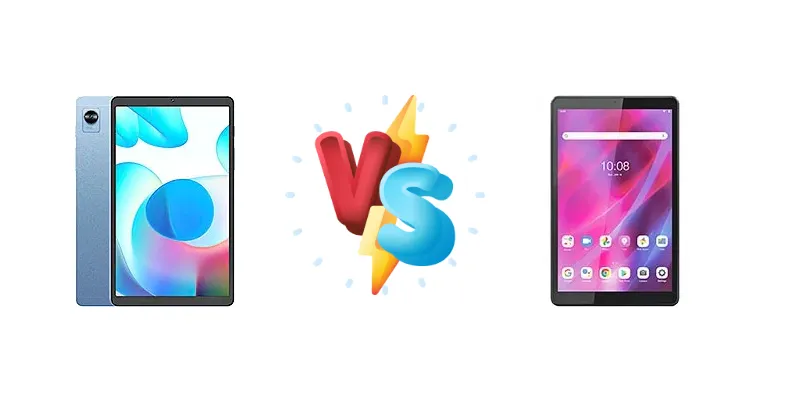
The budget tablet market is booming, offering affordable options for entertainment and light productivity. Two contenders vying for your attention are the Realme Pad Mini and the Lenovo Tab M8 (3rd Gen). But which one delivers the best experience for your money? Let's dive in.
🏆 Quick Verdict
The Lenovo Tab M8 (3rd Gen) edges out the Realme Pad Mini thanks to its slightly more capable chipset and generally better software support. While the Realme Pad Mini boasts a larger screen, the Tab M8's overall performance and value proposition make it the preferred choice for most users.
| Network |
|---|
| 2G bands | GSM 850 / 900 / 1800 / 1900 | GSM 850 / 900 / 1800 / 1900 |
| 3G bands | HSDPA 850 / 900 / 2100 | HSDPA 850 / 900 / 1700(AWS) / 1900 / 2100 - International |
| 4G bands | 1, 3, 5, 7, 8, 20, 28, 38, 40, 41 | 1, 2, 3, 4, 5, 19, 7, 8, 20, 26, 28, 38, 40, 41 - International |
| Speed | HSPA, LTE - cellular model only | HSPA, LTE - cellular model only |
| Technology | GSM / HSPA / LTE | GSM / CDMA / HSPA / LTE |
| | - | 1, 3, 5, 7, 8, 34, 38, 39, 40, 41 - China |
| Launch |
|---|
| Announced | 2022, April 04 | 2021, June 28 |
| Status | Available. Released 2022, April 08 | Available. Released 2022, February |
| Body |
|---|
| Build | - | Glass front, aluminum back, aluminum frame |
| Dimensions | 211.8 x 124.5 x 7.6 mm (8.34 x 4.90 x 0.30 in) | 199.1 x 121.8 x 8.2 mm (7.84 x 4.80 x 0.32 in) |
| SIM | Nano-SIM (cellular model only) | Nano-SIM (cellular model only) |
| Weight | 372 g (13.12 oz) | 305 g (10.76 oz) |
| Display |
|---|
| Resolution | 800 x 1340 pixels, 5:3 ratio (~179 ppi density) | 800 x 1280 pixels, 16:10 ratio (~189 ppi density) |
| Size | 8.7 inches, 214.9 cm2 (~81.5% screen-to-body ratio) | 8.0 inches, 185.6 cm2 (~76.5% screen-to-body ratio) |
| Type | IPS LCD | TDDI IPS LCD, 350 nits (typ) |
| Platform |
|---|
| CPU | Octa-core (2x2.0 GHz Cortex-A75 & 6x1.8 GHz Cortex-A55) | Octa-core (4x2.3 GHz Cortex-A53 & 4x1.8 GHz Cortex-A53) |
| Chipset | Unisoc Tiger T616 (12 nm) | Mediatek MT8768T Helio P22T (12 nm) |
| GPU | Mali-G57 MP1 | PowerVR GE8320 |
| OS | Android 11 | Android 11 (Go edition) - 2 GB RAM versionAndroid 11 - 3 GB RAM version |
| Memory |
|---|
| Card slot | microSDXC (uses shared SIM slot) | microSDXC (dedicated slot) |
| Internal | 32GB 3GB RAM, 64GB 4GB RAM, 128GB 6GB RAM | 32GB 2GB RAM, 32GB 3GB RAM |
| | UFS 2.1 | eMMC 5.1 |
| Main Camera |
|---|
| Single | 8 MP, f/2.0 | 5 MP, AF |
| Video | 1080p@30fps | 1080p |
| Selfie camera |
|---|
| Single | 5 MP, f/2.2 | 2 MP |
| Video | - | 720p |
| Sound |
|---|
| 3.5mm jack | Yes | Yes |
| 35mm jack | Yes | Yes |
| Loudspeaker | Yes, with stereo speakers | Yes |
| Comms |
|---|
| Bluetooth | 5.0, A2DP, LE | 5.0, A2DP, LE |
| NFC | No | No |
| Positioning | GPS, GLONASS, BDS - cellular model only | GPS, GLONASS, BDS - cellular model only |
| Radio | No | FM radio |
| USB | USB Type-C 2.0, OTG | USB Type-C 2.0, OTG |
| WLAN | Wi-Fi 802.11 a/b/g/n/ac, dual-band, Wi-Fi Direct | Wi-Fi 802.11 a/b/g/n, dual-band, Wi-Fi Direct |
| Features |
|---|
| Sensors | Accelerometer, proximity | Accelerometer, proximity |
| Battery |
|---|
| Charging | 18W wired
5W reverse wired | - |
| Type | 6400 mAh | Li-Po 5100 mAh |
| Misc |
|---|
| Colors | Gray, Blue | Iron Grey, Platinum Grey |
| Models | RMP2105, RMP2106 | - |
| Price | About 180 EUR | - |
Realme Pad Mini
- Larger 8.7-inch display
- Compact and lightweight design
- Decent audio quality
- Less powerful chipset
- Potentially shorter software support
- Average camera performance
Lenovo Tab M8 (3rd Gen)
- Slightly better performance
- More polished software experience
- Generally better value
- Smaller 8-inch display
- Basic design
- Average camera performance
Display Comparison
The Realme Pad Mini features an 8.7-inch display, offering a more immersive viewing experience compared to the Lenovo Tab M8's 8-inch screen. Both panels are likely to be LCDs with standard resolutions, but the larger size of the Pad Mini gives it a slight advantage for watching videos and browsing the web. Expect similar color accuracy and brightness levels.
Camera Comparison
Neither tablet excels in the camera department. Both likely feature basic 5MP front and rear cameras suitable for video calls and occasional snapshots. Image quality will be average in good lighting conditions, with noticeable noise in low light. Don't expect to use these tablets for serious photography.
Performance
Here's where the Lenovo Tab M8 (3rd Gen) takes a lead. The MediaTek Helio P22T chipset generally outperforms the Unisoc Tiger T616. While both are entry-level processors, the P22T offers better sustained performance and handles multitasking slightly more smoothly. Expect the Realme Pad Mini to feel a bit sluggish under heavier loads.
Battery Life
Battery life is expected to be comparable between the two devices, likely offering around 8-10 hours of mixed usage. Both tablets feature relatively small batteries, but efficient processors help extend their runtime. The Realme Pad Mini's larger screen might slightly impact battery life under heavy usage.
Buying Guide
The Realme Pad Mini is ideal for users prioritizing a larger screen for media consumption and basic tasks. The Lenovo Tab M8 (3rd Gen) is a better fit for those seeking a more responsive experience, longer software support, and a more polished overall package, especially for casual gaming and browsing.
Frequently Asked Questions
❓ Which tablet is better for gaming?
The Lenovo Tab M8 (3rd Gen) is slightly better for gaming due to its more capable chipset, although neither tablet is designed for demanding games.
❓ How long will Lenovo Tab M8 (3rd Gen) receive software updates?
Lenovo typically provides longer software support for its tablets compared to Realme, so expect more Android updates and security patches on the Tab M8.