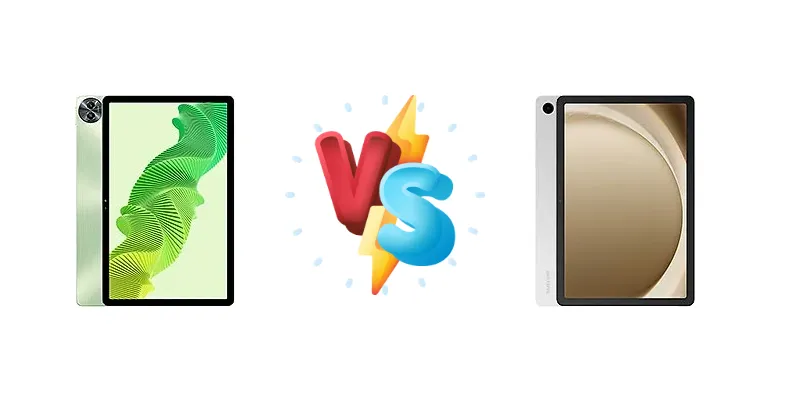
The mid-range Android tablet space is heating up, with the Realme Pad 2 and Samsung Galaxy Tab A9+ vying for dominance. Both offer compelling features at attractive price points, but significant differences in their core hardware – specifically the chipset and charging capabilities – dictate which tablet is best suited for different users. This comparison dives deep into these distinctions to help you make an informed decision.
🏆 Quick Verdict
For users prioritizing sustained performance and faster charging, the Realme Pad 2 emerges as the winner. Its Mediatek Helio G99 chipset, while not a flagship, offers a slight edge in CPU performance and supports 33W charging, significantly faster than the Tab A9+'s 15W. However, the Tab A9+ benefits from Samsung's software ecosystem and 5G connectivity.
| Network |
|---|
| 2G bands | GSM 850 / 900 / 1800 / 1900 | GSM 850 / 900 / 1800 / 1900 |
| 3G bands | HSDPA 850 / 900 / 2100 | HSDPA 850 / 900 / 1700(AWS) / 1900 / 2100 |
| 4G bands | 1, 3, 5, 7, 8, 20, 28, 38, 40, 41 | 1, 2, 3, 4, 5, 7, 8, 12, 13, 17, 20, 26, 28, 38, 40, 41, 66 |
| 5G bands | - | 1, 3, 5, 7, 8, 20, 28, 38, 40, 41, 66, 77, 78 SA/NSA/Sub6 |
| Speed | HSPA, LTE - cellular model only | HSPA, LTE, 5G - cellular model only |
| Technology | GSM / HSPA / LTE | GSM / HSPA / LTE / 5G |
| Launch |
|---|
| Announced | 2023, July 19 | 2023, October 05 |
| Status | Available. Released 2023, August 01 | Available. Released 2023, October 17 |
| Body |
|---|
| Dimensions | 268.2 x 168.5 x 7.2 mm (10.56 x 6.63 x 0.28 in) | 257.1 x 168.7 x 6.9 mm (10.12 x 6.64 x 0.27 in) |
| SIM | Nano-SIM (cellular model only) | Nano-SIM + eSIM (cellular model only) |
| Weight | 518 g (1.14 lb) | 480 g or 492 g (1.06 lb) |
| Display |
|---|
| Resolution | 1200 x 2000 pixels, 5:3 ratio (~203 ppi density) | 1200 x 1920 pixels, 16:10 ratio (~206 ppi density) |
| Size | 11.5 inches, 376.4 cm2 (~83.3% screen-to-body ratio) | 11.0 inches, 350.9 cm2 (~80.9% screen-to-body ratio) |
| Type | IPS LCD, 1B colors, 120Hz, 450 nits (peak) | TFT LCD, 90Hz |
| Platform |
|---|
| CPU | Octa-core (2x2.2 GHz Cortex-A76 & 6x2.0 GHz Cortex-A55) | Octa-core (2x2.2 GHz Kryo 660 Gold & 6x1.8 GHz Kryo 660 Silver) |
| Chipset | Mediatek Helio G99 (6 nm) | Qualcomm SM6375 Snapdragon 695 5G (6 nm) |
| GPU | Mali-G57 MC2 | Adreno 619 |
| OS | Android 13 or Android 14, Realme UI 4 | Android 13, upgradable to Android 15, One UI 7 |
| Memory |
|---|
| Card slot | microSDXC (uses shared SIM slot) | microSDXC (dedicated slot) |
| Internal | 128GB 6GB RAM, 256GB 8GB RAM | 64GB 4GB RAM, 128GB 4GB RAM, 128GB 8GB RAM, 256GB 8GB RAM |
| Main Camera |
|---|
| Features | HDR, panorama | - |
| Single | 8 MP, f/2.0, (wide) | 8 MP, AF |
| Video | 1080p@30fps | 1080p@30fps |
| Selfie camera |
|---|
| Features | HDR, panorama | - |
| Single | 5 MP, f/2.2, (wide) | 5 MP |
| Video | 1080p@30fps | 1080p@30fps |
| Sound |
|---|
| 35mm jack | No | Yes |
| Loudspeaker | Yes, with stereo speakers (4 speakers) | Yes, with stereo speakers (4 speakers) |
| Comms |
|---|
| Bluetooth | 5.2, A2DP, LE | 5.1, A2DP, LE |
| NFC | No | No |
| Positioning | GPS, GALILEO, GLONASS, BDS - cellular model only | GPS, GLONASS, GALILEO, BDS, QZSS - cellular model only |
| Radio | No | No |
| USB | USB Type-C | USB Type-C 2.0 |
| WLAN | Wi-Fi 802.11 a/b/g/n/ac, dual-band | Wi-Fi 802.11 a/b/g/n/ac, dual-band, Wi-Fi Direct |
| Features |
|---|
| Sensors | Fingerprint (side-mounted), accelerometer, gyro, compass | Accelerometer, gyro, proximity (accessories only), compass |
| Battery |
|---|
| Charging | 33W wired
Reverse wired | 15W wired |
| Type | 8360 mAh | Li-Po 7040 mAh |
| Misc |
|---|
| Colors | Gray, Green | Graphite, Silver, Navy |
| Models | - | SM-X210, SM-X215, SM-X216B |
| Price | About 220 EUR | $ 199.99 |
| SAR | - | 0.42 W/kg (body) |
| SAR EU | - | 1.19 W/kg (body) |
Realme Pad 2
- Faster 33W charging for quicker top-ups
- Potentially slightly better CPU performance with Helio G99
- More affordable price point (likely)
- Lacks 5G connectivity
- Software experience may not be as refined as Samsung's One UI
Samsung Galaxy Tab A9+
- Integrated 5G modem for mobile data access
- Samsung’s One UI software offers a polished experience
- Strong brand recognition and ecosystem integration
- Significantly slower 15W charging
- Snapdragon 695 may offer slightly lower CPU performance
- Potentially higher price
Display Comparison
Neither device boasts a particularly standout display. While specific panel details (like peak brightness in nits or color gamut coverage) are absent, both tablets likely utilize IPS LCD panels common in this price bracket. The focus here shifts to the internal hardware impacting performance, rather than display quality. Bezels are expected to be moderate on both, typical for tablets in this segment. Color accuracy will likely be adequate for general use, but not geared towards professional content creation.
Camera Comparison
Camera performance is unlikely to be a deciding factor for most buyers in this segment. Both tablets will likely feature basic camera setups suitable for casual snapshots and video calls. Details regarding sensor sizes and apertures are unavailable, but it’s safe to assume neither device will excel in low-light conditions. Focusing on the chipset’s image signal processor (ISP) capabilities, the Helio G99’s ISP is optimized for its sensor, while the Snapdragon 695’s ISP is geared towards its 5G connectivity and general image processing. Expect similar image quality overall.
Performance
The core difference lies in the chipsets. The Realme Pad 2’s Mediatek Helio G99 (6nm) features a CPU configuration of 2x2.2 GHz Cortex-A76 and 6x2.0 GHz Cortex-A55 cores. The Samsung Galaxy Tab A9+ utilizes the Qualcomm Snapdragon 695 5G (6nm) with 2x2.2 GHz Kryo 660 Gold and 6x1.8 GHz Kryo 660 Silver cores. While both CPUs peak at 2.2 GHz, the Cortex-A76 cores in the Helio G99 generally offer a slight performance advantage in single-core tasks. The Snapdragon 695’s strength is its integrated 5G modem, a feature absent in the Realme Pad 2. Both devices will likely handle everyday tasks smoothly, but the G99 may exhibit less stuttering during demanding multitasking or graphically intensive games. RAM configurations are crucial here, but unspecified; faster LPDDR5x RAM would further benefit the Pad 2.
Battery Life
The Realme Pad 2’s 33W wired charging is a significant advantage over the Galaxy Tab A9+'s 15W charging. This translates to substantially faster charging times, allowing users to quickly replenish the battery when needed. While battery capacity is unspecified for both, the faster charging of the Pad 2 mitigates the impact of a potentially smaller battery. The Tab A9+'s slower charging means longer downtime between uses, especially for power users. The 6nm process node of both chipsets contributes to reasonable power efficiency, but the faster charging of the Pad 2 provides a tangible benefit.
Buying Guide
Buy the Realme Pad 2 if you need a tablet primarily for media consumption, light gaming, and productivity tasks where sustained CPU performance and quick top-ups are crucial. It’s ideal for students or anyone who frequently uses their tablet on the go. Buy the Samsung Galaxy Tab A9+ if you prioritize 5G connectivity for mobile data access, prefer Samsung’s One UI software experience, and are less concerned with maximizing raw processing power or charging speed. It’s a solid choice for casual users and those already invested in the Samsung ecosystem.
Frequently Asked Questions
❓ Will the Realme Pad 2 handle demanding games like Genshin Impact or Call of Duty Mobile?
The Mediatek Helio G99 is capable of running these games, but you'll likely need to lower graphics settings to achieve a smooth frame rate. Sustained performance is key, and the G99's 6nm process helps with thermal management, but it's not a gaming powerhouse. Expect medium settings for a playable experience.
❓ How long will it take to fully charge the Samsung Galaxy Tab A9+ from 0%?
With its 15W charging, expect a full charge to take approximately 3-4 hours. This is considerably slower than the Realme Pad 2's 33W charging, making it less convenient for users who need a quick power boost.
❓ Does the Snapdragon 695 in the Tab A9+ support carrier aggregation for faster 5G speeds?
Yes, the Snapdragon 695 supports carrier aggregation, allowing it to combine multiple 5G channels for potentially faster download and upload speeds, provided your carrier and network support it. This is a key benefit of the Tab A9+’s 5G connectivity.
❓ Is the lack of 5G on the Realme Pad 2 a dealbreaker for most users?
For most tablet users, 5G isn't essential. Tablets are often used in Wi-Fi environments. However, if you frequently need mobile data access on the go without relying on a hotspot, the Tab A9+'s 5G connectivity is a significant advantage.