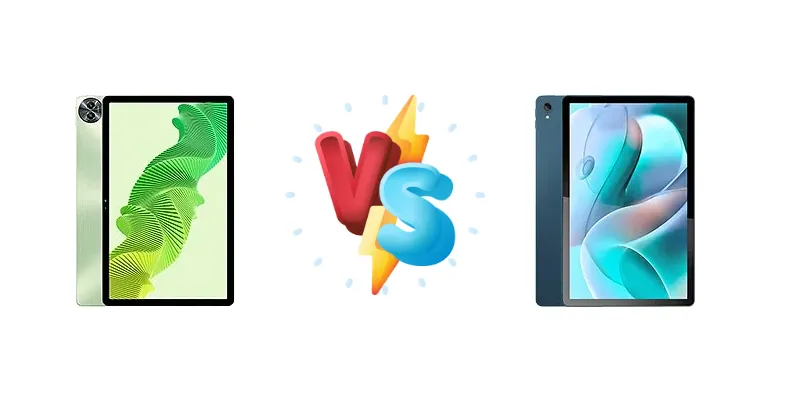
The tablet market is heating up with compelling options in the budget to mid-range segment. The Realme Pad 2 and Motorola Moto Tab G70 both aim to deliver a versatile experience, but they take different approaches to achieving it. This comparison dissects their core components – specifically their chipsets and charging capabilities – to determine which tablet offers the best balance of performance and value for your needs.
🏆 Quick Verdict
For most users, the Realme Pad 2 emerges as the better choice. Its newer Mediatek Helio G99 chipset, built on a more efficient 6nm process, provides a performance edge and potentially better thermal management compared to the Moto Tab G70’s older 12nm Helio G90T. The faster 33W charging is also a significant advantage.
| Network |
|---|
| 2G bands | GSM 850 / 900 / 1800 / 1900 | GSM 850 / 900 / 1800 / 1900 |
| 3G bands | HSDPA 850 / 900 / 2100 | HSDPA 850 / 900 / 1900 / 2100 |
| 4G bands | 1, 3, 5, 7, 8, 20, 28, 38, 40, 41 | 1, 2, 4, 7, 8, 20, 28, 38, 40, 41 |
| Speed | HSPA, LTE - cellular model only | HSPA 42.2/5.76 Mbps, LTE Cat4 150/50 Mbps - cellular model only |
| Technology | GSM / HSPA / LTE | GSM / HSPA / LTE |
| Launch |
|---|
| Announced | 2023, July 19 | 2022, January 12 |
| Status | Available. Released 2023, August 01 | Available. Released 2022, January 13 |
| Body |
|---|
| Build | - | Glass front, aluminum back, aluminum frame |
| Dimensions | 268.2 x 168.5 x 7.2 mm (10.56 x 6.63 x 0.28 in) | 258.4 x 163 x 7.5 mm (10.17 x 6.42 x 0.30 in) |
| SIM | Nano-SIM (cellular model only) | Nano-SIM (cellular model only) |
| Weight | 518 g (1.14 lb) | 500 g (1.10 lb) |
| | - | Water repellent design |
| Display |
|---|
| Resolution | 1200 x 2000 pixels, 5:3 ratio (~203 ppi density) | 1200 x 2000 pixels, 5:3 ratio (~212 ppi density) |
| Size | 11.5 inches, 376.4 cm2 (~83.3% screen-to-body ratio) | 11.0 inches, 344.4 cm2 (~81.8% screen-to-body ratio) |
| Type | IPS LCD, 1B colors, 120Hz, 450 nits (peak) | IPS LCD, 400 nits (typ) |
| Platform |
|---|
| CPU | Octa-core (2x2.2 GHz Cortex-A76 & 6x2.0 GHz Cortex-A55) | Octa-core (2x2.05 GHz Cortex-A76 & 6x2.0 GHz Cortex-A55) |
| Chipset | Mediatek Helio G99 (6 nm) | Mediatek MT6785 Helio G90T (12 nm) |
| GPU | Mali-G57 MC2 | Mali-G76 MC4 |
| OS | Android 13 or Android 14, Realme UI 4 | Android 11 |
| Memory |
|---|
| Card slot | microSDXC (uses shared SIM slot) | microSDXC (dedicated slot) |
| Internal | 128GB 6GB RAM, 256GB 8GB RAM | 64GB 4GB RAM, 128GB 6GB RAM |
| | - | eMMC 5.1 |
| Main Camera |
|---|
| Features | HDR, panorama | LED flash |
| Single | 8 MP, f/2.0, (wide) | 13 MP, f/2.2, 26mm (wide), AF |
| Video | 1080p@30fps | 1080p@30fps |
| Selfie camera |
|---|
| Features | HDR, panorama | - |
| Single | 5 MP, f/2.2, (wide) | 8 MP, f/2.0, 26mm (wide) |
| Video | 1080p@30fps | 1080p@30fps |
| Sound |
|---|
| 3.5mm jack | - | Yes |
| 35mm jack | No | Yes |
| Loudspeaker | Yes, with stereo speakers (4 speakers) | Yes, with stereo speakers (4 speakers) |
| Comms |
|---|
| Bluetooth | 5.2, A2DP, LE | 5.2, A2DP, LE |
| NFC | No | No |
| Positioning | GPS, GALILEO, GLONASS, BDS - cellular model only | GPS, GLONASS - cellular model only |
| Radio | No | No |
| USB | USB Type-C | USB Type-C 2.0, OTG |
| WLAN | Wi-Fi 802.11 a/b/g/n/ac, dual-band | Wi-Fi 802.11 a/b/g/n/ac, dual-band, Wi-Fi Direct |
| Features |
|---|
| Sensors | Fingerprint (side-mounted), accelerometer, gyro, compass | Accelerometer, gyro, proximity |
| Battery |
|---|
| Charging | 33W wired
Reverse wired | 20W wired |
| Type | 8360 mAh | Li-Po 7700 mAh |
| Misc |
|---|
| Colors | Gray, Green | Modernist Teal, Blue |
| Price | About 220 EUR | About 380 EUR |
Realme Pad 2
- More efficient Mediatek Helio G99 chipset
- Faster 33W wired charging
- Potentially better thermal management
- Price may be slightly higher
- Specific display specs unknown
Motorola Moto Tab G70
- Potentially lower price point
- Likely larger screen size (assumption based on market positioning)
- Acceptable performance for basic tasks
- Less efficient Mediatek Helio G90T chipset
- Slower 20W wired charging
- Potential for thermal throttling under load
Display Comparison
While both tablets likely feature LCD panels (data not provided), the core difference lies in the processing power driving the visuals. Without specific display specs like resolution or brightness, it’s difficult to make a direct comparison. However, a more powerful chipset, like the G99 in the Realme Pad 2, can contribute to smoother animations and faster app loading times, enhancing the overall visual experience.
Camera Comparison
Neither tablet is positioned as a photography powerhouse, and detailed camera specs are unavailable. It’s safe to assume both feature basic camera setups suitable for video calls and casual snapshots. Without information on sensor size, aperture, or image processing algorithms, a meaningful comparison is impossible. Focusing on the chipset, the G99’s improved ISP (Image Signal Processor) *could* offer slightly better image quality, but this is speculative without further data.
Performance
The Realme Pad 2’s Mediatek Helio G99 (6nm) represents a significant architectural improvement over the Motorola Moto Tab G70’s Helio G90T (12nm). The 6nm process inherently offers better power efficiency, meaning the G99 can deliver comparable or even superior performance while consuming less energy. Both chipsets utilize an octa-core configuration with 2x Cortex-A76 and 6x Cortex-A55 cores, but the G99’s slightly higher clock speeds (2.2 GHz vs 2.05 GHz) provide a marginal performance boost. This translates to snappier app launches, smoother multitasking, and potentially higher frame rates in games. The G90T, while still capable, will likely exhibit more thermal throttling under sustained load.
Battery Life
The Realme Pad 2’s 33W wired charging is a clear advantage over the Moto Tab G70’s 20W charging. This faster charging speed significantly reduces the time required to replenish the battery, making it more convenient for users who rely on their tablet throughout the day. While battery capacity isn’t specified, the more efficient Helio G99 in the Realme Pad 2 will likely contribute to longer battery life, even with a similar capacity battery, due to reduced power consumption.
Buying Guide
Buy the Realme Pad 2 if you prioritize sustained performance for gaming or multitasking, and value faster charging speeds for minimal downtime. It’s ideal for students, casual gamers, and anyone who frequently uses their tablet on the go. Buy the Motorola Moto Tab G70 if you’re looking for a larger screen experience at a potentially lower price point, and your usage is primarily focused on media consumption and light tasks where raw processing power isn’t critical.
Frequently Asked Questions
❓ Will the Realme Pad 2 handle demanding games like Genshin Impact at playable frame rates?
The Mediatek Helio G99 is capable of running Genshin Impact, but you’ll likely need to lower the graphics settings to medium or low to achieve consistent 30fps gameplay. The 6nm process and improved CPU/GPU architecture offer a better gaming experience than the Moto Tab G70’s G90T.
❓ How long will it take to fully charge the Motorola Moto Tab G70 with the 20W charger?
Without knowing the battery capacity, it’s difficult to provide an exact time. However, with a 20W charger, a full charge will likely take between 3 to 4 hours, depending on the battery size and current charge level. The Realme Pad 2’s 33W charging will significantly reduce this time.
❓ Is the difference between the 6nm and 12nm process technologies significant in real-world usage?
Yes, the difference is noticeable. The 6nm process used in the Helio G99 is more power-efficient, leading to longer battery life and reduced heat generation. This means the Realme Pad 2 can sustain peak performance for longer periods without throttling, providing a smoother user experience.