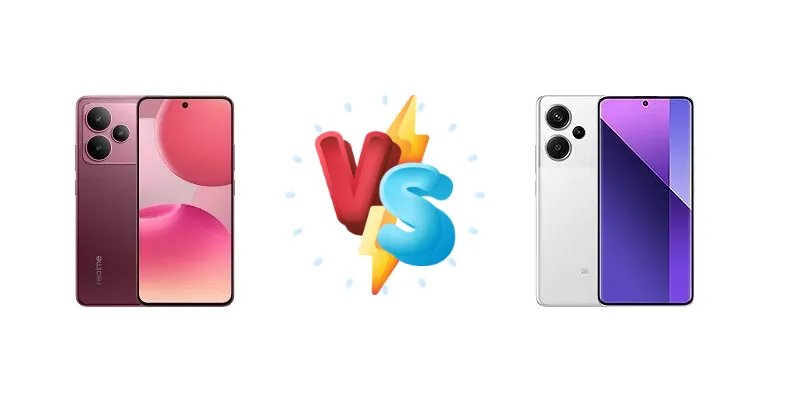
The Realme P4 and Xiaomi Redmi Note 13 Pro+ represent compelling options in the increasingly competitive mid-range smartphone market. While both leverage Mediatek's Dimensity series, they diverge in charging speeds, display capabilities, and core processing architectures, creating a clear distinction for potential buyers. This comparison dives deep into these differences to determine which device delivers the most value.
🏆 Quick Verdict
For the average user prioritizing rapid charging and a brighter display, the Xiaomi Redmi Note 13 Pro+ is the clear winner. Its 120W charging and 1283 nit peak brightness offer a tangible advantage. However, the Realme P4 presents a strong value proposition for those less concerned with these features.
| Network |
|---|
| 2G bands | GSM 850 / 900 / 1800 / 1900 | GSM 850 / 900 / 1800 / 1900 |
| 3G bands | HSDPA 850 / 900 / 2100 | HSDPA 800 / 850 / 900 / 1700(AWS) / 1900 / 2100 - International |
| 4G bands | 1, 3, 5, 8, 28, 40, 41 | 1, 2, 3, 4, 5, 7, 8, 12, 13, 17, 18, 19, 20, 26, 28, 32, 38, 40, 41, 66 - International |
| 5G bands | 1, 3, 5, 8, 28, 40, 41, 77, 78 SA/NSA | 1, 3, 5, 7, 8, 20, 28, 38, 40, 41, 66, 77, 78 SA/NSA- International |
| Speed | HSPA, LTE, 5G | HSPA, LTE, 5G |
| Technology | GSM / HSPA / LTE / 5G | GSM / CDMA / HSPA / EVDO / LTE / 5G |
| Launch |
|---|
| Announced | 2025, August 20 | 2023, September 21 |
| Status | Available. Released 2025, August 20 | Available. Released 2023, September 21 |
| Body |
|---|
| Build | Glass front, plastic frame, plastic back | Glass front (Gorilla Glass Victus), glass back or silicone polymer back (eco leather) |
| Dimensions | 163.3 x 75.9 x 7.6 mm (6.43 x 2.99 x 0.30 in) | 161.4 x 74.2 x 8.9 mm (6.35 x 2.92 x 0.35 in) |
| SIM | Nano-SIM + Nano-SIM | · Nano-SIM + eSIM· Nano-SIM + Nano-SIM |
| Weight | 185 g (6.53 oz) | 199 g or 204.5 g (7.02 oz) |
| Display |
|---|
| Protection | - | Corning Gorilla Glass Victus |
| Resolution | 1080 x 2392 pixels (~388 ppi density) | 1220 x 2712 pixels, 20:9 ratio (~446 ppi density) |
| Size | 6.77 inches, 110.9 cm2 (~89.5% screen-to-body ratio) | 6.67 inches, 107.4 cm2 (~89.7% screen-to-body ratio) |
| Type | AMOLED, 1B colors, 144Hz, HDR10+, 3840Hz PWM, 1600 nits (HBM), 4500 nits (peak) | AMOLED, 68B colors, 120Hz, 1920Hz PWM, Dolby Vision, HDR10+, 1800 nits (peak) |
| Platform |
|---|
| CPU | Octa-core (4x2.6 GHz Cortex-A78 & 4x2.0 GHz Cortex-A55) | Octa-core (2x2.8 GHz Cortex-A715 & 6x2.0 GHz Cortex-A510) |
| Chipset | Mediatek Dimensity 7400 (4 nm) | Mediatek Dimensity 7200 Ultra (4 nm) |
| GPU | Mali-G615 MC2 | Mali-G610 MC4 |
| OS | Android 15, Realme UI 6.0 | Android 13, up to 3 major Android upgrades, HyperOS |
| Memory |
|---|
| Card slot | No | No |
| Internal | 128GB 6GB RAM, 128GB 8GB RAM, 256GB 8GB RAM | 256GB 8GB RAM, 256GB 12GB RAM, 512GB 8GB RAM, 512GB 12GB RAM, 512GB 16GB RAM |
| Main Camera |
|---|
| Dual | 50 MP, f/1.8, 27mm (wide), PDAF
8 MP, f/2.2, 112˚ (ultrawide) | - |
| Features | LED flash, HDR, panorama | Dual-LED dual-tone flash, HDR, panorama |
| Triple | - | 200 MP, f/1.7, 23mm (wide), 1/1.4", 0.56µm, multi-directional PDAF, OIS
8 MP, f/2.2, 16mm, 120˚ (ultrawide), 1/4.0", 1.12µm
2 MP (macro) |
| Video | 4K@30fps, 1080p@30/60/120fps, gyro-EIS | 4K@24/30fps, 1080p@30/60/120fps, gyro-EIS |
| Selfie camera |
|---|
| Features | Panorama | HDR, panorama |
| Single | 16 MP, f/2.4, (wide) | 16 MP, f/2.4, (wide) |
| Video | 1080p@30fps | 1080p@30/60fps |
| Sound |
|---|
| 35mm jack | No | No |
| Loudspeaker | Yes, with stereo speakers | Yes, with stereo speakers |
| Comms |
|---|
| Bluetooth | 5.4, A2DP, LE | 5.3, A2DP, LE |
| Infrared port | Yes | Yes |
| NFC | No | Yes (market/region dependent) |
| Positioning | GPS, GALILEO, GLONASS, BDS | GPS, GLONASS, BDS, GALILEO, QZSS |
| Radio | Unspecified | No |
| USB | USB Type-C 2.0, OTG | USB Type-C 2.0, OTG |
| WLAN | Wi-Fi 802.11 a/b/g/n/ac, dual-band | Wi-Fi 802.11 a/b/g/n/ac/6, dual-band, Wi-Fi Direct |
| Features |
|---|
| Sensors | Fingerprint (under display, optical), accelerometer, gyro, proximity, compass | Fingerprint (under display, optical), accelerometer, gyro, proximity, compass |
| Battery |
|---|
| Charging | 80W wired
10W reverse wired
Bypass charging | 120W wired, PD3.0, 100% in 19 min |
| Type | Si/C Li-Ion 7000 mAh | Li-Po 5000 mAh |
| Misc |
|---|
| Colors | Steel Gray, Engine Blue, Forge Red | Midnight Black (Fushion Black), Moonlight White (Fushion White), Aurora Purple, Fushion Purple, Camo Green |
| Models | - | 23090RA98C, 23090RA98G, 23090RA98I |
| Price | About 190 EUR | $ 299.98 / £ 299.00 / € 208.98 / ₹ 24,999 |
| SAR | - | 1.09 W/kg (head) 0.85 W/kg (body) |
| SAR EU | - | 0.98 W/kg (head) 1.00 W/kg (body) |
Realme P4
- Potentially more affordable price point
- Efficient 80W charging
- Dimensity 7400 offers strong performance
- Likely lower peak display brightness
- Less advanced CPU architecture compared to the Redmi Note 13 Pro+
Xiaomi Redmi Note 13 Pro+
- Ultra-fast 120W charging (19 minutes to full)
- Significantly brighter 1283 nit display
- Potentially superior camera system with OIS
- Higher price tag
- May generate more heat under sustained load
Display Comparison
The Xiaomi Redmi Note 13 Pro+ boasts a significantly brighter display, reaching a measured peak of 1283 nits. This is a substantial advantage over what we'd expect from the Realme P4, making the Redmi Note 13 Pro+ far more usable in direct sunlight. While the Realme P4's display specs are currently unknown, the Redmi Note 13 Pro+'s brightness alone is a major selling point. We anticipate the P4 will likely have a lower peak brightness, potentially impacting outdoor visibility. Panel technology (LTPO vs standard OLED) is also a key differentiator, with LTPO enabling variable refresh rates for improved power efficiency, a feature not confirmed on the P4.
Camera Comparison
Without detailed camera specifications for the Realme P4, a direct comparison is limited. However, the Redmi Note 13 Pro+ is expected to feature a high-resolution main sensor (likely 200MP, based on previous Redmi Pro models) with optical image stabilization (OIS). This combination promises excellent detail and low-light performance. The P4 will likely rely on a more standard sensor setup. Image processing algorithms will also play a significant role, with Xiaomi typically favoring vibrant, saturated colors, while Realme often aims for a more natural look. We'd expect the Redmi Note 13 Pro+ to offer a more versatile and capable camera system overall.
Performance
Both phones utilize Mediatek's 4nm Dimensity series, but differ in their specific chips. The Redmi Note 13 Pro+ features the Dimensity 7200 Ultra, with a CPU configuration of 2x2.8 GHz Cortex-A715 and 6x2.0 GHz Cortex-A510 cores. The Realme P4 employs the Dimensity 7400, utilizing 4x2.6 GHz Cortex-A78 and 4x2.0 GHz Cortex-A55 cores. The A715 cores in the Redmi Note 13 Pro+ represent a newer generation architecture than the A78 cores in the P4, suggesting a potential performance edge in CPU-intensive tasks. However, the P4's higher clock speeds on its prime cores could offset this difference in some scenarios. Both devices likely utilize LPDDR5X RAM, but thermal management will be crucial in sustaining peak performance during prolonged gaming sessions.
Battery Life
The Redmi Note 13 Pro+ shines with its 120W wired charging, capable of a full charge in a claimed 19 minutes. This is a significant advantage over the Realme P4's 80W charging. While the P4's 80W is still fast, the Redmi Note 13 Pro+ offers a substantially quicker top-up time. The Redmi Note 13 Pro+ also boasts an active use battery score of 10:38h, indicating excellent battery life. While the P4's battery capacity is unknown, the faster charging of the Redmi Note 13 Pro+ mitigates concerns about potential capacity differences.
Buying Guide
Buy the Realme P4 if you need a balanced device with solid performance and efficient 80W charging, and are comfortable with a slightly less vibrant display. It's ideal for everyday users who prioritize value. Buy the Xiaomi Redmi Note 13 Pro+ if you prioritize the fastest possible charging speeds (120W), a significantly brighter display for outdoor visibility (1283 nits), and are willing to pay a premium for these features. This phone caters to power users and media consumers.
Frequently Asked Questions
❓ Does the Dimensity 7200 Ultra in the Redmi Note 13 Pro+ get noticeably warmer than the Dimensity 7400 during extended gaming sessions?
While both chips are 4nm, the Dimensity 7200 Ultra's higher peak performance could lead to slightly more heat generation under sustained load. However, Xiaomi typically employs effective thermal management solutions, so overheating shouldn't be a major concern. The Realme P4's Dimensity 7400 might run cooler, but potentially at the cost of peak performance.
❓ How much faster is the 120W charging on the Redmi Note 13 Pro+ compared to the 80W charging on the Realme P4 in real-world use?
The Redmi Note 13 Pro+ can fully charge in approximately 19 minutes, while the Realme P4 will take considerably longer. A typical 0-50% charge on the Redmi Note 13 Pro+ will take around 8-10 minutes, whereas the P4 will likely take 15-20 minutes for the same level. This difference is significant for users who frequently need to quickly top up their battery.
❓ Is the difference in CPU architecture (Cortex-A715 vs A78) between the Redmi Note 13 Pro+ and Realme P4 significant for everyday tasks?
For typical everyday tasks like browsing, social media, and video streaming, the difference in CPU architecture is unlikely to be noticeable. Both chips are more than capable of handling these workloads smoothly. The advantage of the A715 cores in the Redmi Note 13 Pro+ will be more apparent in demanding applications like video editing or graphically intensive games.