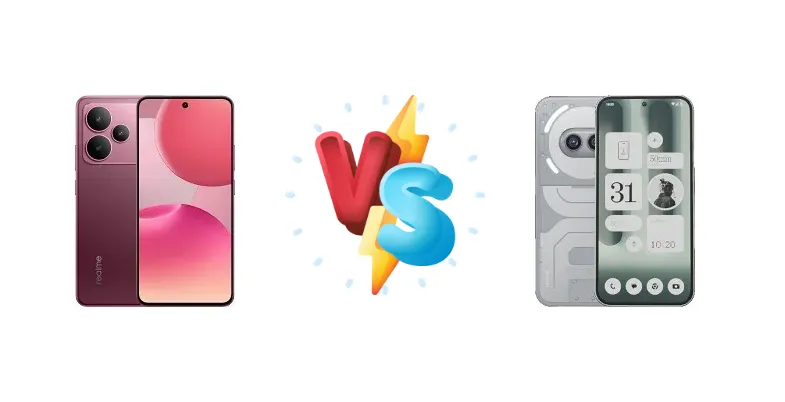
The mid-range smartphone market is fiercely competitive, and the Realme P4 and Nothing Phone (2a) Plus represent compelling options. The Realme P4 aims for aggressive value with its 80W charging, while the Nothing Phone (2a) Plus focuses on a refined user experience and a brighter display. This comparison dissects their key differences to help you choose the right device.
🏆 Quick Verdict
For the average user prioritizing raw charging speed and potentially sustained performance, the Realme P4 emerges as the winner. Its 80W charging significantly reduces downtime, and the Dimensity 7400, while architecturally similar, offers a slight edge in CPU performance. However, the Nothing Phone (2a) Plus counters with a superior display.
| Network |
|---|
| 2G bands | GSM 850 / 900 / 1800 / 1900 | GSM 850 / 900 / 1800 / 1900 |
| 3G bands | HSDPA 850 / 900 / 2100 | HSDPA 800 / 850 / 900 / 1700(AWS) / 1900 / 2100 |
| 4G bands | 1, 3, 5, 8, 28, 40, 41 | 1, 3, 4, 5, 7, 8, 18, 19, 20, 26, 28, 38, 39, 40, 41, 42, 66 |
| 5G bands | 1, 3, 5, 8, 28, 40, 41, 77, 78 SA/NSA | 1, 3, 5, 7, 8, 20, 28, 38, 40, 41, 66, 77, 78 SA/NSA |
| Speed | HSPA, LTE, 5G | HSPA, LTE, 5G |
| Technology | GSM / HSPA / LTE / 5G | GSM / HSPA / LTE / 5G |
| Launch |
|---|
| Announced | 2025, August 20 | 2024, July 31 |
| Status | Available. Released 2025, August 20 | Available. Released 2024, August 03 |
| Body |
|---|
| Build | Glass front, plastic frame, plastic back | Glass front (Gorilla Glass 5), plastic frame, plastic back |
| Dimensions | 163.3 x 75.9 x 7.6 mm (6.43 x 2.99 x 0.30 in) | 161.7 x 76.3 x 8.5 mm (6.37 x 3.00 x 0.33 in) |
| SIM | Nano-SIM + Nano-SIM | Nano-SIM + Nano-SIM |
| Weight | 185 g (6.53 oz) | 190 g (6.70 oz) |
| Display |
|---|
| Protection | - | Corning Gorilla Glass 5 |
| Resolution | 1080 x 2392 pixels (~388 ppi density) | 1080 x 2412 pixels, 20:9 ratio (~395 ppi density) |
| Size | 6.77 inches, 110.9 cm2 (~89.5% screen-to-body ratio) | 6.7 inches, 107.5 cm2 (~87.1% screen-to-body ratio) |
| Type | AMOLED, 1B colors, 144Hz, HDR10+, 3840Hz PWM, 1600 nits (HBM), 4500 nits (peak) | AMOLED, 1B colors, 120Hz, 2160Hz PWM, HDR10+, 700 nits (typ), 1100 nits (HBM), 1300 nits (peak) |
| Platform |
|---|
| CPU | Octa-core (4x2.6 GHz Cortex-A78 & 4x2.0 GHz Cortex-A55) | Octa-core (2x3.0 GHz Cortex-A715 & 6x 2.0 GHz Cortex-A510) |
| Chipset | Mediatek Dimensity 7400 (4 nm) | Mediatek Dimensity 7350 Pro (4 nm) |
| GPU | Mali-G615 MC2 | Mali-G610 MC4 |
| OS | Android 15, Realme UI 6.0 | Android 14, up to 3 major Android upgrades, Nothing OS 3.0 |
| Memory |
|---|
| Card slot | No | No |
| Internal | 128GB 6GB RAM, 128GB 8GB RAM, 256GB 8GB RAM | 256GB 8GB RAM, 256GB 12GB RAM |
| Main Camera |
|---|
| Dual | 50 MP, f/1.8, 27mm (wide), PDAF
8 MP, f/2.2, 112˚ (ultrawide) | 50 MP, f/1.9, 24mm (wide), 1/1.57", 1.0µm, PDAF, OIS
50 MP, f/2.2, 114˚ (ultrawide), 1/2.76", 0.64µm |
| Features | LED flash, HDR, panorama | LED flash, panorama, HDR |
| Video | 4K@30fps, 1080p@30/60/120fps, gyro-EIS | 4K@30fps, 1080p@60/120fps, gyro-EIS |
| Selfie camera |
|---|
| Features | Panorama | HDR |
| Single | 16 MP, f/2.4, (wide) | 50 MP, f/2.2, (wide), 1/2.76" |
| Video | 1080p@30fps | 4K@30fps |
| Sound |
|---|
| 35mm jack | No | No |
| Loudspeaker | Yes, with stereo speakers | Yes, with stereo speakers |
| Comms |
|---|
| Bluetooth | 5.4, A2DP, LE | 5.3, A2DP, LE |
| Infrared port | Yes | - |
| NFC | No | Yes, 360˚ |
| Positioning | GPS, GALILEO, GLONASS, BDS | GPS, GALILEO, GLONASS, BDS, QZSS |
| Radio | Unspecified | No |
| USB | USB Type-C 2.0, OTG | USB Type-C 2.0, OTG |
| WLAN | Wi-Fi 802.11 a/b/g/n/ac, dual-band | Wi-Fi 802.11 a/b/g/n/ac/6, dual-band, Wi-Fi Direct |
| Features |
|---|
| Sensors | Fingerprint (under display, optical), accelerometer, gyro, proximity, compass | Fingerprint (under display, optical), accelerometer, gyro, proximity, compass |
| Battery |
|---|
| Charging | 80W wired
10W reverse wired
Bypass charging | 50W wired, 50% in 21 min, 100% in 56 min |
| Type | Si/C Li-Ion 7000 mAh | 5000 mAh |
| Misc |
|---|
| Colors | Steel Gray, Engine Blue, Forge Red | Black, Grey |
| Models | - | A142P |
| Price | About 190 EUR | € 269.90 / ₹ 22,599 |
Realme P4
- 80W SuperVOOC charging for incredibly fast top-ups.
- Potentially stronger CPU performance with the Dimensity 7400’s core configuration.
- Aggressive pricing likely offers excellent value for money.
- Display brightness likely lags behind the Nothing Phone (2a) Plus.
- Camera performance is unknown and may not match the Nothing Phone (2a) Plus.
Nothing Phone (2a) Plus
- Bright and vibrant 1097 nit display for excellent outdoor visibility.
- Long-lasting battery life with 16:34 hours of active use.
- Refined software experience and clean design aesthetic.
- Slower 50W charging compared to the Realme P4.
- CPU performance may be slightly behind the Realme P4 in certain scenarios.
Display Comparison
The Nothing Phone (2a) Plus boasts a significantly brighter display, reaching a measured peak of 1097 nits. This translates to superior visibility outdoors under direct sunlight, a clear advantage for users who spend considerable time outside. While the Realme P4’s display specifications are not provided, it’s unlikely to match this peak brightness. The Nothing Phone (2a) Plus’s brightness also suggests a potentially wider color gamut and better HDR performance, enhancing the viewing experience for videos and photos. The absence of LTPO technology on either device means refresh rate scaling isn't as efficient as on flagship models, but the Nothing Phone (2a) Plus’s brightness is a key differentiator.
Camera Comparison
Without detailed camera specifications for the Realme P4, a direct comparison is limited. However, the Nothing Phone (2a) Plus’s image processing is known for its natural color reproduction and balanced dynamic range. The Realme P4’s camera performance will likely depend heavily on its main sensor size and aperture, which are currently unknown. It’s reasonable to assume both phones will include standard features like night mode and portrait mode, but the Nothing Phone (2a) Plus’s software optimization may provide a more refined image processing experience. We can expect both phones to include a suite of cameras, but focusing on the main sensor is crucial for assessing image quality.
Performance
Both phones utilize Mediatek Dimensity chips fabricated on a 4nm process, promising good efficiency. However, the Nothing Phone (2a) Plus employs the Dimensity 7350 Pro, featuring 2x Cortex-A715 cores clocked at 3.0 GHz, while the Realme P4 uses the Dimensity 7400 with 4x Cortex-A78 cores at 2.6 GHz. While the A715 cores are newer, the higher core count and clock speed of the A78 cores in the Realme P4 suggest a potential advantage in multi-threaded tasks and sustained performance. The Realme P4’s CPU architecture may translate to better performance in demanding applications and games. Both devices likely feature ample RAM, but the speed (LPDDR5x) isn’t specified, impacting overall system responsiveness.
Battery Life
The Nothing Phone (2a) Plus delivers an impressive 16:34 hours of active use, demonstrating excellent battery life. The Realme P4’s battery capacity is not specified, but its 80W wired charging is a significant advantage. The Nothing Phone (2a) Plus takes 56 minutes for a full charge, while the Realme P4’s 80W charging promises a faster turnaround. This difference is crucial for users who need to quickly replenish their battery. While the Nothing Phone (2a) Plus’s longer runtime is beneficial, the Realme P4’s charging speed mitigates the impact of a potentially smaller battery.
Buying Guide
Buy the Realme P4 if you need the fastest possible charging and prioritize sustained performance during extended gaming sessions. It’s ideal for users who frequently top up their phones throughout the day and demand quick power boosts. Buy the Nothing Phone (2a) Plus if you prefer a brighter, more visually immersive display and value a cleaner software experience. It’s best suited for media consumption and everyday tasks where display quality is paramount.
Frequently Asked Questions
❓ How does the Dimensity 7400 in the Realme P4 handle sustained gaming performance compared to the Dimensity 7350 Pro in the Nothing Phone (2a) Plus?
The Dimensity 7400’s Cortex-A78 cores, while older architecture, have a higher clock speed and core count than the A715 cores in the 7350 Pro. This suggests the Realme P4 may maintain higher frame rates for longer periods during demanding games, potentially experiencing less throttling due to its CPU configuration. However, thermal management will play a crucial role in both devices.
❓ Does the 50W charging on the Nothing Phone (2a) Plus feel significantly slower in daily use compared to the 80W charging on the Realme P4?
Yes, the difference is noticeable. While 50W charging is still respectable, the Realme P4’s 80W charging can add a substantial amount of battery life in a short period. The Nothing Phone (2a) Plus takes 56 minutes for a full charge, while the Realme P4 will likely achieve a full charge in under an hour, making it ideal for users who need a quick power boost.
❓ Is the difference in display brightness between the two phones noticeable for everyday use, or only in direct sunlight?
The difference is noticeable even in indoor environments. The Nothing Phone (2a) Plus’s 1097 nits peak brightness results in a more vibrant and punchy image, with better contrast and color accuracy. While not critical for all users, those who consume a lot of media will appreciate the improved visual experience.