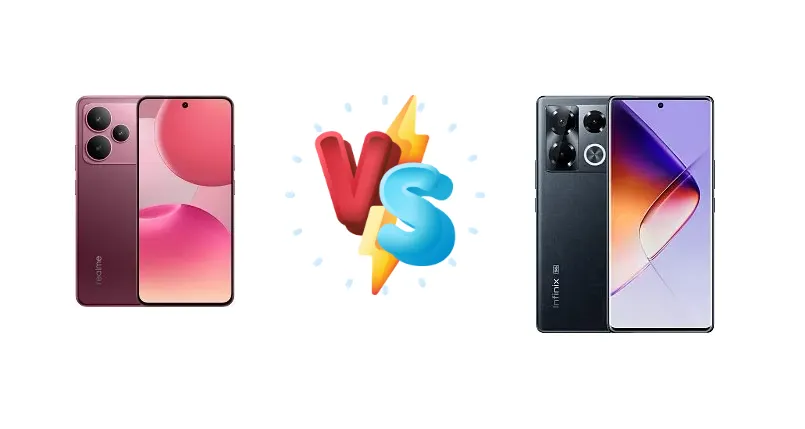
The mid-range smartphone market is fiercely competitive, and the Realme P4 and Infinix Note 40 Pro+ are two contenders vying for your attention. The P4 boasts the newer Dimensity 7400 chipset, while the Note 40 Pro+ counters with 100W charging and a brighter display. This comparison dissects their strengths and weaknesses to determine which device offers the best overall package.
🏆 Quick Verdict
For the average user prioritizing all-around performance and future-proofing, the Realme P4 emerges as the winner. Its more efficient 4nm Dimensity 7400 chipset and faster CPU cores provide a noticeable edge in demanding tasks, despite the Infinix Note 40 Pro+'s impressive charging capabilities.
| Network |
|---|
| 2G bands | GSM 850 / 900 / 1800 / 1900 | GSM 850 / 900 / 1800 / 1900 |
| 3G bands | HSDPA 850 / 900 / 2100 | HSDPA 850 / 900 / 1700(AWS) / 1900 / 2100 |
| 4G bands | 1, 3, 5, 8, 28, 40, 41 | 1, 2, 3, 4, 5, 7, 8, 12, 17, 20, 28, 38, 40, 41, 42, 66 |
| 5G bands | 1, 3, 5, 8, 28, 40, 41, 77, 78 SA/NSA | 1, 3, 5, 7, 8, 12, 20, 28, 38, 40, 41, 66, 77, 78 SA/NSA |
| Speed | HSPA, LTE, 5G | HSPA, LTE, 5G |
| Technology | GSM / HSPA / LTE / 5G | GSM / HSPA / LTE / 5G |
| Launch |
|---|
| Announced | 2025, August 20 | 2024, March 18 |
| Status | Available. Released 2025, August 20 | Available. Released 2024, March 19 |
| Body |
|---|
| Build | Glass front, plastic frame, plastic back | Glass front, plastic frame, silicone polymer (eco leather) back |
| Dimensions | 163.3 x 75.9 x 7.6 mm (6.43 x 2.99 x 0.30 in) | 164.3 x 74.5 x 8.1 mm (6.47 x 2.93 x 0.32 in) |
| SIM | Nano-SIM + Nano-SIM | Nano-SIM + Nano-SIM |
| Weight | 185 g (6.53 oz) | 190 g or 196 g (6.70 oz) |
| Display |
|---|
| Protection | - | Corning Gorilla Glass |
| Resolution | 1080 x 2392 pixels (~388 ppi density) | 1080 x 2436 pixels (~393 ppi density) |
| Size | 6.77 inches, 110.9 cm2 (~89.5% screen-to-body ratio) | 6.78 inches, 109.9 cm2 (~89.8% screen-to-body ratio) |
| Type | AMOLED, 1B colors, 144Hz, HDR10+, 3840Hz PWM, 1600 nits (HBM), 4500 nits (peak) | AMOLED, 1B colors, 120Hz, 1300 nits (peak) |
| Platform |
|---|
| CPU | Octa-core (4x2.6 GHz Cortex-A78 & 4x2.0 GHz Cortex-A55) | Octa-core (2x2.2 GHz Cortex-A78 & 6x2.0 GHz Cortex-A55) |
| Chipset | Mediatek Dimensity 7400 (4 nm) | Mediatek Dimensity 7020 (6 nm) |
| GPU | Mali-G615 MC2 | IMG BXM-8-256 |
| OS | Android 15, Realme UI 6.0 | Android 14, up to 2 major Android upgrades, XOS 14 |
| Memory |
|---|
| Card slot | No | No |
| Internal | 128GB 6GB RAM, 128GB 8GB RAM, 256GB 8GB RAM | 256GB 12GB RAM, 512GB 12GB RAM |
| Main Camera |
|---|
| Dual | 50 MP, f/1.8, 27mm (wide), PDAF
8 MP, f/2.2, 112˚ (ultrawide) | - |
| Features | LED flash, HDR, panorama | Dual-LED flash, HDR, panorama |
| Triple | - | 108 MP, f/1.8, 24mm (wide), 1/1.67", 0.64µm, PDAF, OIS
2 MP, f/2.4
2 MP, f/2.4 |
| Video | 4K@30fps, 1080p@30/60/120fps, gyro-EIS | 1440p@30fps, 1080p@30/60fps |
| Selfie camera |
|---|
| Features | Panorama | Dual-LED flash |
| Single | 16 MP, f/2.4, (wide) | 32 MP, f/2.2, (wide), 1/3.1", 0.7µm |
| Video | 1080p@30fps | 1440p@30fps, 1080p@30/60fps |
| Sound |
|---|
| 35mm jack | No | No |
| Loudspeaker | Yes, with stereo speakers | Yes, with stereo speakers |
| Comms |
|---|
| Bluetooth | 5.4, A2DP, LE | Yes |
| Infrared port | Yes | Yes |
| NFC | No | Yes (market/region dependent) |
| Positioning | GPS, GALILEO, GLONASS, BDS | GPS |
| Radio | Unspecified | FM radio |
| USB | USB Type-C 2.0, OTG | USB Type-C 2.0, OTG |
| WLAN | Wi-Fi 802.11 a/b/g/n/ac, dual-band | Wi-Fi 802.11 a/b/g/n/ac, dual-band |
| Features |
|---|
| Sensors | Fingerprint (under display, optical), accelerometer, gyro, proximity, compass | Fingerprint (under display, optical), accelerometer, gyro, proximity, compass |
| Battery |
|---|
| Charging | 80W wired
10W reverse wired
Bypass charging | 100W wired, 50% in 12 min
20W wireless MagCharge
Reverse wired
Reverse wireless |
| Type | Si/C Li-Ion 7000 mAh | 4600 mAh |
| Misc |
|---|
| Colors | Steel Gray, Engine Blue, Forge Red | Obsidian Black, Vintage Green, Racing Edition |
| Models | - | X6851B |
| Price | About 190 EUR | About 290 EUR |
Realme P4
- More efficient 4nm Dimensity 7400 chipset
- Faster CPU clock speeds for improved responsiveness
- Potential for longer software support due to newer chipset
- Lacks 100W charging and wireless charging
- Display specifications are currently unknown
Infinix Note 40 Pro+
- 100W wired charging and 20W MagCharge wireless charging
- Brighter display (1130 nits)
- Strong battery life (12:23h active use)
- Less efficient 6nm Dimensity 7020 chipset
- Slower CPU clock speeds compared to the P4
Display Comparison
The Infinix Note 40 Pro+ takes the lead in display technology with a measured peak brightness of 1130 nits, ensuring excellent visibility even in direct sunlight. While the Realme P4’s display specs are not provided, the Note 40 Pro+'s brightness advantage is significant. The Note 40 Pro+ also introduces MagCharge wireless charging, a convenient feature absent on the P4. However, without knowing the Realme P4’s panel type (LCD vs AMOLED) or refresh rate, a complete assessment is difficult. The Note 40 Pro+'s brightness is a clear benefit for outdoor use.
Camera Comparison
Without detailed camera specifications for either device, a direct comparison is challenging. However, given the market positioning, it’s likely both phones will feature a multi-camera setup with a primary sensor. The absence of information regarding sensor size, OIS, or lens apertures prevents a meaningful analysis. We can assume both will include standard features like portrait mode and night mode, but image quality will heavily depend on the underlying hardware and software processing, which remains unknown.
Performance
The Realme P4’s Mediatek Dimensity 7400 (4nm) chipset offers a distinct advantage over the Infinix Note 40 Pro+'s Dimensity 7020 (6nm). The 4nm process node translates to improved thermal efficiency, reducing throttling during prolonged gaming sessions. Furthermore, the P4’s CPU configuration – 4x2.6 GHz Cortex-A78 & 4x2.0 GHz Cortex-A55 – features higher clock speeds on its prime cores compared to the Note 40 Pro+'s 2x2.2 GHz Cortex-A78 & 6x2.0 GHz Cortex-A55. This means faster responsiveness and quicker app loading times for the P4. While both utilize the same core architecture, the P4’s implementation is more potent.
Battery Life
The Infinix Note 40 Pro+ shines in the charging department with its 100W wired charging, capable of reaching 50% charge in just 12 minutes. It also boasts 20W wireless MagCharge, a feature the Realme P4 lacks. The P4 offers 80W wired charging and 10W reverse wired charging. While the Note 40 Pro+’s charging speed is faster, the Realme P4’s more efficient chipset may offset the difference in battery capacity (which is not specified for either device) through better power management. The Note 40 Pro+ also has a reported active use score of 12:23h, indicating strong battery endurance.
Buying Guide
Buy the Realme P4 if you need a phone that excels in sustained performance, offering a smoother experience for gaming and multitasking. Its newer chipset provides a longer software support lifespan. Buy the Infinix Note 40 Pro+ if you prioritize incredibly fast charging – both wired and wireless – and a very bright display, and are willing to trade some raw processing power for those features. It's ideal for users who frequently top up their phones throughout the day.
Frequently Asked Questions
❓ Does the Dimensity 7020 in the Infinix Note 40 Pro+ get noticeably hot during extended gaming sessions?
Given the 6nm process node, the Dimensity 7020 is likely to generate more heat than the Realme P4’s 4nm Dimensity 7400 during prolonged gaming. While Infinix likely implements thermal management solutions, users should expect some degree of throttling after extended play, potentially impacting frame rates.
❓ How does the 80W charging on the Realme P4 compare to the 100W charging on the Infinix Note 40 Pro+ in real-world usage?
While 100W is faster on paper, the difference in charging time may not be drastically noticeable for typical users. The Infinix Note 40 Pro+ can reach 50% in 12 minutes, while the Realme P4 will take slightly longer. Both offer significantly faster charging than older standards, and the P4’s efficiency may partially offset the charging speed gap.
❓ Is MagCharge on the Infinix Note 40 Pro+ compatible with all wireless chargers?
MagCharge is based on the Qi wireless charging standard, but the 'magnetic' aspect requires a compatible MagSafe-style charger for optimal alignment and charging speed. Standard Qi chargers will work, but may not provide the same secure connection or charging efficiency.