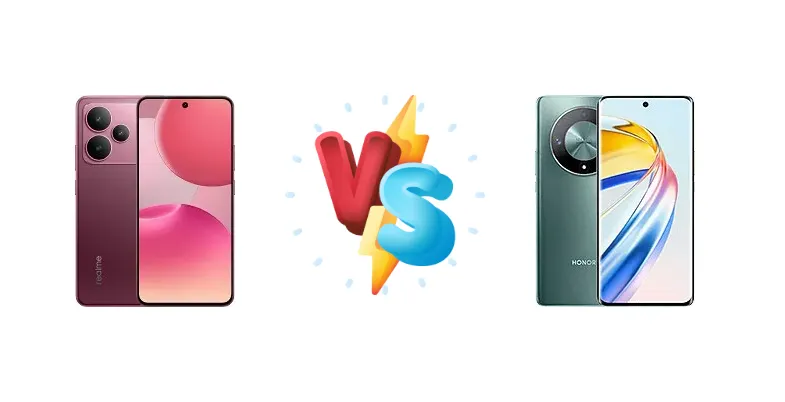
The Realme P4 and Honor X9b represent compelling options in the increasingly competitive mid-range smartphone market. Both leverage 4nm chipsets for efficiency, but diverge significantly in processing power and charging capabilities. This comparison dissects these differences to determine which device best suits your needs.
🏆 Quick Verdict
For the average user prioritizing performance and rapid replenishment, the Realme P4 is the stronger choice. Its Dimensity 7400 chipset offers a noticeable performance advantage, and the 80W charging dramatically reduces downtime. However, the Honor X9b’s more conservative approach may appeal to those valuing sustained efficiency.
| Network |
|---|
| 2G bands | GSM 850 / 900 / 1800 / 1900 | GSM 850 / 900 / 1800 / 1900 |
| 3G bands | HSDPA 850 / 900 / 2100 | HSDPA 850 / 900 / 1900 / 2100 |
| 4G bands | 1, 3, 5, 8, 28, 40, 41 | 1, 2, 3, 4, 5, 7, 8, 20, 28, 32, 38, 40, 41 |
| 5G bands | 1, 3, 5, 8, 28, 40, 41, 77, 78 SA/NSA | 1, 3, 7, 8, 20, 28, 38, 40, 41, 77, 78 SA/NSA |
| Speed | HSPA, LTE, 5G | HSPA, LTE, 5G |
| Technology | GSM / HSPA / LTE / 5G | GSM / HSPA / LTE / 5G |
| Launch |
|---|
| Announced | 2025, August 20 | 2023, October 18 |
| Status | Available. Released 2025, August 20 | Available. Released 2023, October |
| Body |
|---|
| Build | Glass front, plastic frame, plastic back | - |
| Dimensions | 163.3 x 75.9 x 7.6 mm (6.43 x 2.99 x 0.30 in) | 163.6 x 75.5 x 8 mm (6.44 x 2.97 x 0.31 in) |
| SIM | Nano-SIM + Nano-SIM | Nano-SIM + Nano-SIM |
| Weight | 185 g (6.53 oz) | 185 g (6.53 oz) |
| Display |
|---|
| Resolution | 1080 x 2392 pixels (~388 ppi density) | 1220 x 2652 pixels, 19.5:9 ratio (~431 ppi density) |
| Size | 6.77 inches, 110.9 cm2 (~89.5% screen-to-body ratio) | 6.78 inches, 112.6 cm2 (~91.2% screen-to-body ratio) |
| Type | AMOLED, 1B colors, 144Hz, HDR10+, 3840Hz PWM, 1600 nits (HBM), 4500 nits (peak) | AMOLED, 1B colors, 120Hz, 1200 nits (peak) |
| Platform |
|---|
| CPU | Octa-core (4x2.6 GHz Cortex-A78 & 4x2.0 GHz Cortex-A55) | Octa-core (4x2.2 GHz Cortex-A78 & 4x1.8 GHz Cortex-A55) |
| Chipset | Mediatek Dimensity 7400 (4 nm) | Qualcomm SM6450 Snapdragon 6 Gen 1 (4 nm) |
| GPU | Mali-G615 MC2 | Adreno 710 |
| OS | Android 15, Realme UI 6.0 | Android 13, Magic OS 7.2 |
| Memory |
|---|
| Card slot | No | No |
| Internal | 128GB 6GB RAM, 128GB 8GB RAM, 256GB 8GB RAM | 256GB 8GB RAM, 256GB 12GB RAM, 512GB 8GB RAM, 512GB 12GB RAM |
| Main Camera |
|---|
| Dual | 50 MP, f/1.8, 27mm (wide), PDAF
8 MP, f/2.2, 112˚ (ultrawide) | - |
| Features | LED flash, HDR, panorama | LED flash, panorama, HDR |
| Triple | - | 108 MP, f/1.8, (wide), 1/1.67", PDAF
5 MP, f/2.2, (ultrawide)
2 MP (macro) |
| Video | 4K@30fps, 1080p@30/60/120fps, gyro-EIS | 4K@30fps, 1080p@30fps |
| Selfie camera |
|---|
| Features | Panorama | - |
| Single | 16 MP, f/2.4, (wide) | 16 MP, f/2.5, (wide) |
| Video | 1080p@30fps | 1080p@30fps |
| Sound |
|---|
| 35mm jack | No | No |
| Loudspeaker | Yes, with stereo speakers | Yes |
| Comms |
|---|
| Bluetooth | 5.4, A2DP, LE | 5.1, A2DP, LE |
| Infrared port | Yes | Yes |
| NFC | No | Yes (market/region dependent) |
| Positioning | GPS, GALILEO, GLONASS, BDS | GPS, GLONASS, GALILEO, BDS |
| Radio | Unspecified | No |
| USB | USB Type-C 2.0, OTG | USB Type-C 2.0, OTG |
| WLAN | Wi-Fi 802.11 a/b/g/n/ac, dual-band | Wi-Fi 802.11 a/b/g/n/ac, dual-band, Wi-Fi Direct |
| Features |
|---|
| Sensors | Fingerprint (under display, optical), accelerometer, gyro, proximity, compass | Fingerprint (under display, optical), accelerometer, gyro, proximity, compass |
| Battery |
|---|
| Charging | 80W wired
10W reverse wired
Bypass charging | 35W wired
Reverse wired |
| Type | Si/C Li-Ion 7000 mAh | Li-Po 5800 mAh |
| Misc |
|---|
| Colors | Steel Gray, Engine Blue, Forge Red | Sunrise Orange, Midnight Black, Emerald Green |
| Models | - | ALI-NX1 |
| Price | About 190 EUR | About 970 EUR |
Realme P4
- Significantly faster 80W charging
- More powerful Dimensity 7400 chipset
- Bypass charging for improved battery health
- Potentially less efficient thermal management
- Image processing may be overly saturated for some users
Honor X9b
- Potentially better sustained performance due to Qualcomm’s thermal management
- Likely more natural color reproduction in photos
- Reverse wired charging
- Slower 35W charging
- Less powerful Snapdragon 6 Gen 1 chipset
Display Comparison
Neither device's display specifications are provided, so a direct comparison is limited. However, given the price bracket, we can anticipate both utilizing AMOLED panels. The Honor brand historically focuses on color accuracy, while Realme often prioritizes high refresh rates. The absence of LTPO technology on either device suggests standard refresh rate management, impacting battery life during dynamic content. Bezels are likely to be similar, with both aiming for an immersive experience.
Camera Comparison
Without specific camera sensor details, analysis is limited. However, the market segment suggests both phones will feature multi-camera setups. The absence of information regarding OIS (Optical Image Stabilization) is notable; its presence would significantly benefit low-light photography and video recording. We can assume both will include a primary sensor, ultrawide, and potentially a macro lens. Image processing styles will likely differ – Realme tends towards vibrant, saturated colors, while Honor often aims for more natural tones. The larger the primary sensor, the better the low-light performance will be, but this information is currently unavailable.
Performance
The Realme P4’s Mediatek Dimensity 7400 (4nm) and the Honor X9b’s Qualcomm Snapdragon 6 Gen 1 (4nm) are the core of this comparison. The Dimensity 7400, with its Cortex-A78 cores clocked at 2.6 GHz, boasts a higher peak CPU frequency than the Snapdragon 6 Gen 1’s 2.2 GHz Cortex-A78 cores. This translates to faster application loading and smoother multitasking. While both utilize the efficient 4nm process, the Dimensity 7400’s architecture provides a performance edge. The Snapdragon 6 Gen 1 may offer slightly better sustained performance due to Qualcomm’s thermal management expertise, but the P4’s raw power is undeniable. The P4 is likely to perform better in graphically intensive games.
Battery Life
The Realme P4’s 80W wired charging is a standout feature, allowing for a full charge in approximately 30-40 minutes. The Honor X9b’s 35W charging is considerably slower, requiring closer to 1.5-2 hours for a complete charge. While battery capacity isn’t specified, the faster charging of the P4 mitigates the impact of a potentially smaller battery. The P4 also includes 10W reverse wired charging, a convenient feature for topping up accessories, which the X9b also offers. The bypass charging feature on the P4 allows direct power from the charger to the phone, reducing heat during charging and extending battery lifespan.
Buying Guide
Buy the Realme P4 if you need a phone for demanding tasks like gaming or video editing, and value the convenience of incredibly fast charging. You'll benefit from the more powerful processor and quicker top-ups. Buy the Honor X9b if you prioritize a balanced experience with a focus on efficiency and potentially longer battery life between charges, and aren't as concerned with pushing the phone to its absolute performance limits.
Frequently Asked Questions
❓ Will the Dimensity 7400 in the Realme P4 overheat during prolonged gaming sessions?
While the Dimensity 7400 is a powerful chip, thermal throttling is always a possibility. However, Realme often incorporates cooling solutions in their devices. The Snapdragon 6 Gen 1 in the Honor X9b may exhibit more consistent performance under sustained load due to Qualcomm’s thermal management, but the P4’s higher peak performance will likely be noticeable in shorter bursts.
❓ Does the Realme P4’s 80W charging degrade the battery faster than the Honor X9b’s 35W charging?
Not necessarily. Modern smartphones have battery management systems that mitigate the effects of fast charging. The Realme P4’s bypass charging feature further reduces heat buildup during charging, potentially extending battery lifespan. While slower charging generally produces less heat, the difference is often negligible with current technology.
❓ Is the Snapdragon 6 Gen 1 in the Honor X9b capable of running demanding games like PUBG Mobile at high frame rates?
The Snapdragon 6 Gen 1 can run PUBG Mobile, but likely at medium settings to maintain a stable frame rate. Expect to prioritize smoothness over maximum graphical fidelity. The Realme P4’s Dimensity 7400 will offer a more comfortable experience with higher settings and frame rates.