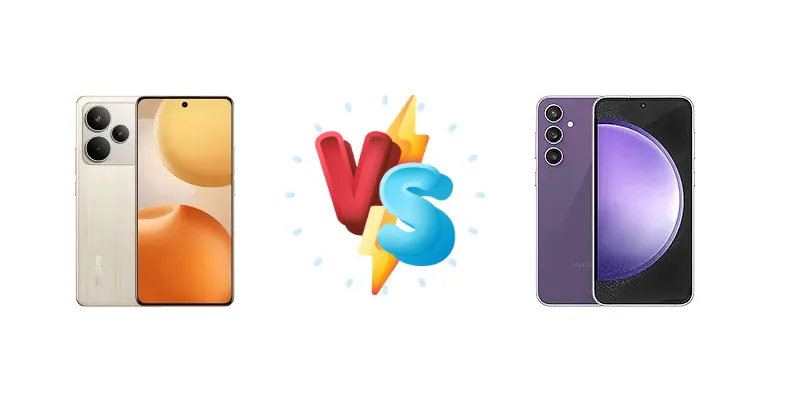
The Realme P4 Pro aims to disrupt the mid-range market with its aggressive pricing and fast charging, while the Samsung Galaxy S23 FE offers a more refined experience and the prestige of the Samsung brand. This comparison dives deep into the specifications and real-world implications of each device to determine which one reigns supreme.
🏆 Quick Verdict
For the average user prioritizing value and rapid charging, the Realme P4 Pro emerges as the winner. Its Snapdragon 7 Gen 4 chipset delivers solid performance, and the 80W charging is a game-changer. However, the Galaxy S23 FE’s superior display and more polished camera system make it a compelling choice for those willing to pay a premium.
| Network |
|---|
| 2G bands | GSM 850 / 900 / 1800 / 1900 | GSM 850 / 900 / 1800 / 1900 |
| 3G bands | HSDPA 850 / 900 / 2100 | HSDPA 850 / 900 / 1700(AWS) / 1900 / 2100 |
| 4G bands | 1, 3, 5, 8, 28, 40, 41 | 1, 2, 3, 4, 5, 7, 8, 12, 13, 17, 20, 26, 28, 38, 40, 41, 66 - International |
| 5G bands | 1, 3, 5, 8, 28, 40, 41, 77, 78 SA/NSA | 1, 2, 3, 5, 7, 8, 20, 28, 38, 40, 41, 66, 77, 78 SA/NSA/Sub6 - International |
| Speed | HSPA, LTE, 5G | HSPA, LTE, 5G |
| Technology | GSM / HSPA / LTE / 5G | GSM / HSPA / LTE / 5G |
| Launch |
|---|
| Announced | 2025, August 20 | 2023, October 04 |
| Status | Available. Released 2025, August 27 | Available. Released 2023, October 05 |
| Body |
|---|
| Build | Glass front (Gorilla Glass 7i), fiber-reinforced plastic frame, plastic back | Glass front (Gorilla Glass 5), glass back (Gorilla Glass 5), aluminum frame |
| Dimensions | 162.3 x 76.2 x 7.7 mm | 158 x 76.5 x 8.2 mm (6.22 x 3.01 x 0.32 in) |
| SIM | Nano-SIM + Nano-SIM | · Nano-SIM· Nano-SIM + Nano-SIM· Nano-SIM + Nano-SIM + eSIM (max 2 at a time) |
| Weight | 189 g (6.67 oz) | 209 g (7.37 oz) |
| Display |
|---|
| Protection | Corning Gorilla Glass 7i | Corning Gorilla Glass 5 |
| Resolution | 1280 x 2800 pixels, 19.5:9 ratio (~453 ppi density) | 1080 x 2340 pixels, 19.5:9 ratio (~403 ppi density) |
| Size | 6.8 inches, 112.8 cm2 (~91.2% screen-to-body ratio) | 6.4 inches, 100.5 cm2 (~83.2% screen-to-body ratio) |
| Type | AMOLED, 1B colors, 144Hz, HDR10+, 4608Hz PWM, 1800 nits (HBM), 6500 nits (peak) | Dynamic AMOLED 2X, 120Hz, HDR10+, 1450 nits (peak) |
| Platform |
|---|
| CPU | Octa-core (1x2.8 GHz Cortex-720 & 4x2.4 GHz Cortex-720 & 3x1.8 GHz Cortex-520) | Octa-core (1x2.8 GHz Cortex-X2 & 3x2.50 GHz Cortex-A710 & 4x1.8 GHz Cortex-A510) - InternationalOcta-core (1x3.00 GHz Cortex-X2 & 3x2.50 GHz Cortex-A710 & 4x1.80 GHz Cortex-A510) - USA |
| Chipset | Qualcomm SM7750-AB Snapdragon 7 Gen 4 (4 nm) | Exynos 2200 (4 nm) - InternationalQualcomm SM8450 Snapdragon 8 Gen 1 (4 nm) - USA |
| GPU | Adreno 722 | Xclipse 920 - InternationalAdreno 730 - USA |
| OS | Android 15, up to 3 major Android upgrades, Realme UI 6.0 | Android 13, up to 4 major Android upgrades, One UI 8 |
| Memory |
|---|
| Card slot | No | No |
| Internal | 128GB 8GB RAM, 256GB 8GB RAM, 256GB 12GB RAM, 512GB 12GB RAM | 128GB 8GB RAM, 256GB 8GB RAM |
| Main Camera |
|---|
| Dual | 50 MP, f/1.8, 24mm (wide), 1/1.56", 1.0µm, PDAF, OIS
8 MP, f/2.2, 16mm, 112˚ (ultrawide) | - |
| Features | LED flash, HDR, panorama | LED flash, HDR, panorama |
| Triple | - | 50 MP, f/1.8, 23mm (wide), 1/1.57", 1.0µm, dual pixel PDAF, OIS
8 MP, f/2.4, 76mm (telephoto), 1/4.5", 1.0µm, PDAF, OIS, 3x optical zoom
12 MP, f/2.2, 13mm, 123˚ (ultrawide), 1/3.0", 1.12µm |
| Video | 4K@30/60fps, 1080p@30/60/120fps, gyro-EIS, OIS | 8K@24fps, 4K@30/60fps, 1080p@30/60/120/240fps |
| Selfie camera |
|---|
| Features | Panorama | - |
| Single | 50 MP, f/2.4, 22mm (wide), 1/2.88", 0.61µm | 10 MP, f/2.4, 25mm (wide), 1/3.0", 1.22µm |
| Video | 4K@30/60fps, 1080p@30/60fps | 4K@30/60fps, 1080p@30/60fps; gyro-EIS |
| Sound |
|---|
| 35mm jack | No | No |
| Loudspeaker | Yes, with stereo speakers | Yes, with stereo speakers |
| Comms |
|---|
| Bluetooth | 5.4, A2DP, LE, aptX HD, LHDC 5 | 5.3, A2DP, LE |
| Infrared port | Yes | - |
| NFC | No | Yes |
| Positioning | GPS, GLONASS, GALILEO, BDS | GPS, GLONASS, GALILEO, BDS |
| Radio | No | Unspecified |
| USB | USB Type-C 2.0 | USB Type-C, OTG |
| WLAN | Wi-Fi 802.11 a/b/g/n/ac/6, dual-band | Wi-Fi 802.11 a/b/g/n/ac/6e, dual-band, Wi-Fi Direct |
| Features |
|---|
| Sensors | Fingerprint (under display, optical), accelerometer, gyro, proximity, compass | Fingerprint (under display, optical), accelerometer, gyro, compass |
| Battery |
|---|
| Charging | 80W wired
10W reverse wired
Bypass charging | 25W wired, PD3.0, 50% in 30 min
15W wireless
Reverse wireless |
| Type | Si/C Li-Ion 7000 mAh | Li-Ion 4500 mAh |
| Misc |
|---|
| Colors | Birch Wood, Dark Oak Wood, Midnight Ivy | Mint, Cream, Graphite, Purple, Indigo, Tangerine |
| Models | RMX5116 | SM-S711B, SM-S711B/DS, SM-S711U1, SM-S711U, SM-S711W, SM-S7110, SM-S711N |
| Price | ₹ 22,250 | $ 219.95 / C$ 327.90 / £ 248.99 / € 272.00 / ₹ 34,999 |
| SAR | - | 0.80 W/kg (head) 0.72 W/kg (body) |
| SAR EU | - | 0.76 W/kg (head) 1.04 W/kg (body) |
Realme P4 Pro
- Significantly faster 80W charging
- More efficient Snapdragon 7 Gen 4 chipset
- Potentially better sustained performance due to thermal efficiency
- Display brightness and quality likely inferior to S23 FE
- Camera system likely less advanced than S23 FE
Samsung Galaxy S23 FE
- Brighter and more color-accurate display
- More versatile and refined camera system
- Established brand reputation and ecosystem
- Slower 25W charging
- Exynos 2200/Snapdragon 8 Gen 1 can throttle under heavy load
- Higher price point
Display Comparison
The Samsung Galaxy S23 FE boasts a significantly brighter display, reaching a measured 985 nits, compared to an unstated peak brightness for the Realme P4 Pro. This translates to better visibility outdoors. While the P4 Pro’s panel technology isn’t specified, the S23 FE’s likely utilizes a high-refresh-rate AMOLED, offering smoother scrolling and animations. The S23 FE’s display is likely to have better color accuracy, a key benefit for content creators and media consumers.
Camera Comparison
The context data is limited regarding camera specifics. However, the Galaxy S23 FE is expected to have a more sophisticated camera system, likely featuring a larger main sensor and more advanced image processing algorithms. Samsung’s reputation for camera quality, particularly in computational photography, gives it an edge. The Realme P4 Pro’s camera capabilities are less clear, and the inclusion of a 2MP macro lens suggests a focus on quantity over quality. The S23 FE’s OIS (Optical Image Stabilization) will provide sharper images and smoother video, especially in low-light conditions.
Performance
The chipset is where the biggest difference lies. The Galaxy S23 FE ships with either the Exynos 2200 (International) or Snapdragon 8 Gen 1 (USA), both 4nm chips, while the Realme P4 Pro utilizes the Snapdragon 7 Gen 4 (also 4nm). While the Exynos 2200/Snapdragon 8 Gen 1 offer higher peak CPU performance – the USA variant with a 3.00 GHz Cortex-X2 core versus the P4 Pro’s 2.8 GHz Cortex-720 – the Snapdragon 7 Gen 4 is more efficient. The P4 Pro’s CPU configuration (1x2.8 GHz Cortex-720, 4x2.4 GHz Cortex-720, 3x1.8 GHz Cortex-520) is designed for sustained performance, potentially avoiding the thermal throttling that can plague the older flagship chips in the S23 FE during extended gaming sessions. The S23 FE’s LPDDR5 RAM is standard for its class, but the P4 Pro’s RAM specification is missing, impacting multitasking capabilities.
Battery Life
The Galaxy S23 FE achieves an active use score of 8:28h, providing a benchmark for real-world battery life. The Realme P4 Pro’s battery capacity is not specified, but its 80W wired charging is a significant advantage. This allows for incredibly fast charging speeds, potentially fully charging the device in under 30 minutes. The S23 FE’s 25W charging, while supporting PD3.0 and reaching 50% in 30 minutes, is considerably slower. The P4 Pro also offers 10W reverse wired charging and bypass charging, features absent in the S23 FE.
Buying Guide
Buy the Realme P4 Pro if you need blazing-fast charging, a modern chipset for smooth daily use, and are comfortable with a less established brand. Buy the Samsung Galaxy S23 FE if you prefer a brighter, more color-accurate display, a more versatile camera system with Samsung’s image processing, and the broader ecosystem benefits of the Samsung brand.
Frequently Asked Questions
❓ Does the Exynos 2200 in the Galaxy S23 FE suffer from overheating issues?
The Exynos 2200 has been known to run hot under sustained load, potentially leading to thermal throttling during demanding tasks like gaming. While Samsung has implemented optimizations, the Snapdragon 8 Gen 1 variant generally performs better in this regard. The Realme P4 Pro’s Snapdragon 7 Gen 4 is designed for efficiency and is less prone to overheating.
❓ Is the 80W charging on the Realme P4 Pro safe for long-term battery health?
While 80W charging is incredibly fast, Realme incorporates charging algorithms to manage heat and minimize battery degradation. Bypass charging further enhances battery health by delivering power directly to the device, bypassing the battery during certain use cases. However, consistently using extremely fast charging *can* contribute to faster battery wear over several years.
❓ How does the Snapdragon 7 Gen 4 compare to the Snapdragon 8 Gen 1 in gaming?
The Snapdragon 8 Gen 1 has a theoretical performance advantage, but the Snapdragon 7 Gen 4’s efficiency allows for more sustained performance. In many games, the P4 Pro may maintain higher frame rates over longer periods due to less throttling. The difference will be most noticeable in graphically intensive titles.
❓ Is the 2MP macro camera on the Realme P4 Pro actually useful?
Generally, 2MP macro cameras offer limited detail and image quality. They are often included for marketing purposes but rarely deliver impressive results. The S23 FE’s camera system is likely to offer a more versatile and higher-quality photography experience.