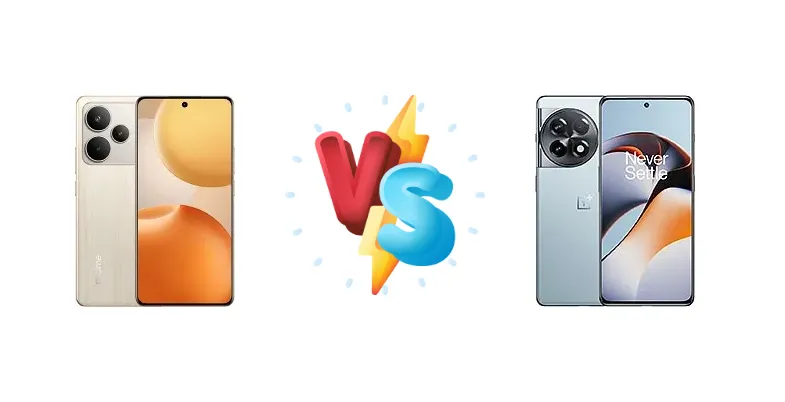
The Realme P4 Pro and OnePlus 11R represent compelling options in the increasingly competitive mid-range smartphone market. While both leverage Qualcomm's Snapdragon platform, they target slightly different priorities – the P4 Pro emphasizing efficiency with the newer 7 Gen 4, and the 11R leaning on the established power of the 8+ Gen 1. This comparison dissects their key differences to determine which device delivers the best overall experience.
🏆 Quick Verdict
For most users, the OnePlus 11R emerges as the stronger choice. Its Snapdragon 8+ Gen 1 chipset provides a significant performance advantage, particularly in demanding tasks and gaming, and the 100W charging is noticeably faster. While the Realme P4 Pro offers a more modern chipset architecture, the performance gap justifies the price difference for power users.
| Network |
|---|
| 2G bands | GSM 850 / 900 / 1800 / 1900 | GSM 850 / 900 / 1800 / 1900 |
| 3G bands | HSDPA 850 / 900 / 2100 | HSDPA 850 / 900 / 1700(AWS) / 2100 |
| 4G bands | 1, 3, 5, 8, 28, 40, 41 | 1, 3, 4, 5, 8, 28, 34, 38, 39, 40, 41 |
| 5G bands | 1, 3, 5, 8, 28, 40, 41, 77, 78 SA/NSA | 1, 3, 5, 8, 28, 40, 41, 77, 78 SA/NSA |
| Speed | HSPA, LTE, 5G | HSPA, LTE (3CA), 5G |
| Technology | GSM / HSPA / LTE / 5G | GSM / CDMA / HSPA / LTE / 5G |
| | - | CDMA 800 |
| Launch |
|---|
| Announced | 2025, August 20 | 2023, February 07 |
| Status | Available. Released 2025, August 27 | Available. Released 2023, February 21 |
| Body |
|---|
| Build | Glass front (Gorilla Glass 7i), fiber-reinforced plastic frame, plastic back | Glass front, glass back (Gorilla Glass 5), plastic frame |
| Dimensions | 162.3 x 76.2 x 7.7 mm | 163.4 x 74.3 x 8.7 mm (6.43 x 2.93 x 0.34 in) |
| SIM | Nano-SIM + Nano-SIM | Nano-SIM + Nano-SIM |
| Weight | 189 g (6.67 oz) | 204 g (7.20 oz) |
| Display |
|---|
| Protection | Corning Gorilla Glass 7i | - |
| Resolution | 1280 x 2800 pixels, 19.5:9 ratio (~453 ppi density) | 1240 x 2772 pixels, 20:9 ratio (~451 ppi density) |
| Size | 6.8 inches, 112.8 cm2 (~91.2% screen-to-body ratio) | 6.74 inches, 109.2 cm2 (~90.0% screen-to-body ratio) |
| Type | AMOLED, 1B colors, 144Hz, HDR10+, 4608Hz PWM, 1800 nits (HBM), 6500 nits (peak) | Fluid AMOLED, 1B colors, 120Hz, HDR10+, 1450 nits (peak) |
| Platform |
|---|
| CPU | Octa-core (1x2.8 GHz Cortex-720 & 4x2.4 GHz Cortex-720 & 3x1.8 GHz Cortex-520) | Octa-core (1x3.0 GHz Cortex-X2 & 3x2.5 GHz Cortex-A710 & 4x1.80 GHz Cortex-A510) |
| Chipset | Qualcomm SM7750-AB Snapdragon 7 Gen 4 (4 nm) | Qualcomm SM8475 Snapdragon 8+ Gen 1 (4 nm) |
| GPU | Adreno 722 | Adreno 730 |
| OS | Android 15, up to 3 major Android upgrades, Realme UI 6.0 | Android 13, upgradable to Android 15, OxygenOS 15 |
| Memory |
|---|
| Card slot | No | No |
| Internal | 128GB 8GB RAM, 256GB 8GB RAM, 256GB 12GB RAM, 512GB 12GB RAM | 128GB 8GB RAM, 256GB 16GB RAM, 512GB 18GB RAM |
| | - | UFS 3.1 |
| Main Camera |
|---|
| Dual | 50 MP, f/1.8, 24mm (wide), 1/1.56", 1.0µm, PDAF, OIS
8 MP, f/2.2, 16mm, 112˚ (ultrawide) | - |
| Features | LED flash, HDR, panorama | Color spectrum sensor, LED flash, HDR, panorama |
| Single | - | 16 MP, f/2.4, 24mm (wide), 1/3.09", 1.0µm |
| Triple | - | 50 MP, f/1.8, 24mm (wide), 1/1.56", 1.0µm, multi-directional PDAF, OIS
8 MP, f/2.2, 120˚ (ultrawide), 1/4.0", 1.12µm
2 MP (macro) |
| Video | 4K@30/60fps, 1080p@30/60/120fps, gyro-EIS, OIS | 4K@30/60fps, 1080p@30/60/240fps, gyro-EIS |
| Selfie camera |
|---|
| Features | Panorama | HDR |
| Single | 50 MP, f/2.4, 22mm (wide), 1/2.88", 0.61µm | 16 MP, f/2.4, 24mm (wide), 1/3.09", 1.0µm |
| Video | 4K@30/60fps, 1080p@30/60fps | 1080p@30fps |
| Sound |
|---|
| 3.5mm jack | - | No |
| 35mm jack | No | No |
| Loudspeaker | Yes, with stereo speakers | Yes, with stereo speakers |
| | - | 24-bit/192kHz audio |
| Comms |
|---|
| Bluetooth | 5.4, A2DP, LE, aptX HD, LHDC 5 | 5.3, A2DP, LE, aptX HD |
| Infrared port | Yes | Yes |
| NFC | No | Yes |
| Positioning | GPS, GLONASS, GALILEO, BDS | GPS (L1+L5), GLONASS (G1), BDS (B1I+B1c+B2a), GALILEO (E1+E5a), QZSS (L1+L5) |
| Radio | No | No |
| USB | USB Type-C 2.0 | USB Type-C 2.0 |
| WLAN | Wi-Fi 802.11 a/b/g/n/ac/6, dual-band | Wi-Fi 802.11 a/b/g/n/ac/6, dual-band |
| Features |
|---|
| Sensors | Fingerprint (under display, optical), accelerometer, gyro, proximity, compass | Fingerprint (under display, optical), accelerometer, gyro, proximity, compass |
| Battery |
|---|
| Charging | 80W wired
10W reverse wired
Bypass charging | 100W wired |
| Type | Si/C Li-Ion 7000 mAh | Li-Po 5000 mAh |
| Misc |
|---|
| Colors | Birch Wood, Dark Oak Wood, Midnight Ivy | Galactic Silver, Sonic Black, Solar Red |
| Models | RMX5116 | CPH2487 |
| Price | ₹ 22,250 | About 600 EUR |
| SAR | - | 1.16 W/kg (head) 0.61 W/kg (body) |
Realme P4 Pro
- More modern chipset architecture (Snapdragon 7 Gen 4)
- 80W fast charging with bypass charging
- 10W reverse wired charging
- Significantly lower peak performance compared to the 11R
- Potentially less refined camera system
OnePlus 11R
- Superior performance with Snapdragon 8+ Gen 1
- 100W SuperVOOC charging for incredibly fast top-ups
- Likely better camera image processing
- Older chipset generation
- No reverse wireless charging
Display Comparison
Neither device's display specifications are provided, so a direct comparison is limited. However, given the market positioning, we can infer both likely utilize AMOLED panels. The OnePlus 11R, being a slightly higher-tier device, may benefit from a higher peak brightness and potentially a more refined color calibration. The Realme P4 Pro's newer chipset *could* allow for more efficient display power consumption, but this is speculative without detailed panel specs. Bezels are likely comparable, and both will likely offer high refresh rates (120Hz is standard in this segment).
Camera Comparison
Without specific camera sensor details, analysis is limited. However, the OnePlus 11R, positioned as a more premium device, likely features a larger main sensor and potentially a more sophisticated image signal processor (ISP) within the Snapdragon 8+ Gen 1. The Realme P4 Pro’s ISP, while capable, will be less powerful. Image processing styles will likely differ – OnePlus tends towards more saturated, punchy images, while Realme often aims for a more natural look. The absence of details regarding OIS (Optical Image Stabilization) makes it impossible to assess low-light performance differences.
Performance
The core difference lies in the chipsets. The OnePlus 11R’s Snapdragon 8+ Gen 1 (4nm) boasts a Cortex-X2 prime core clocked at 3.0 GHz, alongside three Cortex-A710 performance cores at 2.5 GHz and four Cortex-A510 efficiency cores at 1.8 GHz. This configuration delivers significantly higher peak performance than the Realme P4 Pro’s Snapdragon 7 Gen 4 (4nm). The P4 Pro utilizes a 2.8 GHz Cortex-720 prime core, four 2.4 GHz Cortex-720 cores, and three 1.8 GHz Cortex-520 cores. While the 7 Gen 4 benefits from a newer architecture, the 8+ Gen 1’s superior core configuration and higher clock speeds translate to a tangible advantage in benchmarks and real-world applications. The 11R will handle demanding games and multitasking with greater ease. Both devices likely feature LPDDR5x RAM, but the 8+ Gen 1's memory controller will likely offer slightly higher bandwidth.
Battery Life
The OnePlus 11R’s 100W wired charging is a clear advantage over the Realme P4 Pro’s 80W charging. This translates to significantly faster 0-100% charging times – likely under 30 minutes for the 11R versus potentially 40-45 minutes for the P4 Pro. While battery capacity isn’t specified, the faster charging of the 11R mitigates any potential disadvantage from a slightly smaller battery. The Realme P4 Pro does offer 10W reverse wired charging, a feature absent on the 11R, which is useful for topping up accessories.
Buying Guide
Buy the Realme P4 Pro if you prioritize long-term software support from Realme, value the benefits of a newer chipset architecture for potential efficiency gains, and are comfortable with slightly less raw processing power. Buy the OnePlus 11R if you demand the best possible performance for gaming and multitasking, appreciate significantly faster charging speeds, and prefer a proven track record of the Snapdragon 8+ Gen 1.
Frequently Asked Questions
❓ Will the Snapdragon 7 Gen 4 in the Realme P4 Pro struggle with graphically intensive games like Genshin Impact?
While the Snapdragon 7 Gen 4 is a capable chip, Genshin Impact and similar titles will likely require reduced graphics settings for smooth gameplay on the Realme P4 Pro. The OnePlus 11R’s Snapdragon 8+ Gen 1 offers significantly more headroom for high-fidelity gaming.
❓ How much faster is the 100W charging on the OnePlus 11R compared to the 80W charging on the Realme P4 Pro in real-world use?
Expect the OnePlus 11R to charge from 0-100% in approximately 25-30 minutes, while the Realme P4 Pro will likely take 40-45 minutes. This 10-15 minute difference is substantial for users who frequently need to quickly top up their battery.
❓ Does the Snapdragon 8+ Gen 1 in the OnePlus 11R tend to overheat during prolonged gaming sessions?
The Snapdragon 8+ Gen 1 is known to generate heat under sustained load. However, OnePlus typically implements effective thermal management solutions, including vapor chamber cooling, to mitigate throttling. While some heat is expected, the 11R should maintain stable performance for extended gaming sessions.