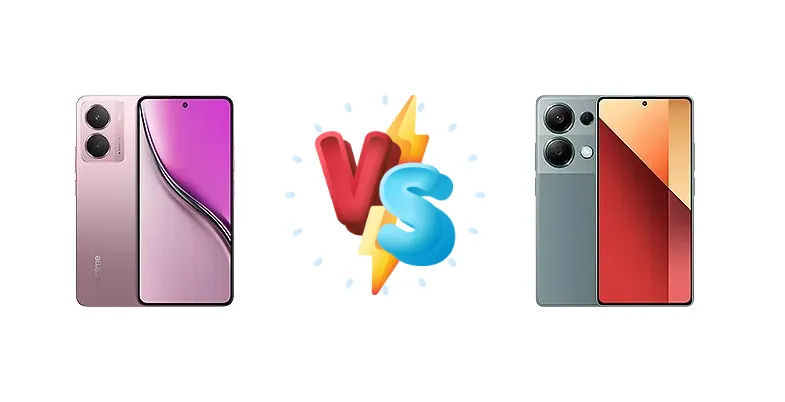
The mid-range smartphone market is fiercely competitive, and the Realme P3 and Xiaomi Redmi Note 13 Pro 4G represent compelling options for budget-conscious buyers. The P3 leverages Qualcomm's latest Snapdragon 6 Gen 4, while the Redmi Note 13 Pro 4G opts for MediaTek's Helio G99 Ultra. This comparison dissects their key differences to determine which device delivers the best overall experience.
🏆 Quick Verdict
For the average user prioritizing sustained performance and long-term battery health, the Realme P3 emerges as the stronger contender. Its Snapdragon 6 Gen 4, built on a 4nm process, offers a more efficient architecture than the Helio G99 Ultra, translating to better thermal management and potentially longer software support. However, the Redmi Note 13 Pro 4G’s faster charging is a significant advantage.
| Network |
|---|
| 2G bands | GSM 850 / 900 / 1800 / 1900 | GSM 850 / 900 / 1800 / 1900 |
| 3G bands | HSDPA 850 / 900 / 2100 | HSDPA 850 / 900 / 1700(AWS) / 1900 / 2100 |
| 4G bands | 1, 3, 5, 8, 28, 40, 41 | 1, 2, 3, 4, 5, 7, 8, 12, 13, 17, 18, 19, 20, 26, 28, 38, 40, 41, 66 |
| 5G bands | 1, 3, 5, 8, 28, 40, 41, 77, 78 SA/NSA | - |
| Speed | HSPA, LTE, 5G | HSPA, LTE |
| Technology | GSM / HSPA / LTE / 5G | GSM / HSPA / LTE |
| Launch |
|---|
| Announced | 2025, March 17 | 2024, January 15 |
| Status | Available. Released 2025, March 19 | Available. Released 2024, January 15 |
| Body |
|---|
| Build | - | Glass front (Gorilla Glass 5), plastic frame, plastic back |
| Dimensions | 163.2 x 75.7 x 8 mm (6.43 x 2.98 x 0.31 in) | 161.1 x 75 x 8 mm (6.34 x 2.95 x 0.31 in) |
| SIM | Nano-SIM + Nano-SIM | Nano-SIM + Nano-SIM |
| Weight | 194 g (6.84 oz) | 188 g (6.63 oz) |
| Display |
|---|
| Protection | Mohs level 5 | Corning Gorilla Glass 5 |
| Resolution | 1080 x 2400 pixels, 20:9 ratio (~395 ppi density) | 1080 x 2400 pixels, 20:9 ratio (~395 ppi density) |
| Size | 6.67 inches, 107.4 cm2 (~86.9% screen-to-body ratio) | 6.67 inches, 107.4 cm2 (~88.9% screen-to-body ratio) |
| Type | AMOLED, 120Hz, 600 nits (typ), 2000 nits (peak) | AMOLED, 1B colors, 120Hz, 500 nits (typ), 1000 nits (HBM), 1300 nits (peak) |
| Platform |
|---|
| CPU | Octa-core (1x2.3 GHz Cortex-A720s & 3x2.2 GHz Cortex-A720s & 4x1.8 GHz Cortex-A520s) | Octa-core (2x2.2 GHz Cortex-A76 & 6x2.0 GHz Cortex-A55) |
| Chipset | Qualcomm Snapdragon 6 Gen 4 (4 nm) | Mediatek Helio G99 Ultra |
| GPU | Adreno 810 | Mali-G57 MC2 |
| OS | Android 15, Realme UI 6.0 | Android 13, up to 3 major Android upgrades, HyperOS |
| Memory |
|---|
| Card slot | microSDXC (uses shared SIM slot) | microSDXC (uses shared SIM slot) |
| Internal | 128GB 6GB RAM, 128GB 8GB RAM, 256GB 8GB RAM, 512GB 12GB RAM | 128GB 8GB RAM, 256GB 8GB RAM, 256GB 12GB RAM, 512GB 8GB RAM, 512GB 12GB RAM |
| Main Camera |
|---|
| Dual | 50 MP, f/1.8, 27mm (wide), 1/2.88", 0.61µm, PDAF
Auxiliary lens | - |
| Features | LED flash, HDR, panorama | LED flash, HDR, panorama |
| Triple | - | 200 MP, f/1.7, 23mm (wide), 1/1.4", 0.56µm, multi-directional PDAF, OIS
8 MP, f/2.2, 15mm, 120˚ (ultrawide), 1/4.4", 1.0µm
2 MP (macro) |
| Video | 4K@30fps, 1080p@30/60/120fps, gyro-EIS | 1080p@30/60fps |
| Selfie camera |
|---|
| Single | 16 MP, f/2.4, 23mm (wide), 1/3.09", 1.0µm | 16 MP, f/2.4, (wide), 1/3.0", 1.0µm |
| Video | 1080p@30fps | 1080p@30/60fps |
| Sound |
|---|
| 35mm jack | No | Yes |
| Loudspeaker | Yes, with stereo speakers | Yes, with dual speakers |
| Comms |
|---|
| Bluetooth | 5.2, A2DP, LE | 5.2, A2DP, LE |
| Infrared port | - | Yes |
| NFC | No | Yes (market/region dependent) |
| Positioning | GPS, GLONASS, GALILEO, BDS, QZSS | GPS, GLONASS, GALILEO, BDS |
| Radio | No | FM radio |
| USB | USB Type-C 2.0 | USB Type-C 2.0, OTG |
| WLAN | Wi-Fi 802.11 a/b/g/n/ac/6, dual-band | Wi-Fi 802.11 a/b/g/n/ac, dual-band |
| Features |
|---|
| Sensors | Fingerprint (under display, optical), accelerometer, gyro, proximity, compass | Fingerprint (under display, optical), accelerometer, gyro, compass |
| Battery |
|---|
| Charging | 45W wired, 50% in 30 min | 67W wired, 50% in 16 min, 100% in 46 min |
| Type | Si/C Li-Ion 6000 mAh | 5000 mAh |
| Misc |
|---|
| Colors | Space Silver, Comet Grey, Nebula Pink | Midnight Black, Lavender Purple, Forest Green |
| Models | RMX5079 | 23117RA68G, 2312FPCA6G |
| Price | £ 260.86 / € 188.00 / ₹ 15,500 | € 92.00 / $ 269.99 / £ 299.99 |
| SAR | - | 1.09 W/kg (head) 1.09 W/kg (body) |
| SAR EU | - | 0.99 W/kg (head) 0.99 W/kg (body) |
| EU LABEL |
|---|
| Battery | 64:57h endurance, 1400 cycles | - |
| Energy | Class A | - |
| Free fall | Class C (90 falls) | - |
| Repairability | Class B | - |
Realme P3
- Superior chipset efficiency (Snapdragon 6 Gen 4, 4nm)
- Exceptional battery endurance (64:57h)
- Potentially longer software support due to chipset architecture
- Slower charging speed (45W)
- Display brightness likely lower than Redmi Note 13 Pro 4G
Xiaomi Redmi Note 13 Pro 4G
- Very fast charging (67W, 100% in 46 min)
- Brighter display (1047 nits)
- Potentially better camera image processing
- Lower battery endurance (11:36h)
- Less efficient chipset (Helio G99 Ultra)
Display Comparison
The Xiaomi Redmi Note 13 Pro 4G boasts a significantly brighter display, reaching a measured 1047 nits. This is a substantial advantage for outdoor visibility. While the Realme P3’s display specifications are not provided, the Redmi’s brightness level suggests a clear win in this category for users who frequently use their phones in direct sunlight. The Redmi Note 13 Pro 4G’s panel likely benefits from its higher peak brightness, offering more vibrant colors and better contrast, though color accuracy data is unavailable for either device.
Camera Comparison
Both devices feature a 'Photo / Video' camera system, but detailed specifications are lacking. Without sensor size, aperture, or image processing details, a direct comparison is difficult. However, the Redmi Note 13 Pro 4G’s brand reputation suggests a greater emphasis on camera features, potentially including more sophisticated image processing algorithms. The absence of details on the Realme P3’s camera system makes it difficult to assess its capabilities beyond basic functionality. We can assume both phones will include a standard set of camera modes, but the Redmi likely has an edge in image quality.
Performance
The core difference lies in the chipsets. The Realme P3’s Qualcomm Snapdragon 6 Gen 4 (4nm) utilizes a more modern and efficient manufacturing process compared to the Redmi Note 13 Pro 4G’s MediaTek Helio G99 Ultra. The Snapdragon 6 Gen 4’s CPU configuration – a mix of Cortex-A720s and A520s cores – suggests a focus on both performance and efficiency. The Helio G99 Ultra, with its Cortex-A76 and A55 cores, is a proven performer but lacks the architectural advantages of the newer Snapdragon. This translates to the P3 likely exhibiting less thermal throttling during extended gaming or demanding tasks. The 4nm process of the Snapdragon 6 Gen 4 also implies better battery efficiency.
Battery Life
The Realme P3 claims an impressive 64:57h endurance, alongside 1400 charge cycles, indicating a focus on long-term battery health. The Redmi Note 13 Pro 4G, with an active use score of 11:36h, falls significantly behind in endurance. However, the Redmi compensates with significantly faster charging: 67W wired, achieving 50% charge in just 16 minutes and 100% in 46 minutes, compared to the P3’s 45W charging (50% in 30 minutes). This makes the Redmi ideal for users who frequently need to top up their battery quickly, while the P3 is better suited for those who prioritize longevity and less frequent charging.
Buying Guide
Buy the Realme P3 if you need a phone that prioritizes long-term performance, efficient power usage, and potentially better software updates. Its Snapdragon 6 Gen 4 chipset is designed for sustained workloads. Buy the Xiaomi Redmi Note 13 Pro 4G if you prioritize a brighter display and exceptionally fast charging speeds, and are willing to potentially trade off some sustained performance and efficiency.
Frequently Asked Questions
❓ Will the Helio G99 Ultra in the Redmi Note 13 Pro 4G overheat during prolonged gaming sessions?
The Helio G99 Ultra is a capable chipset, but its older architecture and larger process node (compared to the Snapdragon 6 Gen 4) mean it's more prone to thermal throttling during extended gaming. While it can handle most games, expect potential frame rate drops or reduced performance after prolonged use. The Realme P3’s Snapdragon 6 Gen 4 is likely to maintain more consistent performance.
❓ How does the 67W charging on the Redmi Note 13 Pro 4G compare to the 45W charging on the Realme P3 in real-world use?
The Redmi Note 13 Pro 4G’s 67W charging is significantly faster. It can reach 50% charge in just 16 minutes and a full charge in 46 minutes. The Realme P3 takes 30 minutes to reach 50%, indicating a substantial difference in charging speed. This makes the Redmi ideal for users who need a quick power boost, while the P3 requires more time to fully recharge.
❓ Does the Realme P3 support any form of fast charging protocol beyond the stated 45W?
While the specifications only list 45W wired charging, Realme often implements proprietary fast charging protocols like SUPERVOOC. It's likely the P3 utilizes a compatible version of SUPERVOOC, potentially requiring a specific Realme charger to achieve optimal charging speeds. Using a standard USB-PD charger may result in slower charging times.