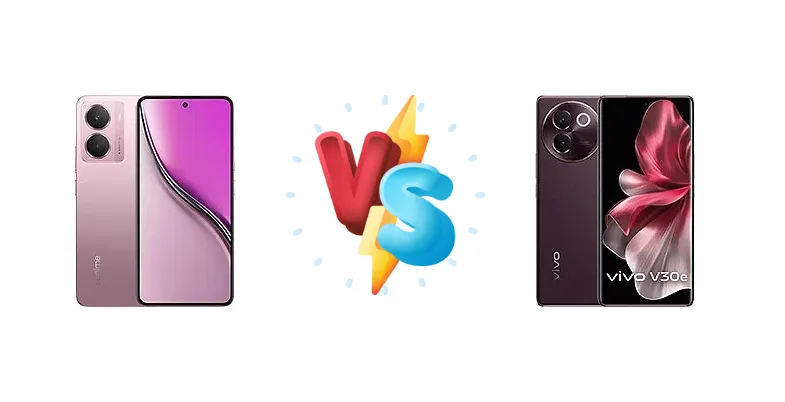
The Realme P3 and vivo V30e represent compelling options in the increasingly competitive mid-range smartphone market. Both leverage Qualcomm's Snapdragon 6 Gen series, but with distinct chipset iterations and feature sets. This comparison dissects the key differences, focusing on performance, battery life, and charging capabilities to determine which device offers the best value.
🏆 Quick Verdict
For the average user prioritizing sustained performance and longevity, the Realme P3 emerges as the stronger contender. Its Snapdragon 6 Gen 4, built on a 4nm process, offers a more modern architecture and potentially better thermal management, coupled with a slightly superior battery endurance rating. However, the vivo V30e's reverse wired charging is a unique advantage.
| Network |
|---|
| 2G bands | GSM 850 / 900 / 1800 / 1900 | GSM 850 / 900 / 1800 / 1900 |
| 3G bands | HSDPA 850 / 900 / 2100 | HSDPA 850 / 900 / 1700(AWS) / 1900 / 2100 - Malaysia |
| 4G bands | 1, 3, 5, 8, 28, 40, 41 | 1, 2, 3, 4, 5, 7, 8, 18, 19, 20, 26, 28, 38, 39, 40, 41 - Malaysia |
| 5G bands | 1, 3, 5, 8, 28, 40, 41, 77, 78 SA/NSA | 1, 3, 5, 7, 8, 20, 28, 38, 40, 41, 77, 78 SA/NSA - Malaysia |
| Speed | HSPA, LTE, 5G | HSPA, LTE, 5G |
| Technology | GSM / HSPA / LTE / 5G | GSM / HSPA / LTE / 5G |
| Launch |
|---|
| Announced | 2025, March 17 | 2024, May 02 |
| Status | Available. Released 2025, March 19 | Available. Released 2024, May 09 |
| Body |
|---|
| Build | - | Glass front, plastic frame, glass back or plastic back |
| Dimensions | 163.2 x 75.7 x 8 mm (6.43 x 2.98 x 0.31 in) | 164.4 x 74.8 x 7.7 mm (6.47 x 2.94 x 0.30 in) |
| SIM | Nano-SIM + Nano-SIM | Nano-SIM + Nano-SIM |
| Weight | 194 g (6.84 oz) | 179 g or 188 g (6.31 oz) |
| Display |
|---|
| Protection | Mohs level 5 | Schott Xensation |
| Resolution | 1080 x 2400 pixels, 20:9 ratio (~395 ppi density) | 1080 x 2400 pixels, 20:9 ratio (~388 ppi density) |
| Size | 6.67 inches, 107.4 cm2 (~86.9% screen-to-body ratio) | 6.78 inches, 111.0 cm2 (~90.3% screen-to-body ratio) |
| Type | AMOLED, 120Hz, 600 nits (typ), 2000 nits (peak) | AMOLED, 1B colors, 120Hz, 1300 nits (peak) |
| Platform |
|---|
| CPU | Octa-core (1x2.3 GHz Cortex-A720s & 3x2.2 GHz Cortex-A720s & 4x1.8 GHz Cortex-A520s) | Octa-core (4x2.2 GHz Cortex-A78 & 4x1.8 GHz Cortex-A55) |
| Chipset | Qualcomm Snapdragon 6 Gen 4 (4 nm) | Qualcomm SM6450 Snapdragon 6 Gen 1 (4 nm) |
| GPU | Adreno 810 | Adreno 710 |
| OS | Android 15, Realme UI 6.0 | Android 14, Funtouch 14 |
| Memory |
|---|
| Card slot | microSDXC (uses shared SIM slot) | microSDXC (uses shared SIM slot) |
| Internal | 128GB 6GB RAM, 128GB 8GB RAM, 256GB 8GB RAM, 512GB 12GB RAM | 128GB 8GB RAM, 256GB 8GB RAM, 256GB 12GB RAM |
| Main Camera |
|---|
| Dual | 50 MP, f/1.8, 27mm (wide), 1/2.88", 0.61µm, PDAF
Auxiliary lens | 50 MP, f/1.8, 26mm (wide), 1/1.95", 0.8µm, PDAF, OIS (India only)
8 MP, f/2.2, 120˚ (ultrawide), 1/4.0", 1.12µm |
| Features | LED flash, HDR, panorama | Ring-LED flash, panorama, HDR |
| Video | 4K@30fps, 1080p@30/60/120fps, gyro-EIS | 4K@30fps, 1080p@30fps |
| Selfie camera |
|---|
| Single | 16 MP, f/2.4, 23mm (wide), 1/3.09", 1.0µm | 50 MP, f/2.5, 25mm (wide), AF - India
32 MP, f/2.0, 24mm (wide) - Malaysia |
| Video | 1080p@30fps | 4K@30fps (India only), 1080p@30fps |
| Sound |
|---|
| 35mm jack | No | No |
| Loudspeaker | Yes, with stereo speakers | Yes |
| Comms |
|---|
| Bluetooth | 5.2, A2DP, LE | 5.1, A2DP, LE |
| NFC | No | Yes (market/region dependent) |
| Positioning | GPS, GLONASS, GALILEO, BDS, QZSS | GPS, GLONASS, GALILEO, BDS, QZSS, NavIC |
| Radio | No | No |
| USB | USB Type-C 2.0 | USB Type-C 2.0, OTG |
| WLAN | Wi-Fi 802.11 a/b/g/n/ac/6, dual-band | Wi-Fi 802.11 a/b/g/n/ac, dual-band |
| Features |
|---|
| Sensors | Fingerprint (under display, optical), accelerometer, gyro, proximity, compass | Fingerprint (under display, optical), accelerometer, gyro, proximity, compass |
| Battery |
|---|
| Charging | 45W wired, 50% in 30 min | 44W wired, PD
Reverse wired |
| Type | Si/C Li-Ion 6000 mAh | Li-Ion 5500 mAh |
| Misc |
|---|
| Colors | Space Silver, Comet Grey, Nebula Pink | Velvet Red (Coco Brown), Silk Blue, Sky Mirror |
| Models | RMX5079 | V2339 |
| Price | £ 260.86 / € 188.00 / ₹ 15,500 | ₹ 23,999 |
| EU LABEL |
|---|
| Battery | 64:57h endurance, 1400 cycles | - |
| Energy | Class A | - |
| Free fall | Class C (90 falls) | - |
| Repairability | Class B | - |
Realme P3
- More modern CPU architecture (Cortex-A720s)
- Longer battery endurance (64:57h)
- Higher battery cycle count (1400 cycles)
- Lacks reverse wireless charging
- Camera specs unknown
vivo V30e
- Reverse wired charging capability
- PD fast charging support
- Sleek design (assumed based on vivo's brand image)
- Older CPU architecture (Cortex-A78)
- Likely shorter battery life
Display Comparison
Display specifications are absent from the provided data, but given the price bracket, both devices likely feature LCD panels with FHD+ resolution. The absence of LTPO technology suggests standard refresh rates (likely 60Hz or 90Hz). The user experience will likely hinge on color calibration and peak brightness, areas where further testing is needed. Bezels are expected to be similar, focusing on maximizing screen real estate within the budget constraints.
Camera Comparison
Camera details are limited. Without sensor size or aperture information, a direct comparison is difficult. However, the focus should be on image processing capabilities. Both phones likely employ computational photography techniques to enhance image quality. The absence of any mention of OIS suggests neither phone features optical image stabilization, relying instead on electronic stabilization. The usefulness of any included 2MP macro lens is questionable, offering limited practical benefit over the main sensor in most scenarios.
Performance
The core difference lies in the chipsets: the Realme P3 boasts the Snapdragon 6 Gen 4 (4nm) versus the vivo V30e’s Snapdragon 6 Gen 1 (4nm). While both are 4nm, the architectural differences are significant. The P3’s CPU utilizes a mix of Cortex-A720s, including a prime core at 2.3 GHz, suggesting a performance edge over the V30e’s Cortex-A78 cores clocked at 2.2 GHz. The A720 series represents a newer generation with improved efficiency. This translates to potentially faster app loading times and smoother multitasking on the Realme P3. The P3's CPU configuration (1+3+4) also suggests a more balanced approach to power distribution. Both devices will likely perform similarly in basic tasks, but the P3 should exhibit better sustained performance under load.
Battery Life
The Realme P3 claims a 64:57h endurance rating, indicating a longer-lasting battery life compared to what we'd expect from the vivo V30e (no endurance data provided). The P3’s 1400 charge cycles suggest superior long-term battery health. Charging speeds are close, with the P3 offering 45W wired charging (50% in 30 minutes) and the V30e at 44W with PD and reverse wired charging. The V30e’s reverse charging is a key differentiator, allowing it to function as a power bank for other devices. While the P3 charges slightly faster, the V30e’s versatility is a significant advantage for users who frequently travel or share power.
Buying Guide
Buy the Realme P3 if you need a phone that can handle demanding apps and moderate gaming for longer periods, and value long-term battery health thanks to its 1400 cycle rating. Buy the vivo V30e if you frequently need to charge other devices wirelessly or via cable, and prioritize a sleek design with the convenience of reverse charging functionality.
Frequently Asked Questions
❓ Will the Snapdragon 6 Gen 1 in the vivo V30e struggle with graphically intensive games like PUBG or Genshin Impact?
While the Snapdragon 6 Gen 1 is capable, it's likely to require lower graphics settings and frame rates for a smooth experience in demanding games. The Realme P3's Snapdragon 6 Gen 4, with its newer architecture, should offer a more consistent and playable experience at higher settings.
❓ How much faster is the 45W charging on the Realme P3 compared to the 44W charging on the vivo V30e in real-world use?
The difference in charging speed is likely to be marginal. Both phones offer fast charging, and the 1W difference won't translate to a significant time saving. The Realme P3's claim of 50% charge in 30 minutes is a good indicator, but actual charging times will vary based on temperature and battery level.
❓ Is the reverse wired charging feature on the vivo V30e useful for everyday use?
Reverse wired charging is a niche but valuable feature for users who frequently travel or find themselves needing to top up accessories like wireless earbuds or smartwatches. It's particularly useful in situations where a power outlet isn't readily available.