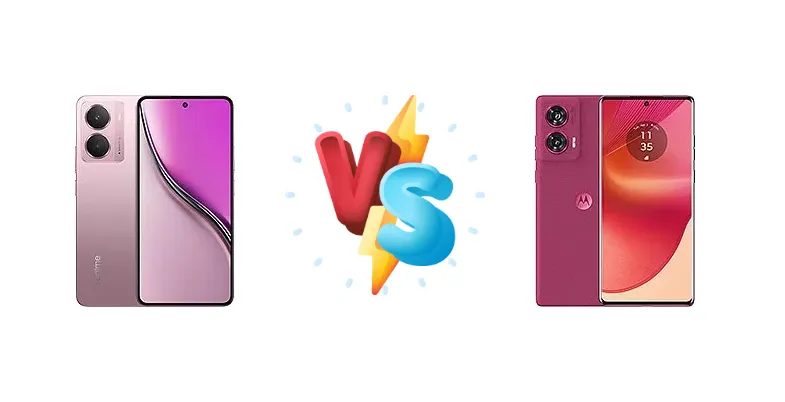
The Realme P3 and Motorola Edge 50 Fusion represent compelling options in the increasingly competitive mid-range smartphone market. The P3 focuses on maximizing battery life and efficiency with the Snapdragon 6 Gen 4, while the Edge 50 Fusion aims for a balance of performance and display quality with the Snapdragon 7s Gen 2. This comparison will dissect their key differences to determine which device best suits your needs.
🏆 Quick Verdict
For the average user prioritizing long-lasting battery life and consistent performance, the Realme P3 emerges as the winner. Its exceptional 64:57h endurance significantly outpaces the Motorola Edge 50 Fusion’s 12:40h active use score, making it ideal for power users and travelers. However, the Edge 50 Fusion’s brighter display is a strong counterpoint.
| Network |
|---|
| 2G bands | GSM 850 / 900 / 1800 / 1900 | GSM 850 / 900 / 1800 / 1900 |
| 3G bands | HSDPA 850 / 900 / 2100 | HSDPA 850 / 900 / 1900 / 2100 |
| 4G bands | 1, 3, 5, 8, 28, 40, 41 | 1, 2, 3, 5, 7, 8, 18, 19, 20, 26, 28, 32, 38, 40, 41, 42, 71 - International |
| 5G bands | 1, 3, 5, 8, 28, 40, 41, 77, 78 SA/NSA | 1, 3, 5, 7, 8, 20, 26, 28, 38, 40, 41, 77, 78 SA/NSA |
| Speed | HSPA, LTE, 5G | HSPA, LTE, 5G |
| Technology | GSM / HSPA / LTE / 5G | GSM / HSPA / LTE / 5G |
| Launch |
|---|
| Announced | 2025, March 17 | 2024, April 16 |
| Status | Available. Released 2025, March 19 | Available. Released 2024, May 15 |
| Body |
|---|
| Build | - | Glass front, silicone polymer back (eco leather), plastic frame |
| Dimensions | 163.2 x 75.7 x 8 mm (6.43 x 2.98 x 0.31 in) | 161.9 x 73.1 x 7.9 mm (6.37 x 2.88 x 0.31 in) |
| SIM | Nano-SIM + Nano-SIM | · Nano-SIM + eSIM· Nano-SIM + Nano-SIM |
| Weight | 194 g (6.84 oz) | 174.9 g (6.17 oz) |
| Display |
|---|
| Protection | Mohs level 5 | Corning Gorilla Glass 5 |
| Resolution | 1080 x 2400 pixels, 20:9 ratio (~395 ppi density) | 1080 x 2400 pixels, 20:9 ratio (~393 ppi density) |
| Size | 6.67 inches, 107.4 cm2 (~86.9% screen-to-body ratio) | 6.7 inches, 108.4 cm2 (~91.6% screen-to-body ratio) |
| Type | AMOLED, 120Hz, 600 nits (typ), 2000 nits (peak) | P-OLED, 1B colors, 120Hz (LATAM), 144Hz (INT), 1600 nits (peak) |
| Platform |
|---|
| CPU | Octa-core (1x2.3 GHz Cortex-A720s & 3x2.2 GHz Cortex-A720s & 4x1.8 GHz Cortex-A520s) | Octa-core (4x2.40 GHz Cortex-A78 & 4x1.95 GHz Cortex-A55) - InternationalOcta-core (4x2.2 GHz Cortex-A78 & 4x1.8 GHz Cortex-A55) - LATAM |
| Chipset | Qualcomm Snapdragon 6 Gen 4 (4 nm) | Qualcomm SM7435-AB Snapdragon 7s Gen 2 (4 nm) - InternationalQualcomm SM6450 Snapdragon 6 Gen 1 (4 nm) - LATAM |
| GPU | Adreno 810 | Adreno 710 |
| OS | Android 15, Realme UI 6.0 | Android 14, upgradable to Android 15, up to 3 major Android upgrades |
| Memory |
|---|
| Card slot | microSDXC (uses shared SIM slot) | No |
| Internal | 128GB 6GB RAM, 128GB 8GB RAM, 256GB 8GB RAM, 512GB 12GB RAM | 128GB 8GB RAM, 256GB 8GB RAM, 256GB 12GB RAM, 512GB 8GB RAM, 512GB 12GB RAM |
| Main Camera |
|---|
| Dual | 50 MP, f/1.8, 27mm (wide), 1/2.88", 0.61µm, PDAF
Auxiliary lens | 50 MP, f/1.9, (wide), 1/1.56", 1.0µm, multi-directional PDAF, OIS
13 MP, f/2.2, 120˚ (ultrawide), 1/3.0", 1.12µm, AF |
| Features | LED flash, HDR, panorama | LED flash, HDR, panorama |
| Video | 4K@30fps, 1080p@30/60/120fps, gyro-EIS | 4K@30fps, 1080p@30/60/120fps, gyro-EIS |
| Selfie camera |
|---|
| Features | - | HDR |
| Single | 16 MP, f/2.4, 23mm (wide), 1/3.09", 1.0µm | 32 MP, f/2.5, (wide), 1/3.14", 0.7µm |
| Video | 1080p@30fps | 4K@30fps, 1080p@30fps |
| Sound |
|---|
| 35mm jack | No | No |
| Loudspeaker | Yes, with stereo speakers | Yes, with stereo speakers |
| Comms |
|---|
| Bluetooth | 5.2, A2DP, LE | 5.2, A2DP, LE |
| NFC | No | Yes |
| Positioning | GPS, GLONASS, GALILEO, BDS, QZSS | GPS, GLONASS, GALILEO |
| Radio | No | No |
| USB | USB Type-C 2.0 | USB Type-C 2.0, OTG |
| WLAN | Wi-Fi 802.11 a/b/g/n/ac/6, dual-band | Wi-Fi 802.11 a/b/g/n/ac, dual-band |
| Features |
|---|
| Sensors | Fingerprint (under display, optical), accelerometer, gyro, proximity, compass | Fingerprint (under display, optical), accelerometer, gyro, proximity, compass |
| Battery |
|---|
| Charging | 45W wired, 50% in 30 min | 68W wired, 50% in 15 min |
| Type | Si/C Li-Ion 6000 mAh | 5000 mAh |
| Misc |
|---|
| Colors | Space Silver, Comet Grey, Nebula Pink | Forest Blue, Marshmallow Blue, Hot Pink |
| Models | RMX5079 | XT2429-1 |
| Price | £ 260.86 / € 188.00 / ₹ 15,500 | € 208.99 / $ 245.00 / ₹ 18,667 |
| EU LABEL |
|---|
| Battery | 64:57h endurance, 1400 cycles | - |
| Energy | Class A | - |
| Free fall | Class C (90 falls) | - |
| Repairability | Class B | - |
Realme P3
- Exceptional battery life (64:57h endurance)
- Efficient Snapdragon 6 Gen 4 chipset
- 1400 charge cycles promise long-term battery health
- Potentially less powerful CPU compared to Snapdragon 7s Gen 2
- Slower charging speed (45W)
Motorola Edge 50 Fusion
- Brighter display (1322 nits)
- Faster charging (68W, 50% in 15 min)
- Potentially more powerful CPU (Snapdragon 7s Gen 2 - International)
- Significantly shorter battery life (12:40h)
- LATAM variant uses Snapdragon 6 Gen 1, reducing performance
Display Comparison
The Motorola Edge 50 Fusion boasts a significantly brighter display, reaching a measured peak brightness of 1322 nits. This is a substantial advantage for outdoor visibility, especially in direct sunlight. While the Realme P3’s display specifications are not provided, the Edge 50 Fusion’s brightness level suggests a superior viewing experience in bright conditions. The lack of LTPO technology on either device means refresh rate scaling for power saving isn’t present, but the Edge 50 Fusion’s higher peak brightness is a clear win for users who spend significant time outdoors.
Camera Comparison
Detailed camera specifications are limited. Without sensor size or aperture information, a direct comparison is difficult. However, the focus should be on the main sensor performance. The absence of details suggests neither phone features a flagship-level camera system. The Edge 50 Fusion likely benefits from Qualcomm’s image signal processor (ISP) within the Snapdragon 7s Gen 2, potentially offering better image processing capabilities. We can assume both phones will include standard features like HDR and night mode, but image quality will likely be a differentiating factor.
Performance
The Motorola Edge 50 Fusion, in its international variant, utilizes the Qualcomm SM7435-AB Snapdragon 7s Gen 2 (4nm). This chipset features a more powerful CPU configuration – an octa-core setup with 4x2.40 GHz Cortex-A78 and 4x1.95 GHz Cortex-A55 cores – compared to the Realme P3’s Snapdragon 6 Gen 4 (4nm) with 1x2.3 GHz Cortex-A720s, 3x2.2 GHz Cortex-A720s, and 4x1.8 GHz Cortex-A520s. While both are 4nm chips, the Cortex-A78 cores in the 7s Gen 2 offer a performance uplift. However, the LATAM version of the Edge 50 Fusion downgrades to the Snapdragon 6 Gen 1, negating this advantage. The P3’s Snapdragon 6 Gen 4 prioritizes efficiency, potentially leading to better sustained performance under load due to improved thermal management, despite the raw clock speed difference.
Battery Life
The Realme P3’s battery endurance of 64:57h is a standout feature, dwarfing the Motorola Edge 50 Fusion’s 12:40h active use score. This translates to significantly longer usage between charges. While the Edge 50 Fusion compensates with 68W wired charging (50% in 15 minutes), the P3’s 45W charging (50% in 30 minutes) is slower. However, the P3’s superior battery capacity and efficiency mean you’ll likely need to charge it less frequently. The Edge 50 Fusion’s faster charging is beneficial for quick top-ups, but the P3’s longevity is more valuable for extended use.
Buying Guide
Buy the Realme P3 if you need exceptional battery life, prioritize efficiency, and value consistent performance over peak power. This phone is perfect for users who frequently travel, stream media, or rely heavily on their smartphone throughout the day. Buy the Motorola Edge 50 Fusion if you prefer a brighter, more vibrant display, and prioritize faster charging speeds, even if it means sacrificing some battery endurance. This phone is ideal for media consumers and those who want a quick power boost.
Frequently Asked Questions
❓ Does the Snapdragon 6 Gen 1 variant of the Motorola Edge 50 Fusion significantly impact performance compared to the 7s Gen 2?
Yes, the downgrade to the Snapdragon 6 Gen 1 in the LATAM version of the Edge 50 Fusion represents a substantial performance decrease. The 7s Gen 2 offers a more powerful CPU and GPU, resulting in smoother multitasking, faster app loading times, and improved gaming performance. Users in LATAM should carefully consider this difference when comparing the two devices.
❓ How does the Realme P3's battery endurance translate to real-world usage scenarios?
The Realme P3’s 64:57h endurance means you can realistically expect over two full days of moderate use on a single charge. This is ideal for users who frequently travel, don't have easy access to power outlets, or simply want to minimize charging frequency. It comfortably handles tasks like streaming video, browsing the web, and using social media without significant battery drain.
❓ Is the 68W charging on the Motorola Edge 50 Fusion fast enough to offset its shorter battery life?
While 68W charging is undeniably fast, allowing for a 50% charge in just 15 minutes, it doesn't fully compensate for the Edge 50 Fusion’s significantly shorter battery life. The Realme P3’s longer endurance means you’ll simply need to charge it less often, reducing the overall reliance on fast charging. The convenience of quick top-ups is valuable, but the P3’s longevity is more impactful for most users.