
Realme P3 Ultra vs Oppo Find X6 Pro: A Deep Dive into Performance and Value
| Phones Images | |||||
|---|---|---|---|---|---|
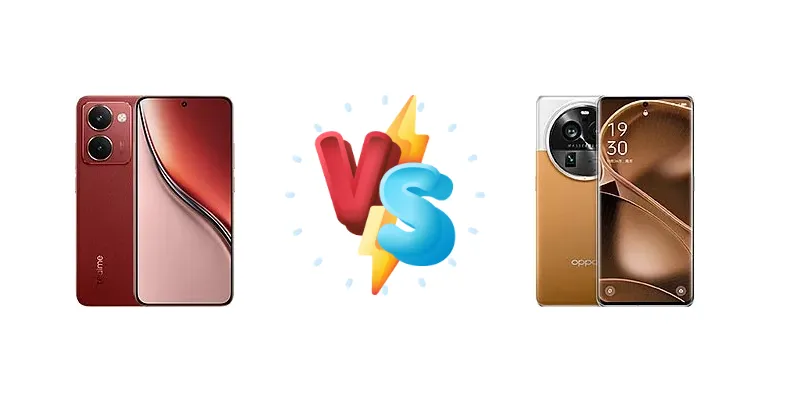
|
🏆 Quick Verdict
For the average user prioritizing battery life and rapid charging, the Realme P3 Ultra emerges as the winner. Its impressive 16:47-hour active use score and 80W charging significantly outperform the Oppo Find X6 Pro’s endurance rating and charging speeds, making it a more practical daily driver.
| PHONES | ||
|---|---|---|
| Phone Names | Realme P3 Ultra | Oppo Find X6 Pro |
| Network | ||
|---|---|---|
| 2G bands | GSM 850 / 900 / 1800 / 1900 | GSM 850 / 900 / 1800 / 1900 |
| 3G bands | HSDPA 800 / 850 / 900 / 1700(AWS) / 1900 / 2100 | HSDPA 800 / 850 / 900 / 1700(AWS) / 1900 / 2100 |
| 4G bands | 1, 2, 3, 4, 5, 7, 8, 12, 13, 17, 18, 19, 20, 26, 28, 38, 40, 41, 66 | 1, 2, 3, 4, 5, 7, 8, 12, 17, 18, 19, 20, 26, 28, 34, 38, 39, 40, 41, 66 |
| 5G bands | 1, 2, 3, 5, 7, 8, 12, 20, 26, 28, 38, 40, 41, 66, 77, 78 SA/NSA | 1, 3, 5, 7, 8, 20, 28, 38, 40, 41, 66, 77, 78, 79 SA/NSA |
| Speed | HSPA, LTE, 5G | HSPA, LTE, 5G |
| Technology | GSM / HSPA / LTE / 5G | GSM / CDMA / HSPA / CDMA2000 / LTE / 5G |
| - | CDMA2000 1x | |
| Launch | ||
|---|---|---|
| Announced | 2025, March 19 | 2023, March 21 |
| Status | Available. Released 2025, March 24 | Available. Released 2023, March 24 |
| Body | ||
|---|---|---|
| Build | Glass front (Gorilla Glass 7i), plastic frame, plastic back or silicone polymer (eco leather) back | Glass front (Gorilla Glass Victus 2), glass back (Gorilla Glass 5) or eco leather back, aluminum frame |
| Dimensions | 163.1 x 76.9 x 7.4 mm (6.42 x 3.03 x 0.29 in) | 164.8 x 76.2 x 9.1 mm or 9.5 mm |
| SIM | Nano-SIM + Nano-SIM | Nano-SIM + Nano-SIM |
| Weight | 183 g or 186 g (6.46 oz) | 216 g or 218 g (7.62 oz) |
| - | IP68 dust/water resistant (up to 1.5m for 30 min) | |
| Display | ||
|---|---|---|
| Protection | Corning Gorilla Glass 7i | Corning Gorilla Glass Victus 2 |
| Resolution | 1272 x 2800 pixels (~450 ppi density) | 1440 x 3168 pixels (~510 ppi density) |
| Size | 6.83 inches, 113.3 cm2 (~90.4% screen-to-body ratio) | 6.82 inches, 113.0 cm2 (~90.0% screen-to-body ratio) |
| Type | AMOLED, 1B colors, 120Hz, 600 nits (typ), 1200 nits (HBM), 1500 nits (peak) | LTPO3 AMOLED, 1B colors, 120Hz, Dolby Vision, HDR10+, 800 nits (typ), 1500 nits (HBM), 2500 nits (peak) |
| Platform | ||
|---|---|---|
| CPU | Octa-core (1x3.35 GHz Cortex-A715 & 3x3.20 GHz Cortex-A715 & 4x2.20 GHz Cortex-A510) | Octa-core (1x3.2 GHz Cortex-X3 & 2x2.8 GHz Cortex-A715 & 2x2.8 GHz Cortex-A710 & 3x2.0 GHz Cortex-A510) |
| Chipset | Mediatek Dimensity 8350 Ultra (4 nm) | Qualcomm SM8550-AB Snapdragon 8 Gen 2 (4 nm) |
| GPU | Mali G615-MC6 | Adreno 740 |
| OS | Android 15, up to 3 major Android upgrades, Realme UI 6.0 | Android 13, up to 4 major Android upgrades, ColorOS 14 |
| Memory | ||
|---|---|---|
| Card slot | No | No |
| Internal | 128GB 8GB RAM, 256GB 8GB RAM, 256GB 12GB RAM, 512GB 12GB RAM | 256GB 12GB RAM, 256GB 16GB RAM, 512GB 16GB RAM |
| - | UFS 4.0 | |
| Main Camera | ||
|---|---|---|
| Dual | 50 MP, f/1.8, 24mm (wide), 1/1.56", 1.0µm, multi-directional PDAF, OIS 8 MP, f/2.2, 16mm, 112˚ (ultrawide), 1/4.0", 1.12µm | - |
| Features | Color spectrum sensor, LED flash, HDR, panorama | Laser AF, color spectrum sensor, Hasselblad Color Calibration, LED flash, HDR, panorama |
| Triple | - | 50 MP, f/1.8, 23mm (wide), 1.0"-type, 1.6µm, dual pixel PDAF, OIS 50 MP, f/2.6, 65mm (periscope telephoto), 1/1.56", 1.0µm, 2.8x optical zoom, multi-directional PDAF, OIS 50 MP, f/2.2, 15mm, 110˚ (ultrawide), 1/1.56", 1.0µm, multi-directional PDAF |
| Video | 4K@30/60fps, 1080p@30/60/120fps, gyro-EIS, OIS | 4K@30/60fps, 1080p@30/60/240fps; gyro-EIS; HDR, 10‑bit video, Dolby Vision |
| Selfie camera | ||
|---|---|---|
| Features | - | Panorama |
| Single | 16 MP, f/2.4, 23mm (wide), 1/3.09", 1.0µm | 32 MP, f/2.4, 21mm (wide), 1/2.74", 0.8µm, PDAF |
| Video | 1080p@30/60fps, gyro-EIS | 4K@30fps, gyro-EIS |
| Sound | ||
|---|---|---|
| 3.5mm jack | - | No |
| 35mm jack | No | No |
| Loudspeaker | Yes, with stereo speakers | Yes, with stereo speakers |
| Comms | ||
|---|---|---|
| Bluetooth | 5.4, A2DP, LE, BLE Audio | 5.3, A2DP, LE, aptX HD |
| Infrared port | Yes | Yes |
| NFC | Yes (market/region dependent) | Yes |
| Positioning | GPS, GLONASS, GALILEO, BDS, QZSS | GPS (L1+L5), GLONASS (G1), BDS (B1I+B1c+B2a), GALILEO (E1+E5a), QZSS (L1+L5) |
| Radio | No | No |
| USB | USB Type-C 2.0, OTG | USB Type-C 3.1, OTG |
| WLAN | Wi-Fi 802.11 a/b/g/n/ac/6, dual-band | Wi-Fi 802.11 a/b/g/n/ac/6e/7, tri-band, Wi-Fi Direct |
| Features | ||
|---|---|---|
| Sensors | Fingerprint (under display, optical), accelerometer, gyro, proximity, compass | Fingerprint (under display, optical), accelerometer, gyro, proximity, compass |
| Battery | ||
|---|---|---|
| Charging | 80W wired, PD, 100% in 47 min 5W reverse wired Bypass charging | 100W wired, PD, 45% in 10 min, 100% in 30 min 50W wireless, 50% in 22 min, 100% in 51 min 10W reverse wireless |
| Type | Si/C Li-Ion 6000 mAh | Li-Po 5000 mAh |
| Misc | ||
|---|---|---|
| Colors | Neptune Blue, Orion Red, Glowing Lunar White | Black, Green, Brown |
| Models | RMX5030, RMX5031 | PGEM110, PGEM10 |
| Price | ₹ 29,599 | About 820 EUR |
| Tests | ||
|---|---|---|
| Battery life | - | Endurance rating 114h |
| Camera | - | Photo / Video |
| Display | - | Contrast ratio: Infinite (nominal) |
| Loudspeaker | - | -25.1 LUFS (Very good) |
| Performance | - | AnTuTu: 1294797 (v9) GeekBench: 4791 (v5.1), 5226 (v6) GFXBench: 60fps (ES 3.1 onscreen) |
Realme P3 Ultra
- Exceptional battery life (16:47h active use)
- Ultra-fast 80W wired charging (100% in 47 min)
- Brightest display (1862 nits)
- Limited camera details available
- No wireless charging
Oppo Find X6 Pro
- Powerful Snapdragon 8 Gen 2 chipset
- 50W wireless charging
- Potentially superior camera system (based on brand reputation)
- Shorter battery life (114h endurance rating)
- Slower wired charging compared to P3 Ultra
Display Comparison
The Realme P3 Ultra boasts a significantly brighter display, reaching a measured 1862 nits, compared to the Oppo Find X6 Pro’s 1318 nits. This translates to superior visibility in direct sunlight. While the Find X6 Pro claims an 'Infinite' contrast ratio, this is a standard marketing term and doesn’t necessarily indicate a superior viewing experience. The lack of PWM frequency data for either phone makes it difficult to assess potential screen flicker, but the higher brightness of the P3 Ultra could mitigate some perceived issues.
Camera Comparison
The provided data offers limited insight into camera capabilities. Both phones are listed as having 'Photo / Video' functionality, but lack specifics on sensor size, aperture, or image processing. Without this information, a direct comparison is impossible. However, Oppo generally prioritizes camera technology in its flagship devices, suggesting the Find X6 Pro may offer a more advanced camera system. The absence of details on the Realme P3 Ultra’s camera setup makes it difficult to assess its capabilities beyond basic smartphone photography.
Performance
Both phones utilize a 4nm process, but the chipsets differ significantly. The Oppo Find X6 Pro’s Snapdragon 8 Gen 2 features the Cortex-X3 prime core for peak performance, while the Realme P3 Ultra employs the Dimensity 8350 Ultra with a mix of Cortex-A715 and A510 cores. The Snapdragon 8 Gen 2’s architecture is optimized for sustained performance, potentially leading to less thermal throttling during extended gaming sessions. However, the Dimensity 8350 Ultra’s octa-core configuration, with more A715 cores, suggests strong multi-core performance. The Find X6 Pro's CPU configuration (1x3.2 GHz Cortex-X3, 2x2.8 GHz Cortex-A715, 2x2.8 GHz Cortex-A710, 3x2.0 GHz Cortex-A510) is geared towards a wider range of tasks, while the P3 Ultra (1x3.35 GHz Cortex-A715, 3x3.20 GHz Cortex-A715, 4x2.20 GHz Cortex-A510) focuses on efficiency and sustained performance.
Battery Life
The Realme P3 Ultra shines in battery performance, achieving 16:47 hours of active use. While the Oppo Find X6 Pro has an endurance rating of 114 hours, this is a different metric and doesn’t directly translate to real-world usage. The P3 Ultra’s 80W wired charging is significantly faster than the Find X6 Pro’s 100W, achieving a full charge in 47 minutes versus 30 minutes. The Find X6 Pro does offer 50W wireless charging, a feature absent in the P3 Ultra, and 50% charge in 22 minutes. However, the P3 Ultra’s faster wired charging and longer active use time make it the more convenient option for most users.
Buying Guide
Buy the Realme P3 Ultra if you need exceptional battery life, incredibly fast wired charging, and strong performance for demanding tasks without breaking the bank. It’s ideal for power users, gamers, and those who frequently rely on their phone throughout the day. Buy the Oppo Find X6 Pro if you prioritize a potentially more refined camera experience (details are limited in the provided data), and are willing to pay a premium for the Snapdragon 8 Gen 2’s ecosystem and potentially better long-term software support.